 Guide On Map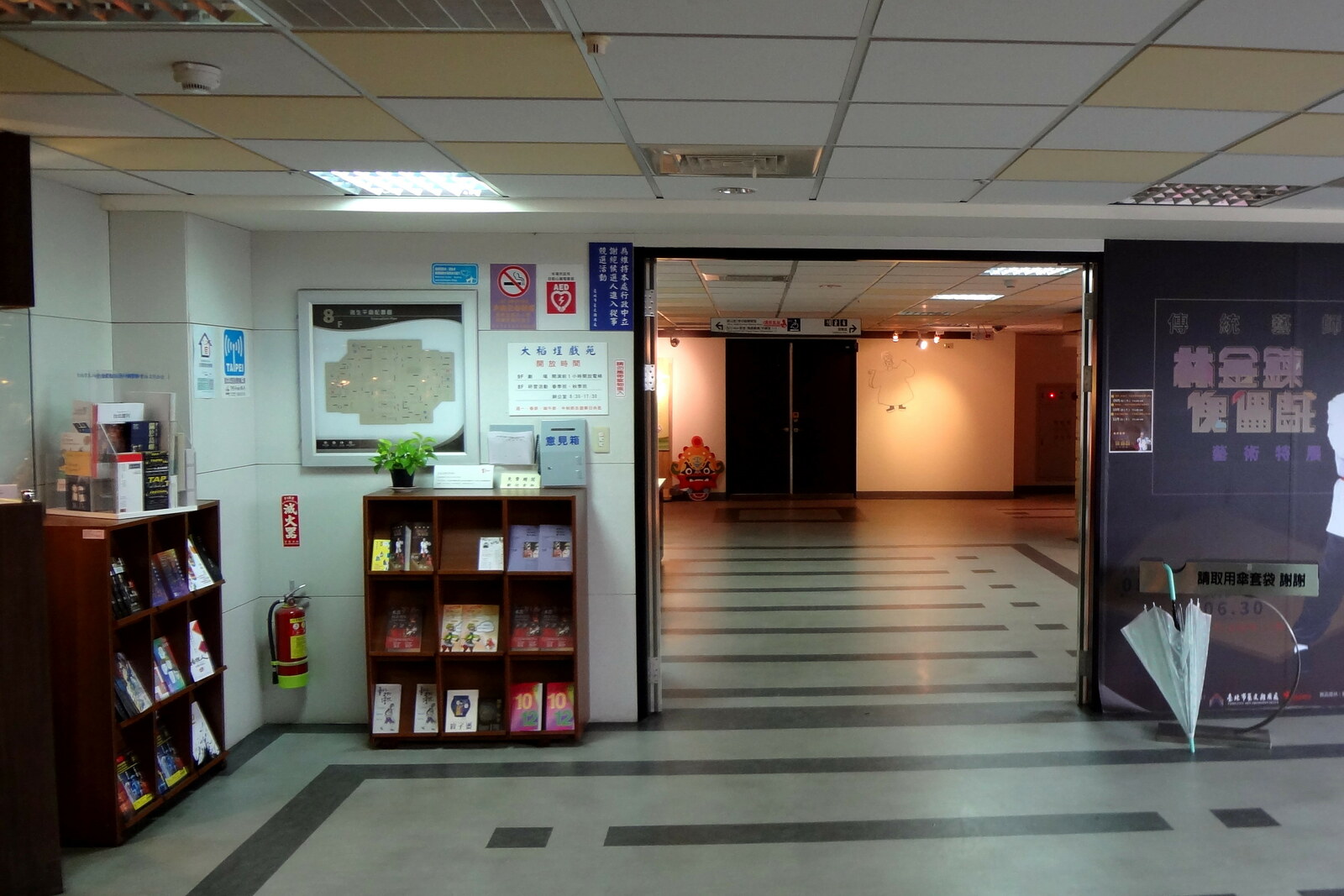
Look around first
What to notice
- Eighth-floor rehearsal rooms
- Eighth-floor classrooms
- Ninth-floor auditorium
- The theater sign
The story of the place
Above Yongle Market are two more floors with a life of their own. After the renovation, the upper premises were set aside for rehearsals, classrooms, an exhibition of traditional theater, and an auditorium. On the eighth floor, people learn roles and movements, while on the ninth this work reaches the public in performances of Gezai opera, puppet shows, and other traditional genres. The theater has a youth troupe where, after studying, members receive their first real roles.
The present-day theater occupies the eighth and ninth floors of Yongle Market. In nineteen eighty-seven, there was still no stage here: the upper premises were called the Yanping Community Education Center. Liao Chiung-chih, a famous performer of Gezai opera, Taiwan’s folk opera, was invited here. She wanted to recruit her first regular students.
Liao knew opera from the stage, not from textbooks. At fifteen, left without means, she bound herself to a troupe for an apprenticeship of three years and four months: performances became her livelihood and her craft. Gezai opera actors usually did not receive a finished script. A mentor retold the play, performers memorized the plot turns, assembled lines from familiar formulas, and themselves made sure that the sung lines rhymed. That was enough to learn a role within a troupe. For a class of city residents who came once a week, it proved insufficient.
Liao studied at school for only two years, and in Japanese at that. Now she had to write down in Chinese what had previously been passed on by word of mouth. She took a dictionary and began turning old productions into teaching plays: Chen San and Wu Niang, Liang Shanbo and Zhu Yingtai, Shen Xizhi. At first, Liao tried to give her students everything she herself knew in a single day. She left lessons exhausted, while the students did not have time to absorb the material. Then the teacher began discussing difficulties with them and broke stagecraft down into exercises: singing, gesture, movement, and individual scenes.
The following year, Liao received an award for passing on folk art and brought together this center’s students and students from Taipei universities in the Hsin Chuan Troupe—“Transmission of Tradition.” They no longer limited themselves to teaching performances: they staged the plays Liao had written down and toured with them. After performances, audience members asked to study with them. In nineteen ninety-six, Liao left the stage to work with her students, and in two thousand she handed them management of the troupe.
For almost twenty years, she taught at this address. When the Taipei Department of Cultural Affairs began renovating the upper floors of the market, rehearsal rooms, classrooms, an exhibition of traditional theater, and an auditorium were installed here. In two thousand eleven, the institution opened under the district’s name—Dadaocheng Theater. At the same time, a youth Gezai opera troupe was created there so that graduates could receive real roles and stage experience.
Today, people still study and rehearse on the eighth floor, while Gezai opera, puppet shows, and other traditional performances are staged on the ninth. Beneath the theater’s sign, the arrangement that began under Liao Chiung-chih has been preserved: first, an actor learns the craft in the classroom, then goes up one floor to the stage.
Useful on site
The theater and public areas operate on a schedule; Monday is often a day off, so check the program.
Checked: date not specified. Check the official source before visiting.An open market does not guarantee access to the theater; check on the exhibition or performance and plan it as a separate visit.