 Guide On Map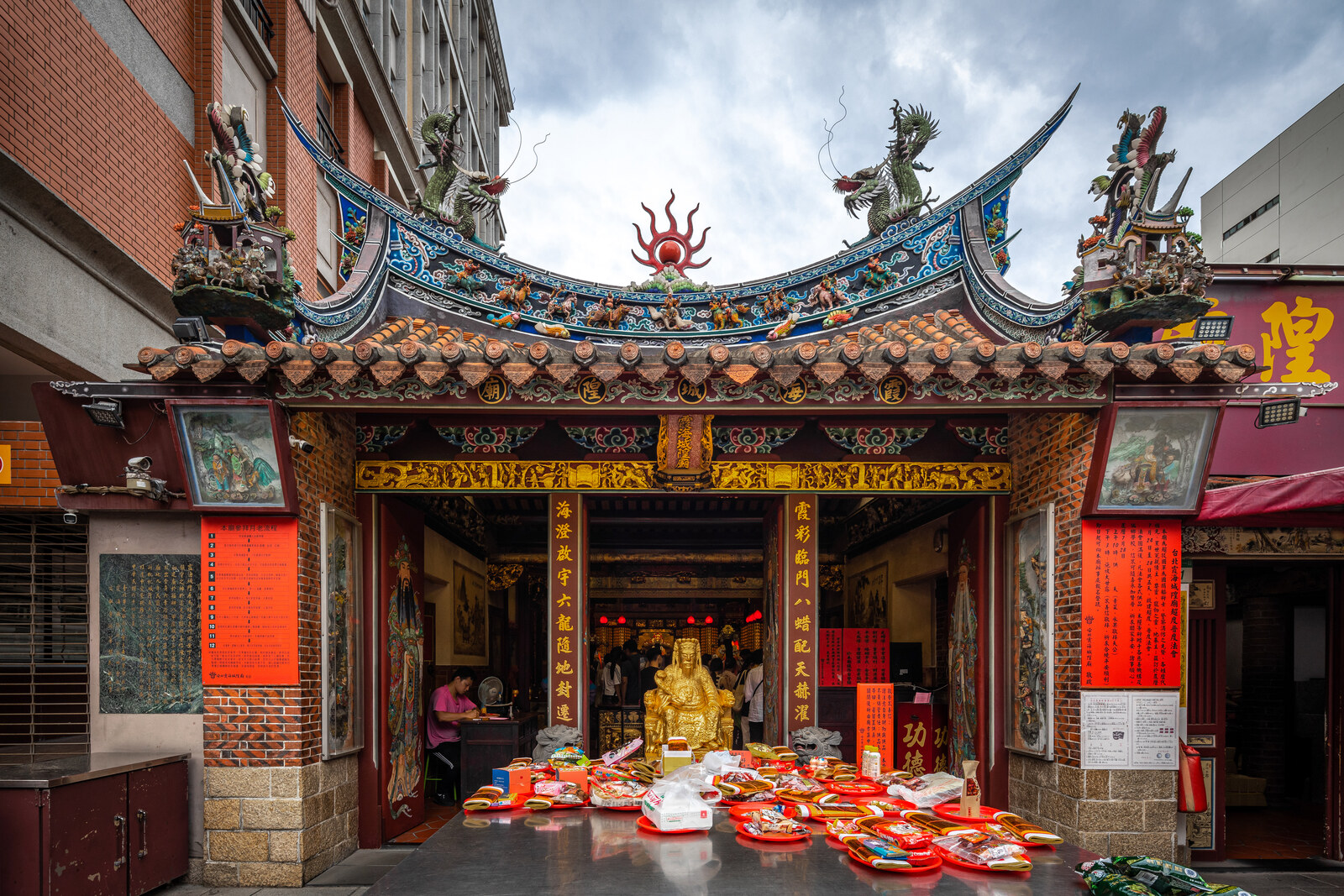
Look around first
What to notice
- Statue of the Xiahai City God
- Yue Lao figurine
- Red threads
- Boxes of wedding cookies
The story of the place
In folk religion, the City God was entrusted with heavenly judgment and the protection of the community. Xiahai City God Temple contains his statue, which the merchant Chen Jin-rong carried across the strait from Tong'an County and initially kept in his own home. The house was in Bangka, the commercial district of present-day Wanhua; the struggle of associations of fellow natives for the river wharves forced the Tong'an people to leave their quarter and move to Dadaocheng. Here, the community established a separate temple and, in its western section, honors thirty-eight fellow natives who died in that clash.
In nineteen seventy-one, an elderly woman from Taipei came here. She thanked the City God because her husband's business was doing well, and her children had received an education and found jobs. One request remained: the children simply could not find spouses.
According to the temple community's account, soon after her prayer, the children found partners. The woman returned with the gratitude she had promised—she offered to donate a statue of Yue Lao, the Old Man Under the Moon, to the temple. In Chinese tradition, he joins people destined for one another with a red thread. The woman's name has not been preserved in this story. It is known, though, that the temple manager, Chen Guo-ting, commissioned Wang Dao-ru, a master craftsman, to make a figurine forty-three centimeters tall.
That very figurine still stands here. Supplicants tell Yue Lao their name, age, and address, take a red thread, and those who marry bring wedding cookies to the temple. Sometimes the boxes are left on a communal table, and visitors help themselves to them—someone else's fulfilled promise becomes part of the next request.
Yue Lao appeared here as an assistant to the temple's much older master. In folk religion, the City God is a heavenly judge and guardian of the community. The Xiahai City God was not appointed as Taipei's patron. He was brought from Tong'an County in Fujian: in eighteen twenty-one, the merchant Chen Jin-rong crossed the strait with a hundred fellow natives and placed the statue in his own home. The name came from there as well. The home temple stood in the settlement of Xiaceng, by Linhai Gate; “Xiahai” was formed from these two names.
Chen's home was in Bangka—the former name of the commercial district in present-day Wanhua. Associations of merchants from the same home districts divided up the river trade there. People from three neighboring counties controlled the wharves and charged a fee on arriving goods; the income of Tong'an merchants depended on those same berths. In eighteen fifty-three, the dispute escalated into a major armed clash. The Tong'an people lost, and their quarter burned down.
Temple tradition says that worshippers carried the statue of the Xiahai City God out of the fire. Thirty-eight people from Tong'an died; later, the community linked their memory to their defense of the deity and their retreating fellow natives. The survivors went north, to Dadaocheng. Chen Hao-ran, Chen Jin-rong's son, placed the rescued figurine in his Jintongli Bakery. For people who had lost their homes, shops, and place by the wharf, the bakery temporarily became a shared shrine.
Three years later, Chen Hao-ran and his fellow natives raised funds for a separate temple. It was completed on this site in eighteen fifty-nine. A memorial to the dead was placed in its western section—they are venerated under the name Yi-Yong Gong, “the thirty-eight righteous braves.”
Now inside stand the statue of the Xiahai City God brought from the burned-down quarter, Yi-Yong Gong, and the small Yue Lao donated after one mother's request. Boxes of wedding cookies are left before that very figurine forty-three centimeters tall.
Useful on site
Active temple; generally open during the day, check current hours before visiting.
Checked: date not specified. Check the official source before visiting.Give way to worshippers, do not touch offerings, and check with attendants whether photography is permitted.