 Guide On Map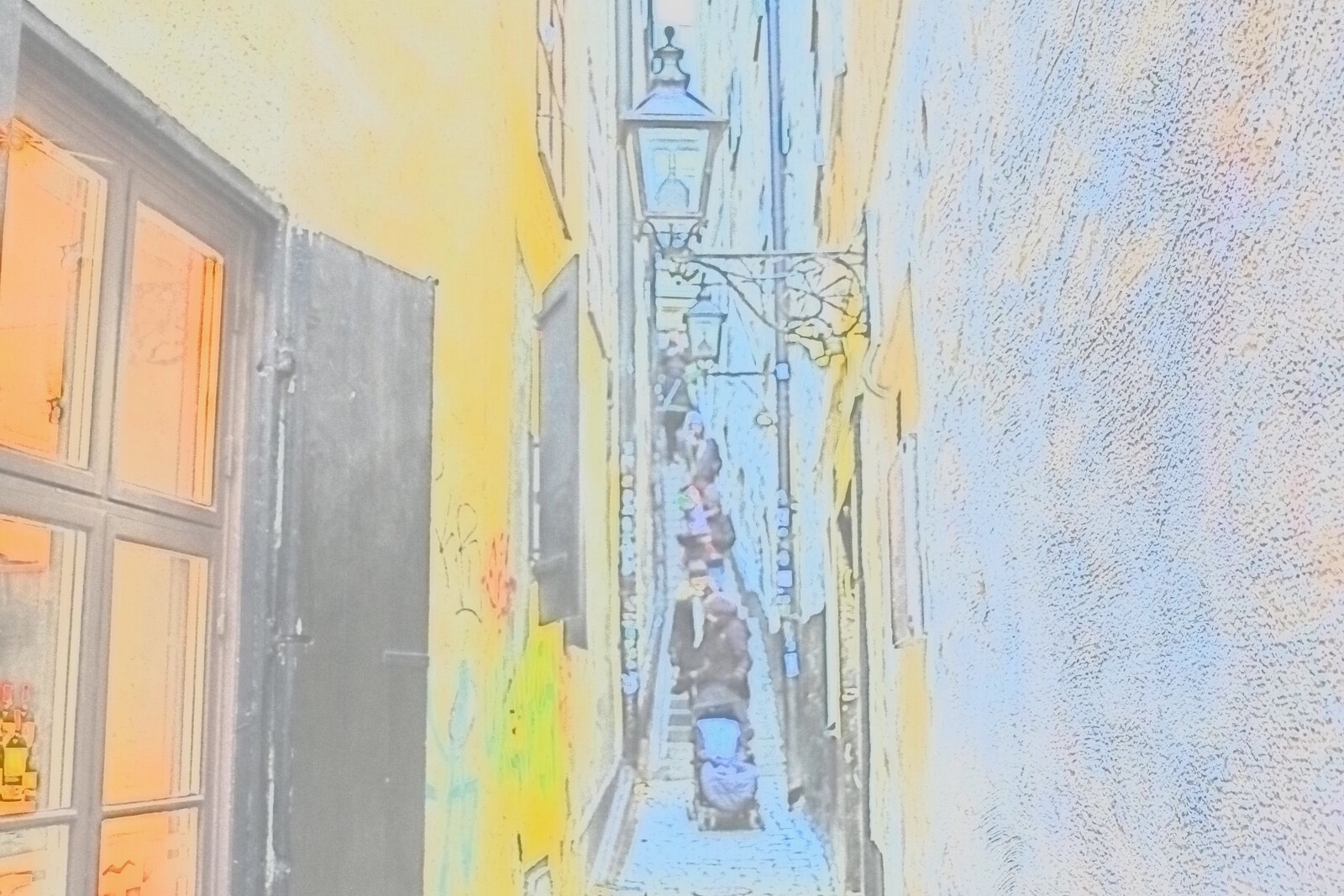
Look around first
What to notice
- Stone staircase
- Narrow gap between the walls
- Street sign
- Commemorative plaque
The story of the place
The stone steps run between the house walls so tightly that two people can barely pass each other here. In the nineteenth century, both entrances were boarded up and the staircase was incorporated into the courtyard of a neighboring house; for many decades it ceased to be a city road. Only after the Second World War was the corridor opened again, and a plaque appeared beside the current sign, recalling the former owner of the houses.
This staircase connects Västerlånggatan near Järntorget with Prästgatan above. At its narrowest point, only ninety centimeters remain between the walls. The passage was this way long before the man whose name is now written on the street sign appeared: as early as fifteen forty-four, it was called Trånga Trappgränd.
Mårten Trotzig arrived from Germany in fifteen eighty-one. At first, he sold wine, beer, spices, tableware, and textiles in Stockholm. He then went into iron and copper. For such a merchant, being next to Järntorget was a working address: iron was weighed in the square before being sent to buyers, and Trotzig himself kept a wine cellar there.
Having grown wealthy, he began buying up houses near the staircase. In fifteen ninety-seven, he bought a small, weathered stone house. Two years later, he bought another house and a plot running from Järntorget along the entire alley. He opened a shop here. As a result, the buildings on one side of the passage belonged to a single owner, and the former description—Trånga Trappgränd—gradually gave way to his surname.
The metal trade required travel to the places from which copper came. In sixteen seventeen, Trotzig set off on business for the Falun area. He was attacked and beaten so badly on the road that he soon died. His widow Karin took over the business. Together with her relative Kristina Kaun, she continued trading and kept the family business going.
The houses by the staircase also remained with the heirs. They sold them only in sixteen seventy-nine. In the deed of sale, the property was described as two small stone houses stretching along the entire Trånga Trappgränd. By seventeen thirty-three, a cartographer had already labeled the passage Trotzig's alley.
In the middle of the nineteenth century, both entrances were boarded up, and the staircase was incorporated into the courtyard of a neighboring house. For almost one hundred years, it was impossible to pass through here. The passage reopened in nineteen forty-five. In August of that same year, Trotzig's descendants placed a commemorative plaque for their ancestor on the wall. Both names remain on it: Trånga Trappgränd and Mårten Trotzig. Four years later, the city officially approved the name that stands here now.
Useful on site
Open passage; best viewed outside heavy pedestrian traffic. The steps and minimal width make the place inconvenient in rain and at peak times.
Checked: June 17, 2026. Check the official source before visiting.The staircase is narrow and slippery in wet weather. Do not stop in the middle for a photo if people are walking behind you, and give way to those coming toward you at the wider points.