 Guide On Map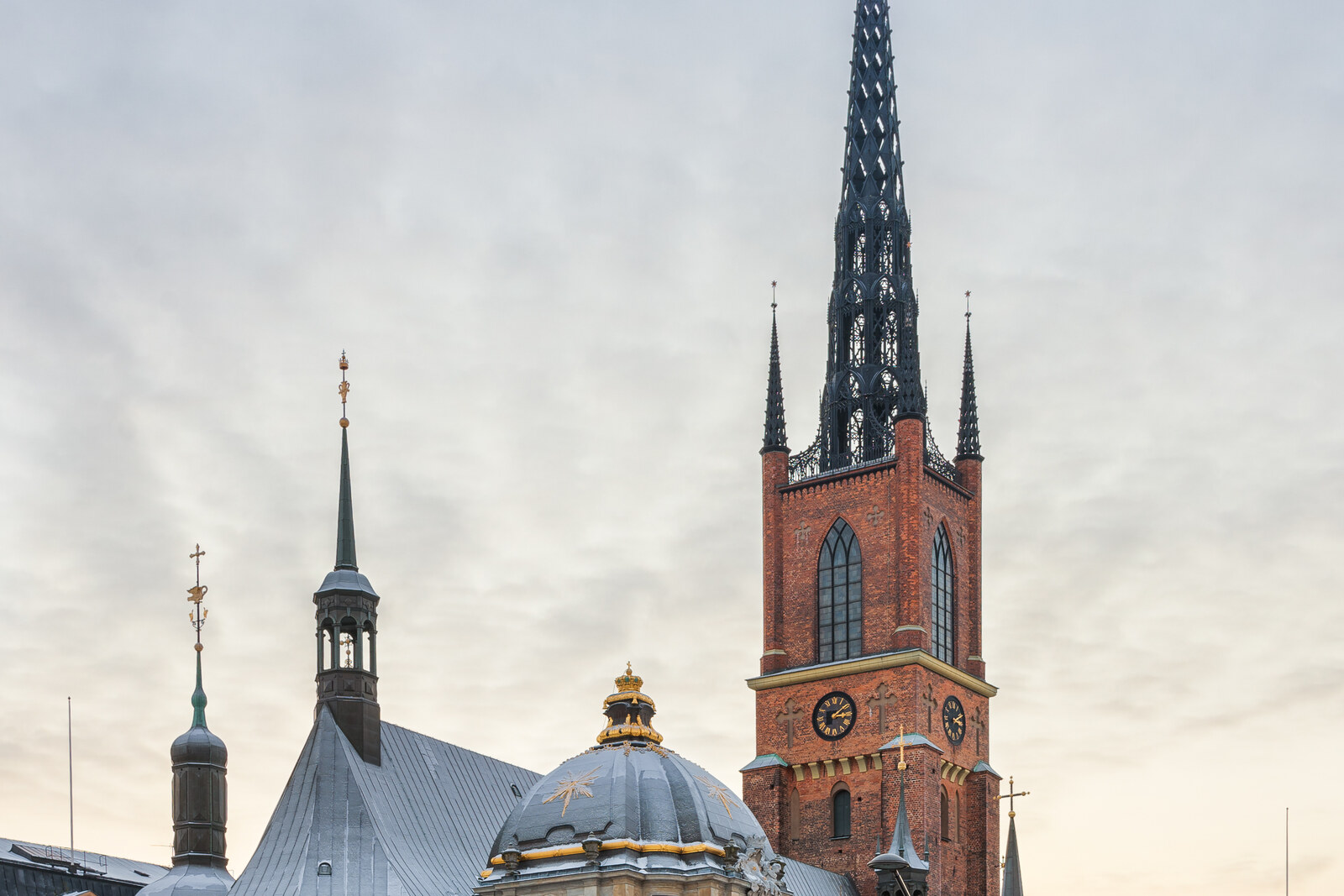
Look around first
What to notice
- Southern burial chapel
- Italian marble sarcophagus
- Inscription “Gustav II Adolf the Great”
- Medieval royal tombstones
The story of the place
A burial chapel has been added to the church's southern side, and a heavy sarcophagus of Italian marble rises inside. The burial place of Sweden's rulers gradually took shape here: over almost three centuries, seventeen monarchs were buried in the church. Regular services ceased in the early nineteenth century, and the church now serves as a museum and memorial church.
The Swedish name Riddarholmskyrkan means “the church of the Knight's Island.” In the seventeenth century, the Crown granted plots here to meritorious nobles; the palaces they built gave the island its present name. The church itself is much older. It was built for a Franciscan monastery, and after the Reformation the monks were expelled. Tombstones of the medieval kings Magnus Ladulås and Karl Knutsson Bonde already stood before the altar.
In sixteen twenty-nine, King Gustav II Adolf ordered a burial chapel to be added to the southern wall. He was preparing to leave for war again and chose in advance the church where he wanted to be buried. Three years later, the king was killed at the Battle of Lützen.
His widow Maria Eleonora wanted to keep her husband's remains with her. By then, she had already lost three children; six-year-old Kristina was still alive and became queen after her father's death. When Gustav Adolf's body was embalmed, it was opened, as was customary at the time, and the heart was placed separately. Maria Eleonora took the casket containing the heart and for a long time would not agree to bury her husband. In Nyköping, where the coffin was placed, she declared that there would be no funeral during her lifetime, or that it should be delayed as long as possible.
The Royal Council pressed for the burial. While the dead king remained unburied, the Council did not want to convene the Assembly of the Estates, which was to determine how the country would be governed under the underage Kristina. Maria Eleonora decided to move the coffin to Uppsala and had already ordered marble and builders there. The Council then reminded her that Gustav Adolf himself had designated Riddarholmskyrkan as his burial place. The widow agreed to a funeral in Stockholm, but demanded that the coffin then be moved to Strömsholm, where she planned to build a separate chapel. The Council refused again.
On June twenty-second, sixteen thirty-four, Gustav Adolf was buried here. Two days later, Maria Eleonora demanded that the coffin be opened. At first she said that she wanted to place the heart inside it, then decided to keep it with her until her own death. The Council did not allow the burial to be opened; later, the casket containing the heart was nevertheless lowered into the coffin.
This funeral began an almost three-hundred-year succession of royal burials. Maria Eleonora herself was buried beside her husband in sixteen fifty-five. The chapel commissioned by Gustav Adolf still adjoins the southern wall, and inside stands his large sarcophagus of Italian marble, inscribed “Gustav II Adolf the Great.” The last of the seventeen rulers buried here was Gustav V in nineteen fifty. There have been no regular services in the church since the early nineteenth century: it is now a museum, a royal burial place, and a memorial church.
Useful on site
The official page lists summer opening and, on the date checked, showed 10:00–17:00; an adult ticket costs 65 SEK. At the same time, in 2026 a long-term restoration of the spire affects the experience and some approaches, so checking the current notice before visiting is essential.
Checked: June 17, 2026. Check the official source before visiting.The exterior of the church and its chapels can be viewed from outside. The sarcophagi and coats-of-arms shields are inside; access depends on the site's operating schedule and restoration work.