 Guide On Map
Gamla stan and Riddarholmen: Who Owned the City
From Slottsbacken through Gamla stan to Riddarholmskyrkan
Guide On Map on your phone
Open the walk like a regular app
It takes about 10 seconds to install. No app store needed.
The whole path
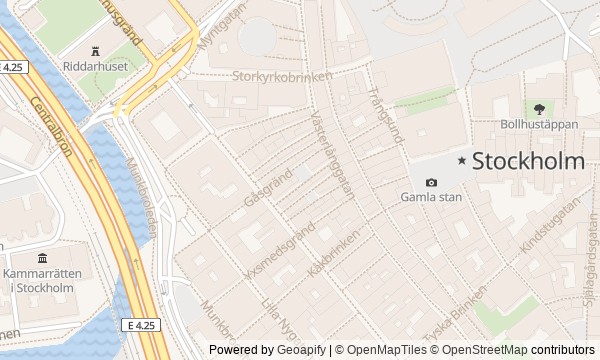
Route map
About the walk
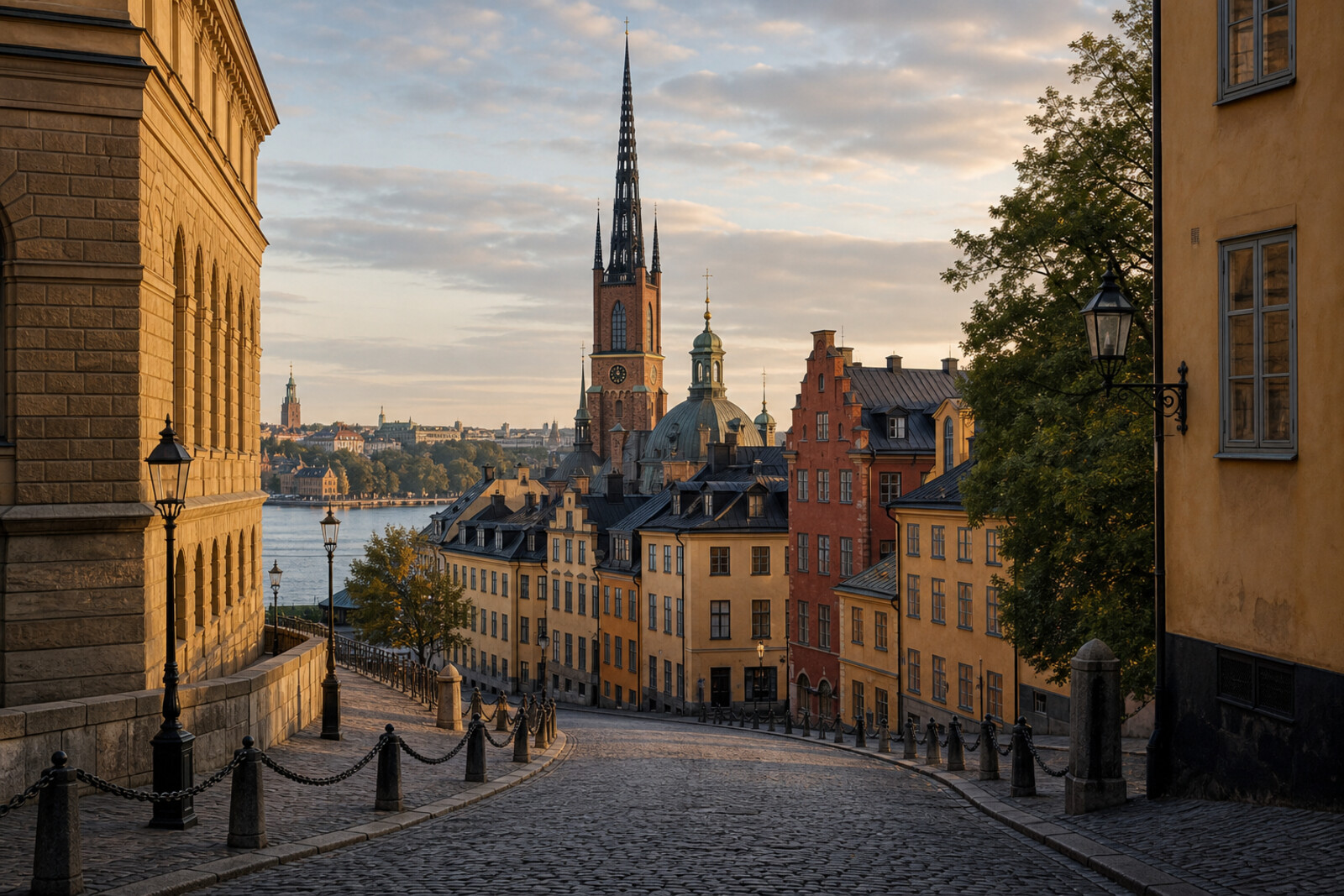
You will begin by the water and climb Slottsbacken toward Kungliga slottet. Then you will pass Storkyrkan and the main square before entering the merchant streets of Gamla stan. The way will grow narrower: from the broad palace slope to a staircase between two walls. Riddarholmen, with its royal church, will bring the walk to its close.
On one slope, two monuments will be thanking one another. At Kungliga slottet, a king will run to the guard with someone else's sword. On the square, a written amnesty will prove weaker than a locked door. And at a narrow staircase, a question will arise: why did a city passage take the name of the owner of the neighboring houses?
The story will be calm and concrete. Rather than tracing a succession of rulers, you will unpack particular decisions, promises, and disputes. By the end of the walk, you will be able to read Gamla stan through who gained the right to own a street, a church, a throne, and their own memory here.
Why this order
Slottsbacken first shows a public exchange of thanks between crown and city, while Kungliga slottet above it immediately tests that ceremony against a real struggle for power. Storkyrkan then explains how the right to govern the country was affirmed even before palace coups. From the church, the route reaches Stortorget, where a coronation and a promised amnesty had consequences for the entire city. Köpmangatan continues the story from below: beside the political square, the power of merchants and the city gates comes into view. Tyska kyrkan shows how a trading community sought not only a place in the market, but a church of its own. Mårten Trotzigs gränd narrows this history to one owner whose surname remained on the map. The crossing to Riddarholmen returns the route from a private name to the crown: in the former monastic church, a dispute over the right to shape memory concludes the conversation about power begun at Kungliga slottet.
Those who want to understand how Gamla stan works, not merely see its facades Those interested in palace coups, city communities, and trading history Those who enjoy dense stories of human decisions and visible traces
Those looking for a walk of shops and cafés alone Those who find it difficult to hear about political violence and struggles for power Those who prefer broad waterfronts to narrow streets and staircases
Before you go
Wear shoes with good grip: the route includes cobblestones, slopes, and steep steps, which are especially awkward after rain or in freezing weather. Kungliga slottet, Storkyrkan, Tyska kyrkan, and Riddarholmskyrkan may be closed to visitors because of ceremonies, services, the season, or restoration work, so treat interiors as an added opportunity rather than a requirement for the walk. If you want to go inside, check each site's rules in advance and allow separate time. Even with doors closed, the route still makes sense: its main transitions and an important share of its details can be read from the street.
When to go
Choose early morning if you want time to study the facades and narrow passages in peace. In the afternoon, the stone looks more expressive, but Stortorget and Mårten Trotzigs gränd are usually busier. Do not save the whole route for twilight: the steps and uneven ground demand attention.
Backup plan
If time is short, take the first four stops: Slottsbacken, Kungliga slottet, Storkyrkan, and Stortorget form a self-contained chapter about the crown, the church, and a broken promise. You can begin the merchant section another day directly from Köpmangatan. If church interiors are closed, do not rearrange the route: view the buildings from outside and continue in order. If you are tired or the paving is slippery, skip the steps of Mårten Trotzigs gränd, but keep the finale on Riddarholmen—it is what completes the transition from a living city to a space of memory.
Route conditions
Surface. Paved — 2.4 km; unpaved — 224 m
Stairs. Flights: 1, 38 m in total
Access. Wheelchair — no; stroller — limited (stairs)
Facilities. Toilets — 8; drinking water — 2
Elevation. Ascent — 19 m; descent — 30 m
OpenStreetMap extract of July 9, 2026: database data, not a check on the ground. Data © OpenStreetMap contributors, ODbL licence
Walk plan
Open in maps ↗- 1
Slottsbacken
Here, a pair of official gifts shows how the city and the monarchy expressed their mutual gratitude. - 2
Kungliga slottet
A brief chase inside the residence will explain why the present royal family belongs to a different dynasty. - 3
Storkyrkan
A medieval sculpture will connect a personal vow, a military victory, and the struggle to govern Sweden. - 4
Stortorget
The square will help trace how the promised reconciliation turned into the collapse of an entire political union. - 5
Köpmangatan
The surviving name helps trace the route goods took from the shore to the city’s main market. - 6
Tyska kyrkan
The history of a shared house of worship shows how two language communities fought for the right to a single building. - 7
Mårten Trotzigs gränd
One city address shows how private property can outlive its owner in a street name. - 8
Riddarholmskyrkan
The final stop will conclude the route with a dispute over who decided the fate of a royal burial.
Route features
Everything you need stays in the browser
Progress, saves and your trip plan are stored on this device.
Add Guide On Map to your home screen so the walk opens outside the browser.
How we handle sources, maps and corrections: our editorial standards