 Guide On Map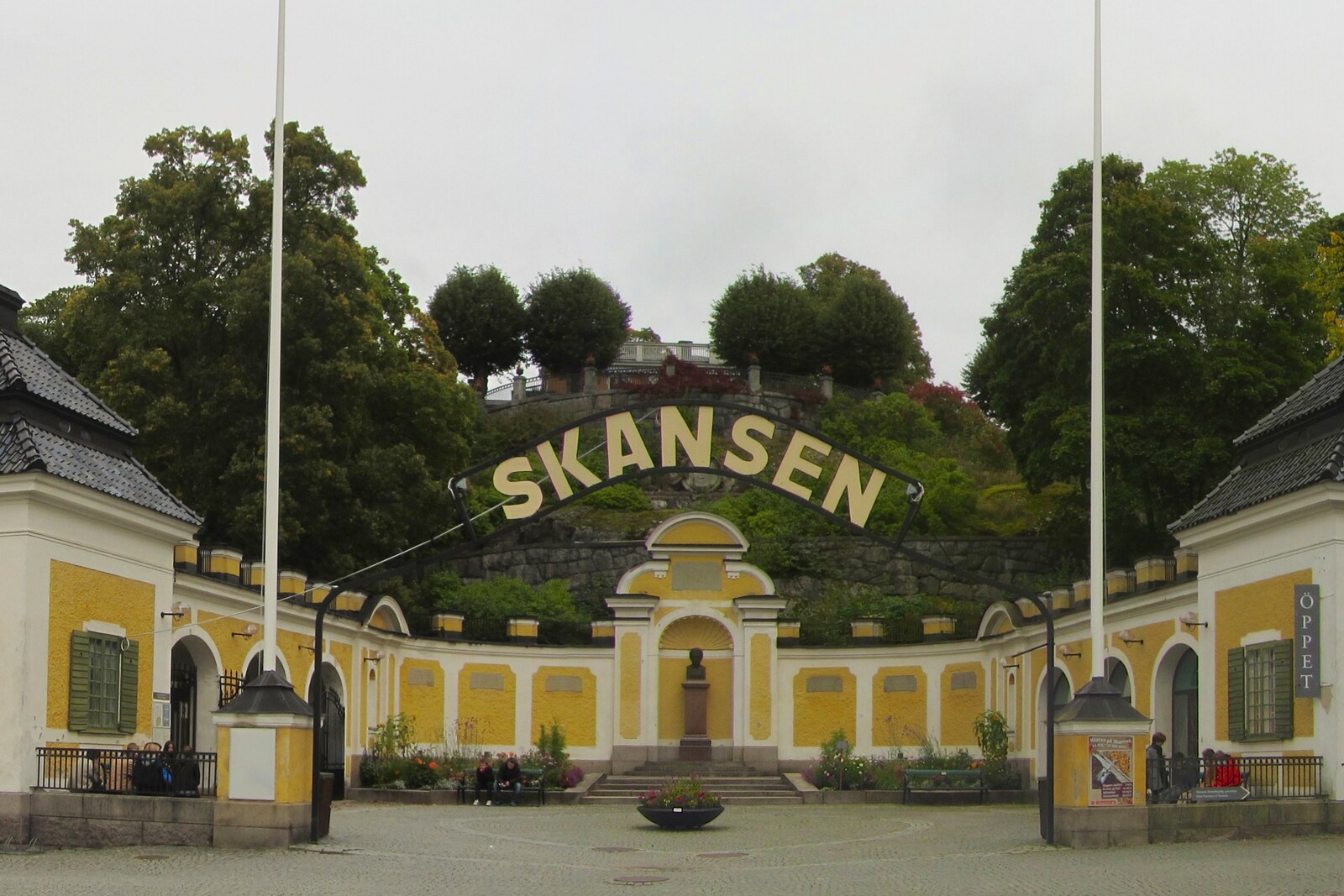
Look around first
What to notice
- Wooden bell tower
- The house at Mora Farmstead
- Historic farmsteads
- Staff in historic clothing
The story of the place
An open-air museum has been laid out here: historic farmsteads, houses, barns, and workshops stand along the slope among paths and courtyards. Staff and volunteers work in the houses, demonstrate crafts, and explain how the farm was run. Domestic animals recall rural life, while northern wild species tell of Sweden’s nature; that is how a zoo came to stand beside the farmsteads.
The name “Skansen” is older than the museum. In Swedish, it means “the redoubt.” In the eighteen-tens, King Carl XIV Johan ordered a small fortification built on the hilltop—a place for military games for his son, the future Oscar I. A tall wooden bell tower now stands roughly there. When Arthur Hazelius acquired the land here, the hill had already retained the name of the vanished redoubt.
Hazelius, the founder of the neighboring Nordic Museum, was looking for a way to show disappearing rural life outside museum display cases. In eighteen eighty-four, he saw an old log house with a tall chimney in the village of Östnor. His employee bargained with the owner for seventy-five kronor, and a year later Hazelius bought the building. At that time, he still had no site for an open-air museum. Only in eighteen ninety-one was the house dismantled, moved to Djurgården, and reassembled. Skansen began with it.
At first, Hazelius placed mannequins in folk costumes in the houses. He then replaced them with people from the regions to which the farmsteads were dedicated. The most visible were the young women from Dalarna, who came to Stockholm to earn money. Their fellow countrywomen found work at breweries, candle works, and in private homes; Skansen offered them paid work and accommodation on its grounds.
The women from Dalarna sold tickets, gave directions, served coffee and pastries, and knitted and wove before the public. On Sundays, they were also required to sing and perform folk dances. Not all of them agreed to turn every skill into a performance. Giers Anna Karlsdotter, who worked at Skansen for several seasons, succeeded in having her employment record marked in large letters: “absolutely does not want to dance.” Some women stayed here for the summer, others for decades. It was their work that allowed Hazelius to remove the mannequins and show the activities for which a house, barn, or workshop had originally been built.
The same ticket office explains why old farmsteads stand beside a zoo. Domestic animals were part of rural life, while northern wild animals represented Swedish nature. Hazelius was also given exotic animals. They had nothing to do with the Sweden in miniature he envisioned, but he reasoned that the public would pay for the opportunity to see them, and he kept the gifts. Later, the zoological section was concentrated on northern species and old Swedish breeds.
The little house from Mora, bought for seventy-five kronor, still stands at Mora Farmstead. Staff and volunteers work in the historic houses, demonstrating crafts and explaining how the farm was run. It was specifically the costumed mannequins that disappeared from Hazelius’s first display.
Useful on site
Skansen is open year-round. In 2026: June 1–August 30 daily 10:00–18:00; August 31–September 27 10:00–17:00; September 28–January 10, 2027, weekdays 10:00–15:00, weekends 10:00–16:00, with holiday exceptions. Individual houses, animal enclosures, and gates have their own hours.
Checked: June 29, 2026. Check the official source before visiting.The grounds are large and require separate admission: decide in advance whether you will limit yourself to the nearest sections or go farther in. Start at the main gates; do not count Hazeliusporten and the funicular as a guaranteed backup entrance.