 Guide On Map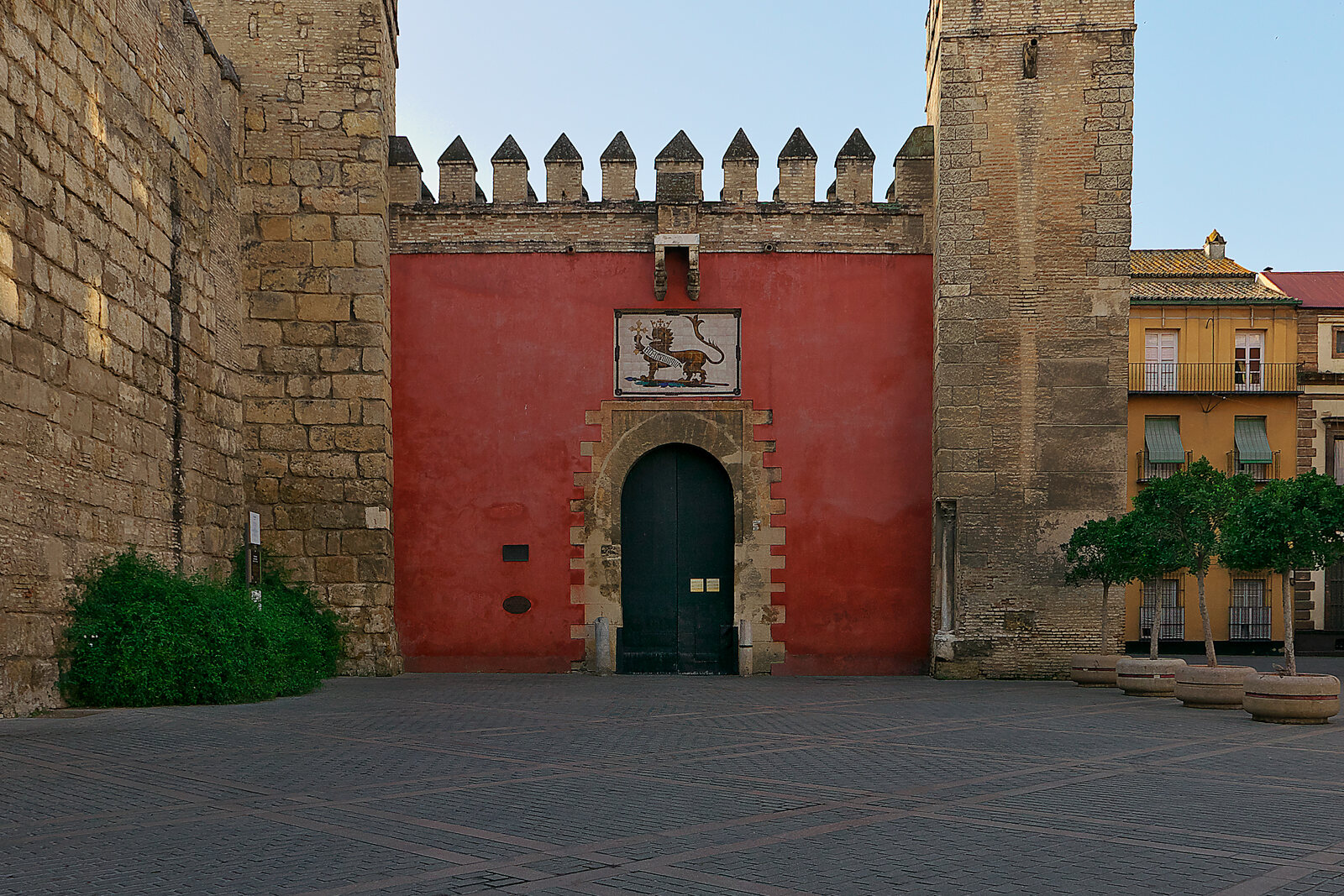
Look around first
What to notice
- The main entrance arch
- The ceramic panel
- The crowned lion with a cross
- The inscriptions of Gestoso and the Mensaque Brothers Factory
The story of the place
A stream of visitors to the Royal Alcázar of Seville now enters through the wide arch with its crowned lion, while in the Middle Ages this was where the monarchs' ceremonial route from Seville Cathedral to the royal palace ended. Old documents called the passage Montería; perhaps hunters gathered beyond it before setting out, although the origin of this name can no longer be established precisely. Later, the entrance from the side of Patio de Banderas was made the main one, and this arch receded into the background for two centuries. The lion holding a cross above the entrance cemented the gate's present name and once again made it the ceremonial threshold of the palace.
In eighteen seventy-six, the court painter Joaquín Domínguez Bécquer climbed up to the image above this entrance. A crowned lion holding a cross had been painted on the plaster. The paint was flaking away, and Bécquer, who oversaw the painting work at the Royal Alcázar of Seville, renewed it. Even then, no one could confidently identify the origin of the design. All that is known is that the traveler Richard Ford sketched the lion here as early as eighteen thirty-two.
Bécquer's repair lasted less than two decades. Sun and rain again damaged the image above the open arch. José Gestoso, the historical adviser to the Royal Alcázar of Seville, proposed transferring it to fired ceramic. The design was entrusted to Manuel Tortosa, an artist at the Triana-based Mensaque Brothers Factory. For Tortosa, painting tiles was a craft and a livelihood; Gestoso determined which historical image should be preserved.
This is how the present lion appeared: a crown on its head, a cross in its right paw, and a fallen banner beneath its left. Written on the ribbon across its chest is “Ad utrumque”—“for either,” an abbreviation of the formula “ready for either.” This emblem was meant to greet the person entering as a guardian of the royal palace. At the bottom of the panel are the names of Gestoso, the Mensaque Brothers Factory, and the year eighteen ninety-four. Tortosa's name, though he transferred the design onto the tiles, is absent from the inscription.
Until the nineteenth century, documents called this passage the Hunting Gate. Royal hunters gathered beyond it before setting out, although historians warn that the exact origin of the old name can no longer be proven. In the nineteenth century, writers and guidebook compilers increasingly spoke of the Lion Gate. The ceramic panel cemented this name, but appeared after it.
In the Middle Ages, people entered the Christian Royal Alcázar of Seville through this arch; this was where the monarchs' ceremonial route from Seville Cathedral to the palace ended. Then, for two centuries, another entrance, on the side of what is now Patio de Banderas, was made the main one. Visitors now again enter through the Lion Gate.
The fired ceramic also needed saving. In two thousand seven, José María Cabezas, the curator of the Royal Alcázar of Seville, noticed during a routine inspection that the tiles were coming away from the wall. Restorers secured more than three hundred pieces, one by one. Above the main entrance, Manuel Tortosa's factory work remained, while below, the name of the man who directed it can still be read.
Useful on site
The exterior point by the entrance is free. Entry inside the Royal Alcázar of Seville follows a separate seasonal schedule: 01.04—30.09 usually 09:30—19:00, 01.10—31.03 usually 09:30—17:00; ticket office in Patio de Banderas, card payment. Checked 2026-06-29.
Checked: June 29, 2026. Check the official source before visiting.The gate is clearly visible from outside; do not join the entrance line unless you intend to visit the Royal Alcázar of Seville on a separate ticket.