 Guide On Map
Seville Between Seville Cathedral, the General Archive of the Indies, and the Royal Alcázar of Seville
From Plaza del Triunfo through the cathedral complex to Patio de Banderas
Guide On Map on your phone
Open the walk like a regular app
It takes about 10 seconds to install. No app store needed.
The whole path
Route map
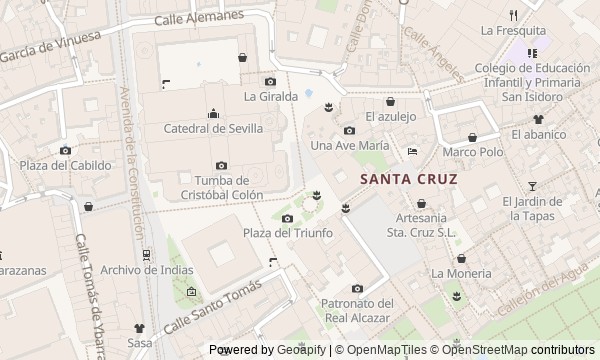
About the walk
You will walk through Seville’s tightest historical knot: from the square between the former exchange, Seville Cathedral, and the royal palace to the quiet courtyard behind the wall of the Royal Alcázar of Seville.
The way is short, but it will change eras several times. A small column raises the first question: why did its presence mean preserving the view of another façade? At the archive, there will be carts, hundreds of crates, and the book that prompted the gathering of an empire’s papers. At Seville Cathedral, a returned sword and a name erased from the pulpit await. On the tower stands a bronze figure whose commission will outlast a fire and a prison. At the Royal Alcázar of Seville, the makers matter more than the official version again, though not all of them will be credited.
The story moves from object to human decision. It separates document from legend. By the end, you will be able to point out why Seville’s principal sites were preserved not only by kings and cathedral chapters, but also by carts, a guarantee, ceramics, and a legend told at the right moment.
Why this order
Plaza del Triunfo first brings Seville Cathedral, the former exchange, and the Royal Alcázar of Seville into a single view. The small monument by the exchange explains why the next stop is the General Archive of the Indies: its façade shaped the square. From the former commercial building, the route crosses the square to Seville Cathedral—from the papers of an overseas empire to the place where the city’s clergy and rulers affirmed their rights through ceremonies and relics. Inside, Seville Cathedral leads to Patio de los Naranjos, where the layout of the former Great Mosque of Seville is clearest and the story of the cathedral pulpit comes into view. Giralda rises above the courtyard, so the route then follows how the minaret acquired its Christian crown. After the tower, the way crosses the square to the Lion Gate of the Royal Alcázar of Seville, placing the signs of cathedral and palace side by side. From the gate, walk along the wall to Patio de Banderas: a vanished image gives the place its name again, while an altar preserved beneath an arch completes the chain of things that outlived their defenders.
Those who want to connect Seville Cathedral, the General Archive of the Indies, and the Royal Alcázar of Seville through one story Those interested in the fates of objects and the work of makers Those who enjoy telling documents apart from city legends
Those expecting an overview walk through different parts of Seville Those mainly looking for an analysis of architectural styles Those who prefer easy legends without checking where they came from
Before you go
Decide in advance whether you want the indoor version of the route: visiting Seville Cathedral, Patio de los Naranjos, and Giralda requires separate planning, and access may change because of services and events. The Royal Alcázar of Seville appears here chiefly through its gate and the surrounding urban space; it is best not to squeeze a full palace visit between stops. The exterior of the General Archive of the Indies is worthwhile in its own right, so a closed entrance will not break the sequence. Bring water, sun protection, and comfortable shoes: the crossings are short, but standing for a long time in stone squares and climbing are more tiring than they seem. At religious and protected sites, pass through security calmly and do not count on free access through service gates.
When to go
The outdoor walk, with listening and close looking, takes about 1.5—2 hours. With Seville Cathedral, Patio de los Naranjos, and the climb up Giralda, allow roughly 2.5—3.5 hours. Leave a detailed visit to the Royal Alcázar of Seville for separate time.
Backup plan
If you cannot get inside Seville Cathedral, keep the order of the stops and read the complex from outside: walk around the cathedral’s mass, find the passages and arcades on the Patio de los Naranjos side, and look at the lower masonry of Giralda separately from its later summit. Do not try to replace a closed official entrance with random passageways. If the General Archive of the Indies is inaccessible, focus on the austere former exchange and its position between church and palace. At the Royal Alcázar of Seville, it is enough to see the thickness of the wall, the structure of the entrance, and the ceramic lion; then finish the route in the accessible part of Patio de Banderas. This version preserves the central story: changing purposes, names, and boundaries.
Route conditions
Surface. Paved — 394 m (data covers 74% of the route)
Facilities. Toilets — 4; drinking water — 4
Elevation. Ascent — 5 m; descent — 5 m
OpenStreetMap extract of June 18, 2026: database data, not a check on the ground. Data © OpenStreetMap contributors, ODbL licence
Walk plan
Open in maps ↗- 1
Plaza del Triunfo
Here a small monument will link an earthquake, a cathedral ceremony, and the square’s very name. - 2
General Archive of the Indies
This stop will show how a commission for one book led to the creation of an entire state archive. - 3
Seville Cathedral
Here, the sword of a dead king will become the guarantee of two campaigns and of his grandson's political fate. - 4
Patio de los Naranjos
The old pulpit will preserve the trace of a preacher whose name the clergy decided to remove. - 5
Giralda
The history of the commission will explain the price the caster paid to raise an enormous bronze weather vane onto the tower. - 6
Lion Gate of the Royal Alcázar of Seville
The ceramic panel shows how an image was preserved and how credit for the work was assigned. - 7
Patio de Banderas
The final stop will show how a legend helped keep in place an object threatened with disappearance.
Route features
Everything you need stays in the browser
Progress, saves and your trip plan are stored on this device.
Add Guide On Map to your home screen so the walk opens outside the browser.
How we handle sources, maps and corrections: our editorial standards