 Guide On Map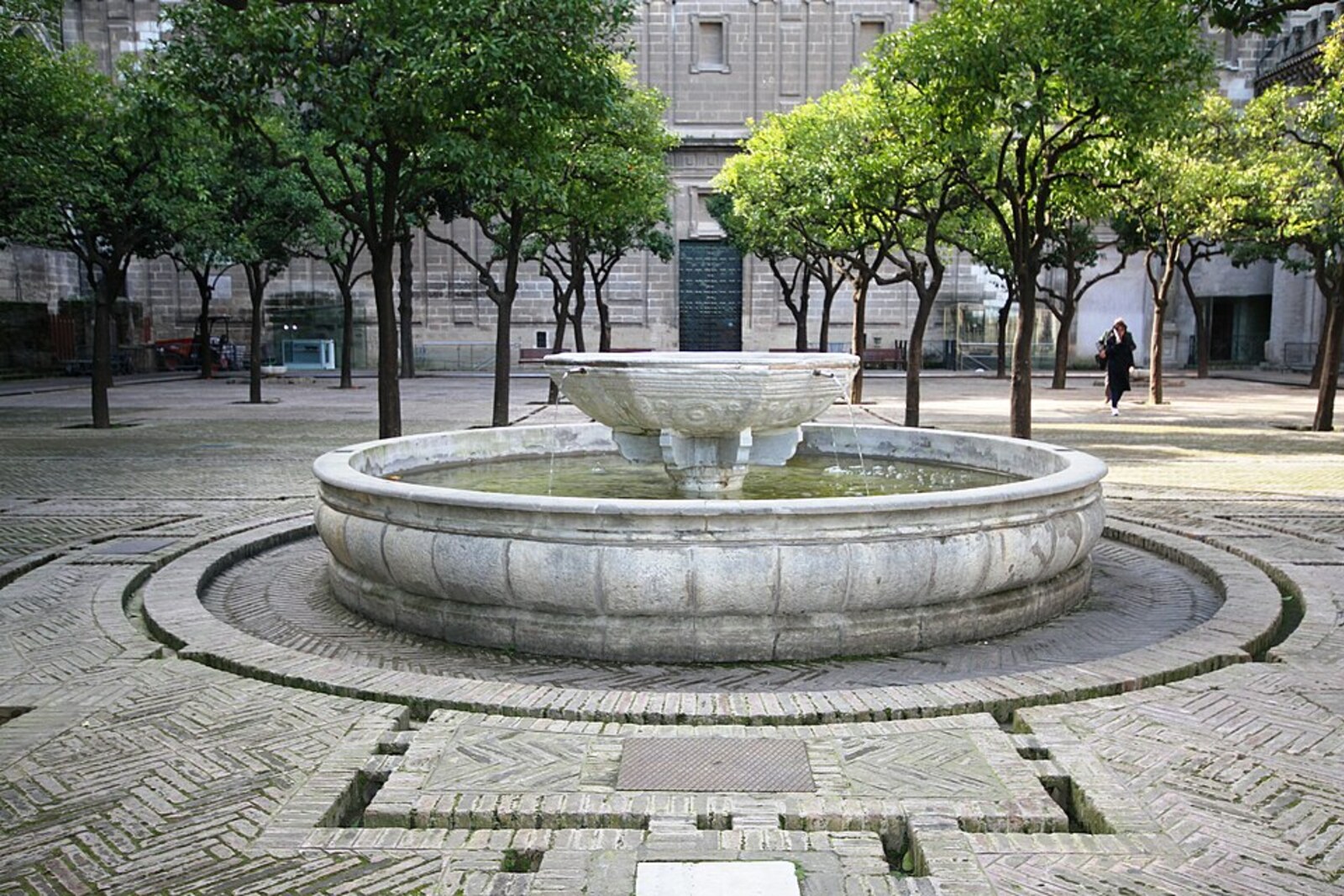
Look around first
What to notice
- Rows of orange trees
- The central fountain
- The black stone canopy
- The marble slab with the names of preachers
The story of the place
Orange trees stand around the fountain in the open courtyard that the cathedral inherited from the Almohads' mosque. When the call to prayer sounded here, people came to the water in the middle of the courtyard for ablutions; the upper bowl of the present fountain has survived from those times. After the cathedral was consecrated, the space was neither closed off nor built over: townspeople continued to gather here, now for Christian sermons. Beneath the black stone canopy beside the trees lies a marble slab bearing the names of preachers whom the cathedral decided to preserve in memory.
In the spring of fifteen fifty-five, Constantino de la Fuente was brought to the cathedral on a stretcher. He had not yet recovered from a serious illness, but he continued preaching on Mondays, Wednesdays, and Fridays during Lent. For such addresses, the chapter used a stone pulpit by the eastern arcade of the Patio de los Naranjos: far more people could stand in front of it than in a separate chapel.
The open space remained from the Almohads' Great Mosque of Seville. At its center, Muslims performed ablutions before prayer; the upper bowl of the present fountain had also served in the mosque's earlier fountain. After the building was consecrated as a Christian cathedral, the clergy gathered townspeople here for sermons. The first reliable record of the pulpit dates to fourteen ninety-seven. The stone canopy above it sheltered the speaker and helped direct his voice toward the listeners. Orange trees had already grown around the central well and fountain in the medieval garden, giving the courtyard its present name.
For Constantino, preaching was a profession. He sought to obtain the magistral canonry—a regular income and the duty to be the cathedral's chief preacher. In fifteen fifty-six, he had to endure a public competition for the post. Fernando de Valdés, Archbishop of Seville and Inquisitor General, supported another candidate. Constantino was bedridden again; his doctor warned in writing that continuing the competition threatened his life. The next day, the judges nevertheless declared Constantino the winner.
He presented theology in Castilian, called for a return to the text of Scripture, and placed inner faith above rites. His opponents saw Protestant teaching in his words. The canonry gave Constantino the pulpit and an income, but at the same time made every one of his sermons an object of scrutiny by Valdés's men.
On August first, fifteen fifty-eight, Constantino delivered his last sermon in the cathedral. Fifteen days later, he was arrested. The inquisitors obtained their final proof by accident. The wealthy widow Isabel Martínez de Alvo hid his library of prohibited religious books behind a false wall. When, after her arrest, investigators came to look for valuables removed from the house, Isabel's son decided that they already knew about the books and opened the hiding place himself.
Constantino spent almost two years in the Spanish Inquisition prison in Triana and died before being sentenced. In December fifteen sixty, his remains were exhumed from the grave and taken to an auto-da-fé along with a straw effigy of the deceased. The figure was placed on the pulpit with its hand raised—in the pose in which townspeople were used to seeing the preacher—and then burned together with the bones. His property was confiscated, and his books and printing equipment were sold; the proceeds were also used to recover the costs of his imprisonment.
Of the old pulpit, only the black stone canopy survived the rebuilding of sixteen ninety-two. The present marble slab beneath it lists six other famous preachers. Constantino de la Fuente's name was erased from it soon after his death and was never restored.
Useful on site
The cultural visit to the cathedral and the Giralda depends on services and work. As of the verification date, a temporary change is in effect from June 8–30, 2026 because of work on the bell tower: check the official schedule before entering. Checked 2026-06-29.
Checked: June 29, 2026. Check the official source before visiting.Access to the courtyard may depend on the operating arrangements of the cathedral complex; if you cannot enter, limit yourself to what can honestly be seen from the permitted area.