 Guide On Map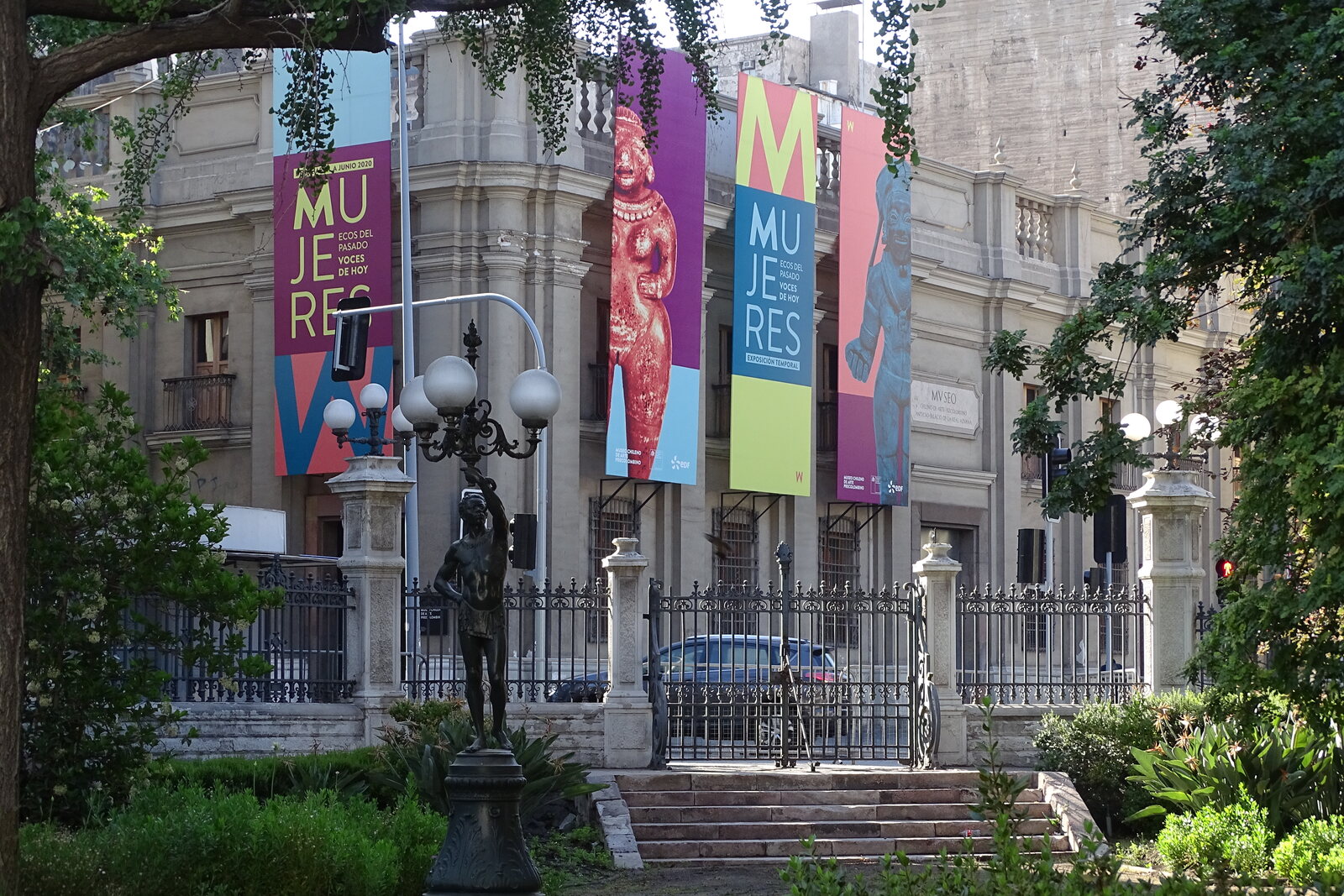
Look around first
What to notice
- The inscription on the façade
- The ceramic figure without an arm
- The figure’s ancient fragments
- Museum display cases
The story of the place
The façade reads: “Chilean Museum of Pre-Columbian Art.” Here, “Chilean” refers to the country where the museum was created, not to the origin of every exhibit. Inside are objects from the peoples of the Americas. The word “pre-Columbian” draws a conventional boundary at Christopher Columbus’s voyage and the European conquest of the continent that followed.
The core of the collection was assembled by the Chilean architect Sergio Larraín García-Moreno. In the nineteen seventies, he realized that the collection he had spent decades gathering might be divided up after his death. Larraín offered to give it to universities and public institutions, until his plan was supported by Santiago mayor Patricio Mekis. The city government provided the building and assumed the costs of maintaining it, while the Larraín family established a foundation to preserve, study, and display the objects.
The museum was housed in the Royal Customs House. It was built between eighteen oh five and eighteen oh seven, and later housed the National Library of Chile and the city courts. In nineteen sixty-eight, a fire destroyed a substantial part of its premises. Once it had been restored, the Larraín collection was moved here, and in December nineteen eighty-one the museum welcomed its first visitors.
Four years later, its staff had to find out what it really meant to “preserve” an ancient object. On March third, nineteen eighty-five, an earthquake blew out the museum windows and damaged several exhibits. The worst hit was a hollow ceramic figure from Veracruz, Mexico, one meter and ten centimeters tall. It is usually called Xipe Totec—an image of the Mesoamerican god of renewal—although some researchers see another god in it. The figure came loose from its mounting and was almost completely shattered.
That day, the British archaeologist Margot Wright arrived in Santiago. She helped the staff secure the surviving objects in the shattered display cases, then develop rules for responding to future earthquakes. The building was closed for about seven months. The figure posed a harder problem: it could have been sent to specialists in the United States, but that work was too expensive. Local conservators still had to prove that they could handle one of the museum’s principal exhibits.
Four years later, the restoration was entrusted to the museum conservator Luis Solar. Together with María Sagredo and María Victoria Carvajal, he began joining the fragments. It then became clear that the figure had been repaired even before the earthquake. When it came into Larraín’s possession, one arm was already missing; before the museum opened, the loss had been concealed with a modern addition.
The team could have presented visitors with a statue that looked whole again. Solar, Sagredo, and Carvajal chose another option: they assembled the ancient fragments, removed the added arm, and documented the restoration process in detail. The figure still has no such arm. It is missing not because the work was left unfinished: the conservators deliberately did not pass off the addition from nineteen eighty as ancient ceramic.
Useful on site
Plan your visit to the exhibition separately and check access in advance; without entering, this stop still works through the biography of the building itself.