 Guide On Map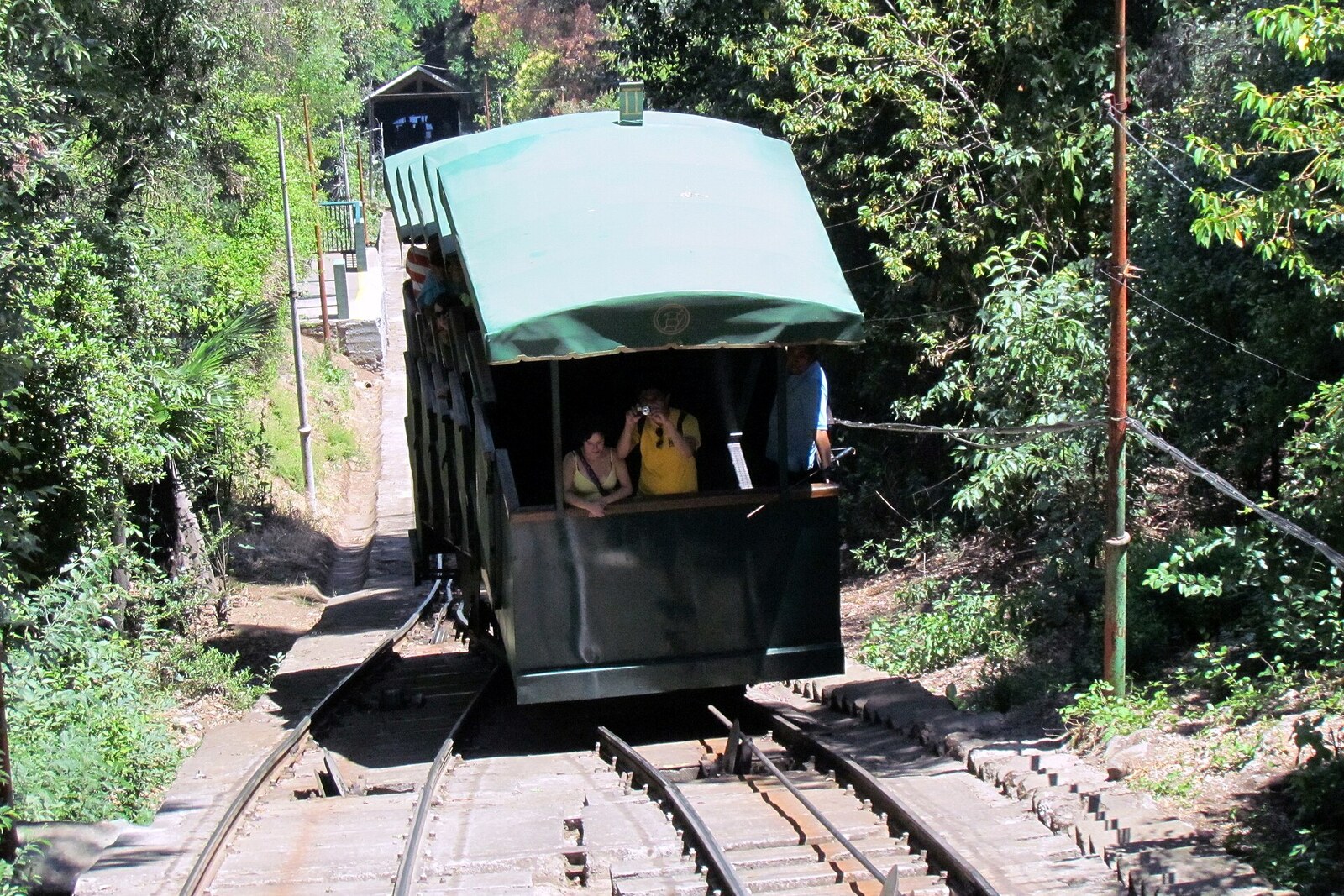
Look around first
What to notice
- Crenellated stone tower
- Ticket hall
- Rail line
- Paired cars
The story of the place
The crenellated stone tower on Pío Nono Street stands at the lower end of the funicular, which links the foot of San Cristóbal Hill with its summit. The stone for its walls was taken from the hill itself; behind the massive facade are a ticket office and a hall where people waited to board. From here, the rail line goes up the slope, and two linked trainsets move toward each other: one takes passengers up, the other brings them back down.
In nineteen sixteen, the journalist Alberto Mackenna, who led the Chilean Boy Scouts, took a troop to the summit of San Cristóbal Hill. The slopes belonged to private owners, stone was quarried here, and Mackenna was campaigning to turn the hill into a public urban park. The Scouts staged a symbolic occupation of the summit, newspapers took up the campaign, and together with Senator Pedro Bannen, Mackenna carried it through to a law on the expropriation of the land.
The law of nineteen seventeen even specified the location of a new entrance: a road to the hill was to be laid opposite Pío Nono Street. A year later, municipal officials took over the land and began creating the ascents, and when Mackenna became governor of the metropolitan province, irrigation channels, plantings, and roads appeared on the slope under his administration. The height remained: between the foot and the summit there were about two hundred forty meters of ascent.
The Italian engineer Ernesto Bozo received permission to build a rail lift here and operate it for a fee for some time. He was one of the enterprise's main investors and was responsible for the project: if the cars did not run along this slope, the money invested would be lost. In November nineteen twenty-three, four hundred sixty-five shareholders, mostly immigrants from Italy, raised one million two hundred thousand pesos. Each share cost twenty pesos. The cars, rails, and machinery were ordered from Milan, and the engineer Juan Nelli was assigned to assist Bozo during construction.
The architect Luciano Kulczewski received a much more modest task: to design the ticket office and waiting room below. He built a crenellated tower from stone quarried on San Cristóbal Hill itself. Its medieval appearance marked the city's entrance to the hill; behind the massive facade, people bought tickets and waited for the car.
On April twenty-fifth, nineteen twenty-five, hundreds of guests gathered at this station. The entrance was decorated with Chilean and Italian flags, the official delegation went up, and the builders handed the structure over to the clients. However, the ceremony did not yet authorize the transport of ordinary passengers. The ministry classified the funicular as a private railway and required a separate inspection.
The engineer Jorge Alessandri, who headed the state commission, ordered the cars to be loaded with sandbags and steel cables. He needed to prove that the traction system, rails, and brakes could bear the weight of people on the steep slope. Permission was issued only on May tenth. Then the shareholders received a working line, Mackenna received an ascent to the public park he had conceived, and passengers received a route to the summit.
No one promised equality inside the first cars. First-class passengers traveled in enclosed compartments with curtains and seats. Second class remained in the open air, and its passengers traveled standing. The hill became more accessible, but the design of the cars preserved the city's division between those who paid for a seat and those who were allotted a platform.
The station's name came from the street. Pío Nono was Pius IX, born Giovanni Maria Mastai-Ferretti. In eighteen twenty-four, he arrived in newly independent Chile as a young church diplomat, as part of a Vatican mission. The negotiations brought the mission no great success, Mastai-Ferretti left, and he became pope only twenty-one years later. His stay in Santiago was preserved in the name of the street that led directly to the future station.
The stone tower still performs the task assigned to Kulczewski: it serves as the ticket office and entrance to the cars. Behind it, two trainsets are linked by a single line—while one rises, the other descends. It begins where the state engineer once ordered passengers to be replaced with sandbags.
Useful on site
Winter funicular schedule: Monday 13:00–18:45, Tuesday–Sunday 10:00–18:45; the first Monday of each month is closed for maintenance. The summer schedule may be longer.
Checked: July 1, 2026. Check the official source before visiting.The station's architecture can be viewed from outside. Before ascending, check whether the line is operating, how the queue is organized, and whether a separate ticket is required; do not rely on the funicular without checking.