 Guide On Map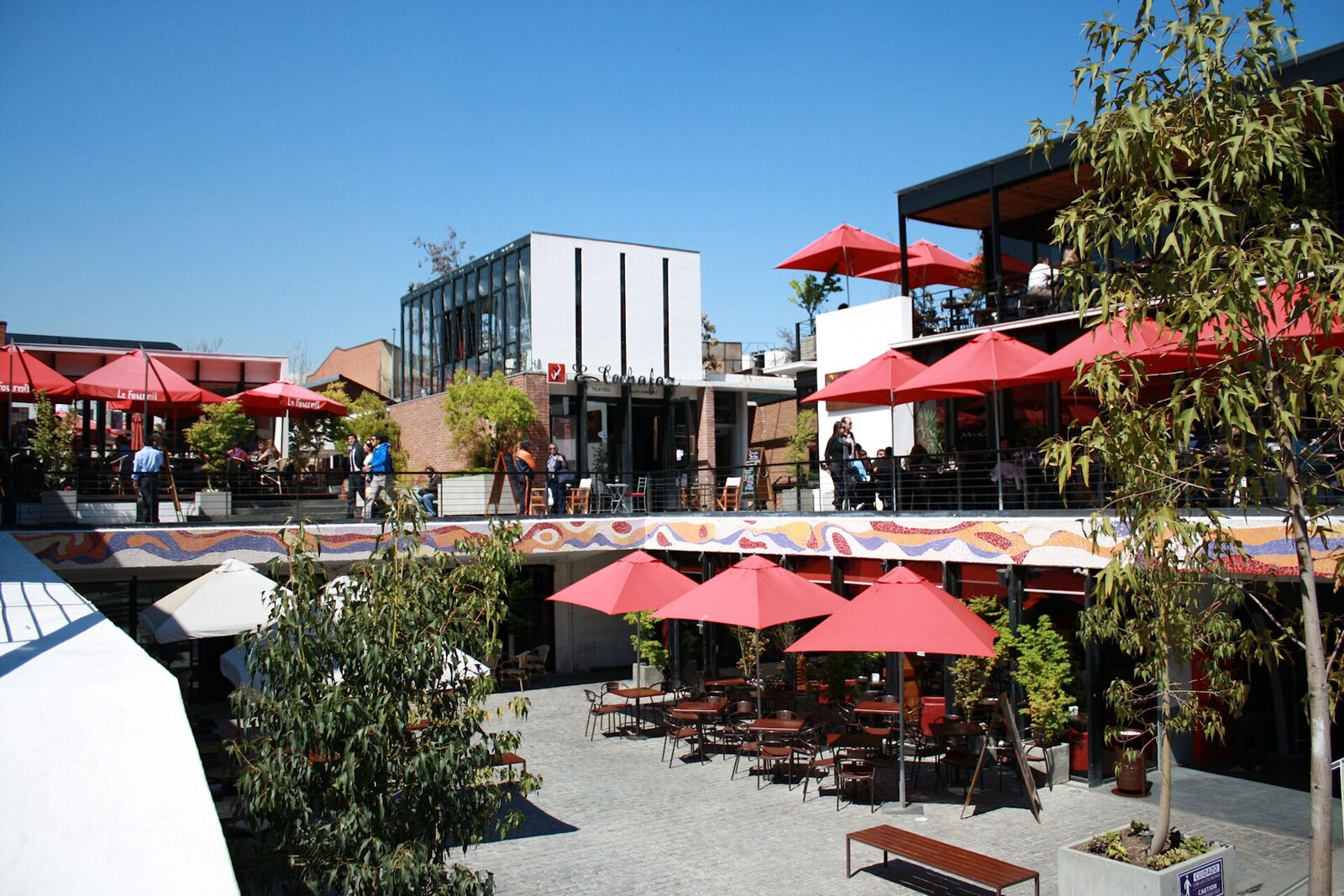
Look around first
What to notice
- Preserved street façades
- Passageways of the former cité
- Inner square
- Old brick walls
The story of the place
Present-day Patio Bellavista occupies a site that Patricio Jadue assembled for an entirely different purpose. Jadue ran the company Salo: it printed albums for collectible stickers, produced cards, and distributed them across Latin America. Its offices, warehouses, and printing shop were located here. In nineteen eighty-seven, the printing business added four neighboring properties to its two holdings. Six separate city plots thus became almost a quarter of a block—enough room for paper, printing presses, and trucks.
Behind the street façades stood early twentieth-century houses, workshops, and a Chilean cité—a row of small dwellings with a shared passageway. Each family had a room, kitchen, bathroom, and tiny courtyard. A large printing press stood in one of the neighboring hangars. By the early two thousands, some of the premises were occupied by auto repair shops, warehouses, and parking lots.
In two thousand, Jadue left Salo and began deciding what to do with the assembled real estate. One option called for demolishing the low houses and building residential towers above a retail floor. Jadue rejected it. In France, he had seen quarters where restaurants, shops, and workshops opened onto a shared square, while architects from the local organization Ciudad Viva proposed opening the inside of the block to pedestrians. In two thousand four and two thousand five, Jadue bought six more plots and commissioned a design for a culinary and cultural center.
Banks considered the venture too risky and gave him no money. Jadue began construction with his own funds. Four months later, he halted the work: the small boulevard around the old cité might not attract enough venues to bring residents from other districts and foreigners here. A month later, Jadue returned to the construction site and chose the more expensive option—to connect the entire site with passageways from Constitución Street to Pío Nono Street and create a square in the middle.
The architects removed the walls between the former properties, reinforced the houses, and restored the cité from nineteen hundred. The fragile structure containing the printing press could not be preserved: its waterlogged adobe walls could collapse. The outer façades and some of the inner brick walls were retained, however, and the new route was laid through the former courtyards and production spaces.
In January two thousand six, Patio Bellavista opened. Five years later, ninety small businesses operated here—restaurants, bars, shops, a bookshop, a theater, and craft workshops. Jadue managed to carry out several more expansions, gradually transferring management to his children.
The printing hangar is no longer here. What remains of it is the layout of the site: entrances in the old continuous façades lead to passageways that converge on the inner square. The word “patio” in the name is literal—restaurant tables and shops have taken over the courtyards of the houses that Jadue added to his printing business over the years.
Useful on site
Patio Bellavista: Sunday through Wednesday until 01:00, Thursday through Saturday until 03:00. Individual restaurants, shops, kitchens, and events may keep different hours.
Checked: July 1, 2026. Check the official source before visiting.You can enter the shared spaces for the architecture without ordering food. Restaurants, shops, and workshops have different rules and opening hours.