 Guide On Map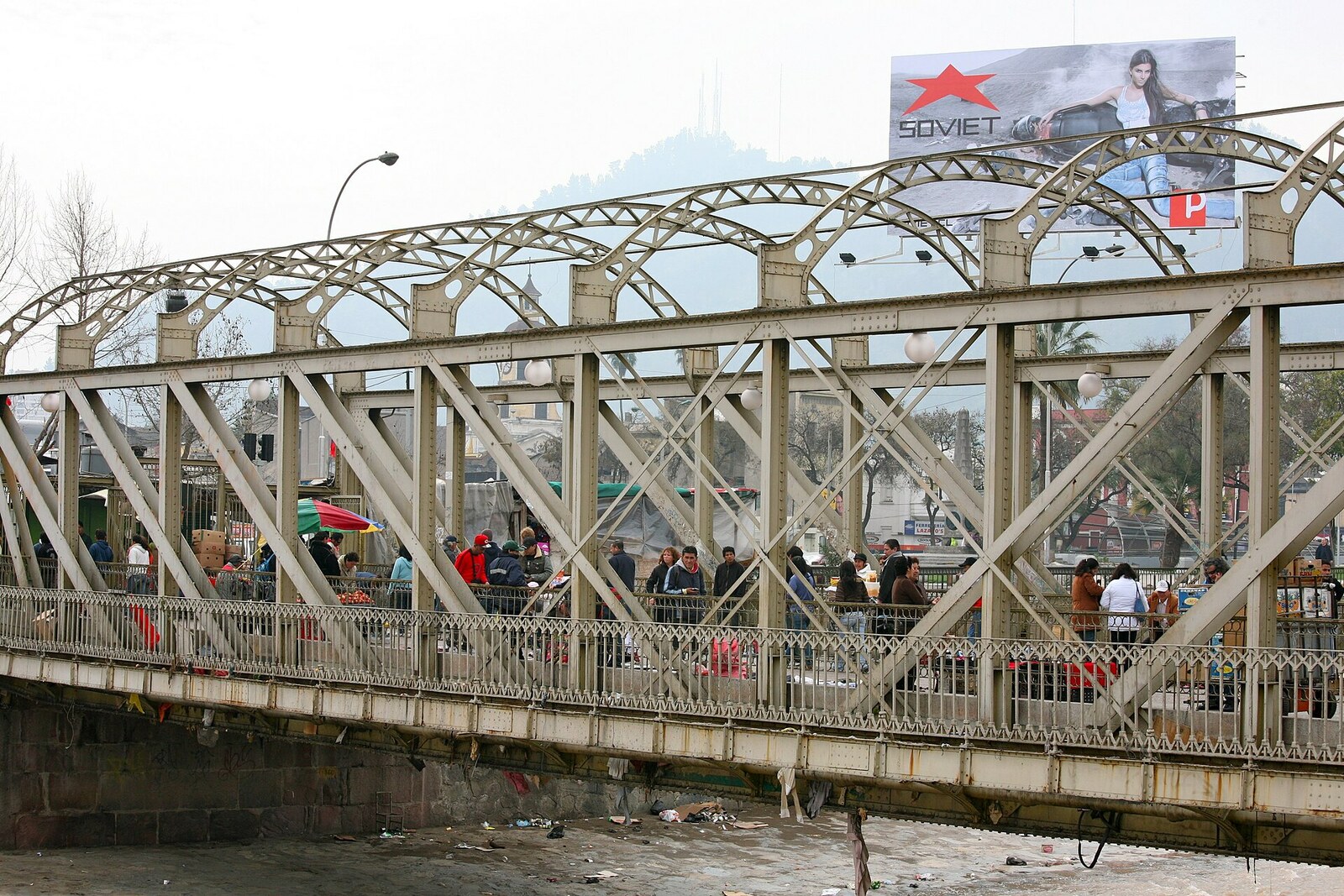
Look around first
What to notice
- The curved facade of the Faculty of Law
- The concrete bridge
- The metal bridge downstream
The story of the place
The current concrete bridge opened in March nineteen eighty-three and took traffic in place of a metal crossing from the end of the nineteenth century. The old span was not sent for scrap: builders laid rails and moved it about one hundred meters west over two weeks. Its metal silhouette is still visible downstream, now under the name of the poet Vicente Huidobro. From the north bank, Pío Nono Street runs through Bellavista to the foot of San Cristóbal Hill.
At the bridge's north end stands the curved facade of the Faculty of Law, University of Chile. On March twenty-third, two thousand, the faculty's proximity turned an ordinary crossing over the Mapocho River into the site of the last student “bridge war.”
In Chile, “mechones” are first-year students. During initiation week, newcomers from the law and engineering faculties faced one another on Pío Nono Street. For the future lawyers, it was home territory: their faculty began immediately beyond the bridge. The engineers came here to defend the honor of their school. A Faculty of Law staff member recalled that the hosts from the north bank usually won.
That time, the engineers arrived in a large group. The participants went beyond the bounds of a conventional clash: students and teachers were injured, and damage totaling three and a half million Chilean pesos was caused to the Faculty of Law building. For first-year students, only just beginning their studies, the ritual of getting to know the university ended in injuries and an investigation. The “bridge war” was not held again after that. A year later, the rector separately reminded the head of the student federation about what had happened and demanded that it not be repeated.
The crossing remained the one where the last clash took place. This concrete bridge opened in March nineteen eighty-three, replacing a metal structure from eighteen ninety-two. The old bridge was not dismantled. Builders laid rails and moved it about one hundred meters west over two weeks. There it was given the name of the poet Vicente Huidobro; later, Cayoja Soto and the Sombrero Verde theater company created a glass-enclosed stage inside it. The metal predecessor of the current Pío Nono Bridge still stands downstream.
The current bridge inherited its name from the street that begins on the north bank and crosses Bellavista to the foot of San Cristóbal Hill. “Pío Nono” means “Pius IX”; the old form of the Spanish word for “ninth” has been preserved here.
The future pope was then called Giovanni Maria Mastai-Ferretti. In eighteen twenty-four, he came to Chile as a young canon and assistant to the papal envoy Giovanni Muzi. The new republic believed that, after separating from Spain, it had inherited the right to nominate candidates for church offices. Rome did not recognize that right. Muzi was to reach an agreement with the Chilean government, and Mastai took part in the first Vatican mission of this kind to independent Spanish America.
The sides did not reach an agreement, and the delegation left without using the powers granted to it. Mastai spent about eight months in Chile, lived with the Dominicans in Recoleta, and saw the papal mission mocked in plays and pamphlets. Twenty-two years later, he was elected pope. He retained his connection with the Chilean Dominicans and sent them gifts; some of them are in their museum and church.
Mastai did not live on the street itself, and the bridge never had a papal residence. The street preserves the memory of his Chilean journey, the bridge took the street's name, and the first metal Pío Nono now stands farther west under a different name.
Useful on site
The city bridge and street are accessible at all times; ease of passage varies because of evening crowds, road conditions, events, and police restrictions.
Checked: July 1, 2026. Check the official source before visiting.Stay where you do not obstruct pedestrians and cyclists. After rain, the current becomes noticeably stronger, but it is not worth approaching the edge for the view.