 Guide On Map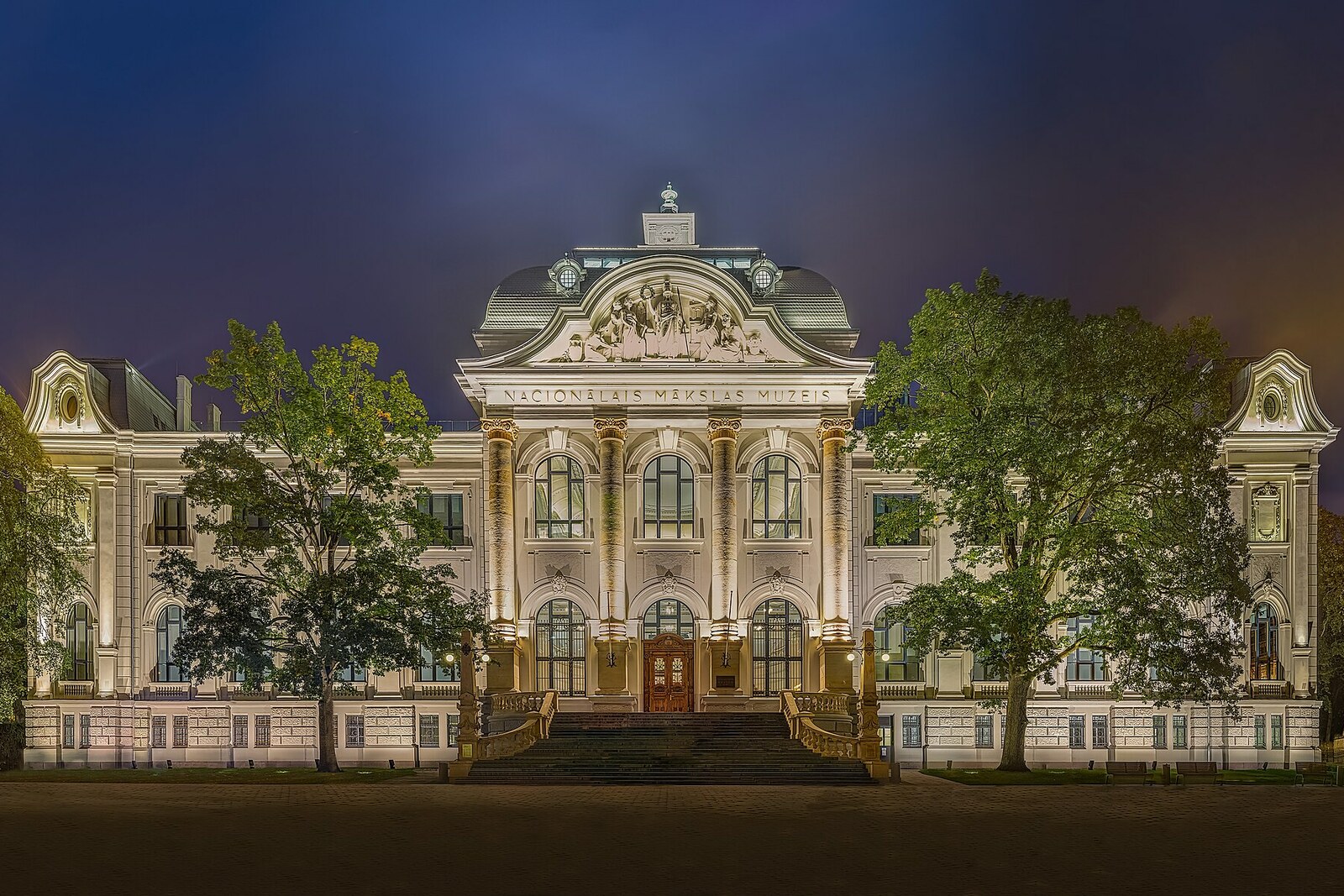
Look around first
What to notice
- Grand facade
- Monumental landscapes in the upper vestibule
- Paintings by Latvian modernists
The story of the place
The grand facade leads into a building that was constructed from the outset for an art museum—the first in the Baltic States. The city gallery brought predominantly Western European paintings here, and the collection later began to seek out works by artists from the Baltic Governorates. Six large landscapes in the upper vestibule remain part of the building itself, while the galleries continue the line of Latvian modernism.
In nineteen nineteen, one Wilhelm replaced another in this building.
The architect and art historian Wilhelm Neumann designed the museum, planned its interiors, and became its first director in nineteen oh five. It was the first building in the Baltic States constructed specifically for an art museum. Neumann received the city gallery's collection, dominated by Western European paintings, and began collecting works by artists from the Baltic Governorates.
Latvian artists had a harder time under him. Before nineteen eighteen, the museum held about sixty exhibitions, but only four solo exhibitions went to Latvian artists. Requests for rooms for their group exhibitions were refused; the Latvian Art Promotion Society complained to the city council.
At the beginning of nineteen nineteen, the Bolshevik government nationalized the museum, removed Neumann, and invited Vilhelms Purvītis to become director—a renowned Latvian landscape painter who wanted to create a full collection of local art. Neumann died soon afterward and never returned to the director's office he had designed. In summer, the Bolshevik government fell, and the museum was handed back to the city, but Purvītis was kept in office.
At first, he had to take in valuables scattered during the years of war and put the damaged building in order. There was not enough money even for heating; employees received part of their wages in lengths of fabric from which clothes could be sewn. Purvītis wrote to the city council that the Latvian department was so poor that it was impossible to explain to a foreign visitor what Latvian painting was.
In the spring of nineteen twenty, the first exhibition of the Riga Group of Artists opened here. The young Romans Suta, Jēkabs Kazaks, and their companions brought Cubist and Expressionist experiments, sharply different from the familiar academic painting. Purvītis warned city officials that if they wanted to acquire the best paintings, they should hurry. The city bought eight works.
The purchase caused a scandal among older-generation artists. Rihards Zariņš, a defender of the academic tradition and Purvītis's former fellow student, accused him of submitting to the modernists. The director's position was indeed ambiguous: Purvītis headed the Latvian Academy of Art while supporting young artists, including his own students, through museum purchases. Every year, he had to ask the minister for permission to hold both positions; formally, no more than five hours a week were allotted to museum work.
He did not reverse the first purchase. Over two decades under Purvītis, the city acquired more than six hundred works—from recognized masters to yesterday's students. He was kept on as director even after reaching the maximum age for the position. The young troublemakers were later called classics of Latvian modernism.
The facade and layout before us were created by Neumann. On the walls of the upper vestibule are six monumental landscapes that he commissioned for the new museum; some were painted by Purvītis before he took the director's office. And the permanent exhibition displays Latvian modernists whom Director Purvītis first bought for the city despite the protests of his old companions.
Useful on site
Check the official LNMM website for interior visits, tickets, exhibitions, and terraces; the exterior is accessible as part of the park.
Checked: June 26, 2026. Check the official source before visiting.The facade and the building's role can be understood without going inside. Plan the permanent collection and the upper vestibule with its landscapes as a separate museum visit.