 Guide On Map
Boulevard Ring: How Riga Became a Capital
From Bastejkalns through Esplanāde to Kronvalda Park
Guide On Map on your phone
Open the walk like a regular app
It takes about 10 seconds to install. No app store needed.
The whole path
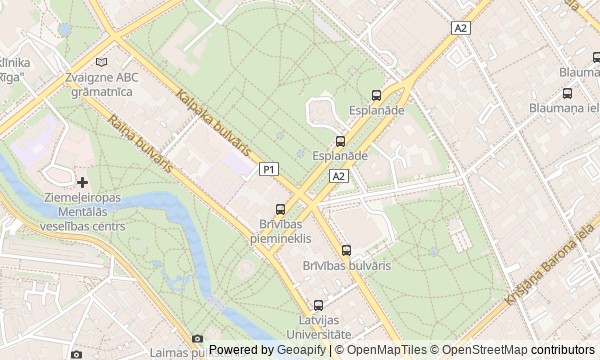
Route map
About the walk
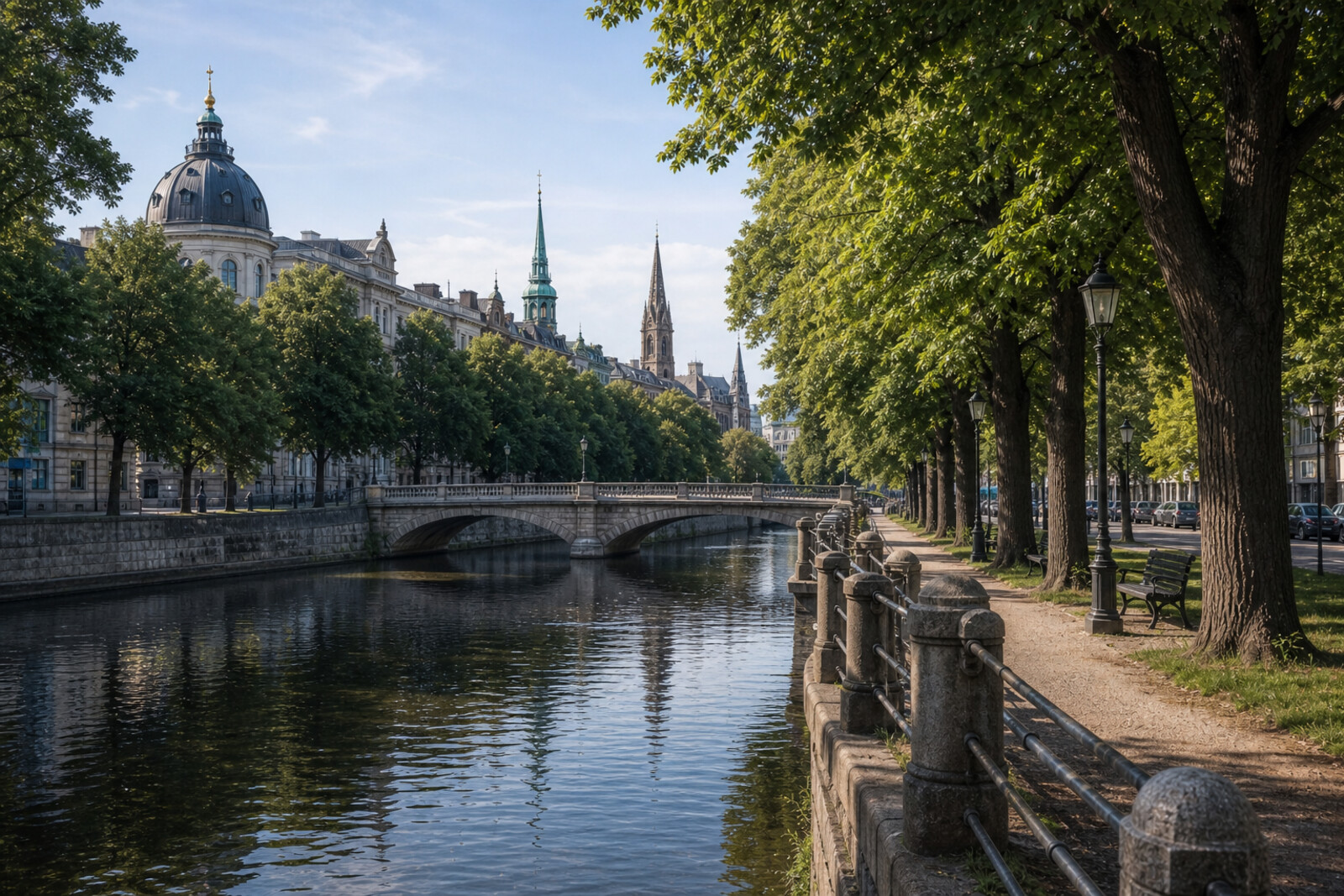
You will walk the green belt between Old Town and the new center: from the former fortress moat to the theatre, the main monument, the museum, and the parks of the boulevard ring. The canal will disappear behind the trees, then return by the bridges; grand facades will give way to lawns and broad avenues.
Behind this calm route lies an argument over who would claim the city stage, the museum walls, the church, and the very right to gather in a square. You will come across split stones by the water, scores hidden beneath a balcony, a floral ribbon with an inscription, and an obelisk paid for by a widow. Why all of this was needed, you will find out in the individual stories.
The story rests on documents, objects, and human decisions. Where an investigation did not establish an answer, it will not invent one. After the walk, you will see Riga’s gardens not as decoration for Old Town, but as the trace of how a fortress fringe became the public center of the Latvian capital.
Why this order
The route follows the line of the former ramparts. The canal first leads from Bastejkalns to the Latvian National Opera: the dismantled fortress gives way to a public theatre. From the stage, the road reaches the Freedom Monument, where the right to speak Latvian continues into the right to gather openly. The northern avenue leads to the museum—from political independence to the choice of art for a national collection. The path then circles Esplanāde and reaches Vērmanes Garden, where the city’s story begins with a private donation. Returning along Elizabetes Street brings you to the cathedral and the community’s struggle for its church and property. From its walls, you step out onto Esplanāde itself and see the scale of the former military parade ground. A final stretch past the museum and along Kalpaka Boulevard leads to Kronvalda Park: after state land came a closed club garden, which also became shared, and the final story is marked by a stone at the origins of Latvian theatre.
Those who have already seen Old Town and want to understand Riga beyond its former ramparts Lovers of urban history told through documents, objects, and human decisions Those who enjoy parks, canals, and major public buildings
Those expecting a walk only through medieval streets Those looking for a detailed look at museum collections and church interiors Those seeking an architectural overview without public conflicts
Before you go
Most of the route is accessible from outside, so you can take the walk without buying tickets. Treat the interiors of the Latvian National Opera, the cathedral, and the Latvian National Museum of Art as a separate plan: access depends on performances, services, exhibitions, and current opening arrangements, which are best checked just before you set out. You will need headphones for the stories, and shoes suitable for unpaved paths and trails made wet by rain in the parks. Ceremonies or city events may take place on Esplanāde and near monuments; do not disturb participants, and if necessary listen to the audio a little farther away.
When to go
2-3 hours
Backup plan
In rain, do not linger on the winding and sloping paths of Bastejkalns: take in the canal and the terrain from firm pavement, then continue along city sidewalks. You can cross Vērmanes Garden, Esplanāde, and Kronvalda Park on straighter paths, shortening the loops within the green spaces. If you cannot enter the Latvian National Opera, the cathedral, or the museum, the route still holds together—all 3 stops have their own exterior story. If you are very tired, finish the walk after the museum; save the final story of Kronvalda Park for a separate visit to the canal.
Route conditions
Surface. Paved — 2.6 km
Facilities. Toilets — 8; drinking water — 2
Elevation. Ascent — 19 m; descent — 19 m
OpenStreetMap extract of June 18, 2026: database data, not a check on the ground. Data © OpenStreetMap contributors, ODbL licence
Walk plan
Open in maps ↗- 1
Bastejkalns
The terrain and the bridge explain why the film crew came under fire and could not cross the canal. - 2
Latvian National Opera
This is where it will be decided how the Latvian troupe gained a stage, state funding, and a national name. - 3
Freedom Monument
The public laying of flowers will show how the monument once again became a place of open civic action. - 4
Latvian National Museum of Art
A museum purchase will show how controversial modernists became recognized classics. - 5
Vērmanes Garden
A private donation explains why the city garden remained open to everyone. - 6
Cathedral of the Nativity of Christ
The archbishop’s basement room will link the return of services with the church’s legal recognition. - 7
Esplanāde
The industrial exhibition explains how the city obtained permission to landscape the edges of the military parade ground. - 8
Kronvalda Park
A memorial stone links a closed club garden to the first Riga performance in the Latvian language.
Route features
Everything you need stays in the browser
Progress, saves and your trip plan are stored on this device.
Add Guide On Map to your home screen so the walk opens outside the browser.
How we handle sources, maps and corrections: our editorial standards