 Guide On Map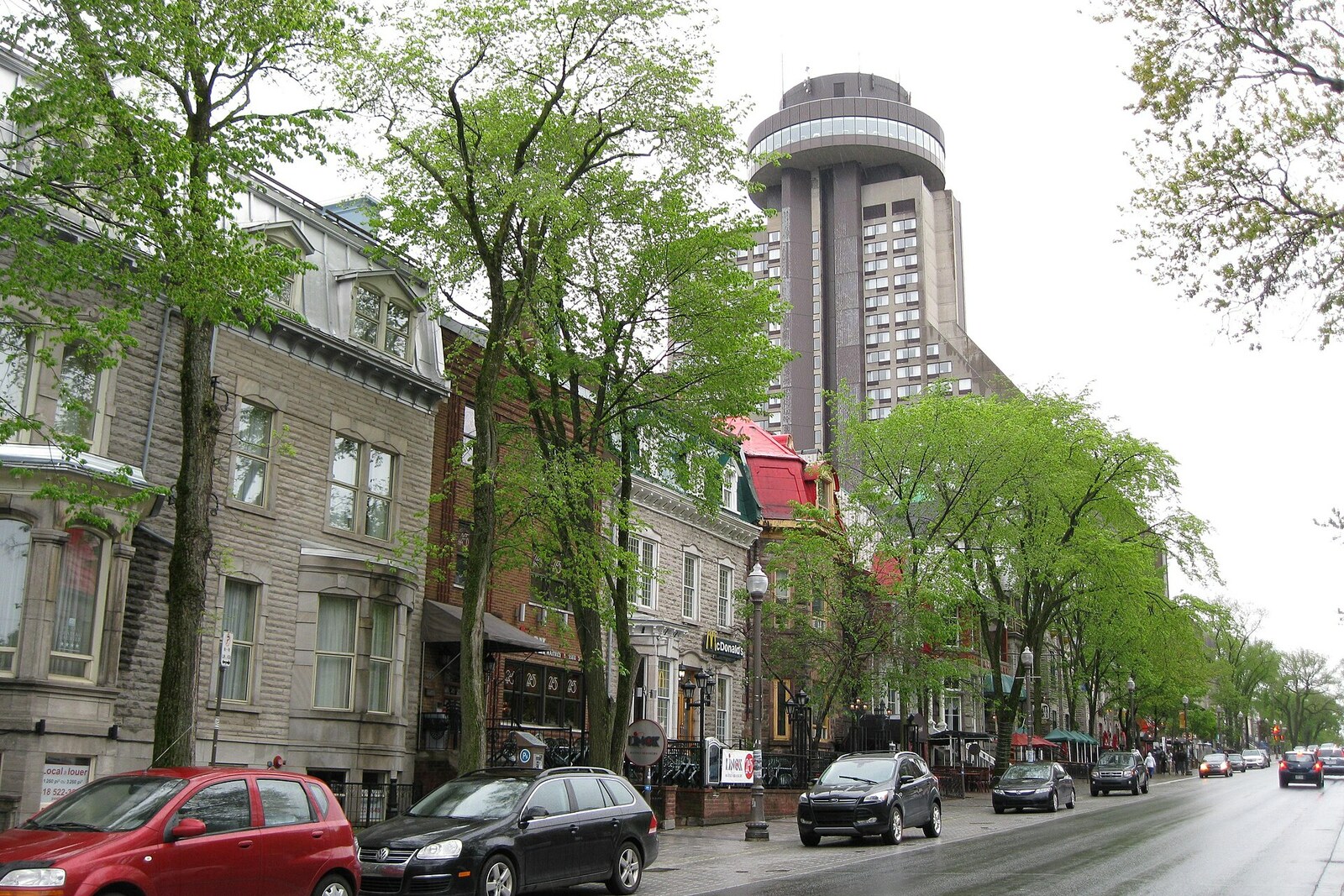
Look around first
What to notice
- Carved porch
- Half-timbered gable
- Semicircular balcony
- Copper roof
The story of the place
Grande Allée stretches west from Old Québec along the route of the old exit road to Sillery and Cap-Rouge. The British garrison long prevented construction on its south side: the open space made it possible to spot an enemy approaching the city walls in time. When the military left, affluent families began settling beside the Parliament Building, and the former defensive clearing became a street of grand houses. Above the later addition by the sidewalk, the wooden patterning of the gable, the semicircular balcony, and the high copper roof are still visible.
A boutique hotel, restaurant, and private cigar club now occupy the former mansion at number five hundred seventy-five. Its carved porch, half-timbered gable, semicircular balcony, and high copper roof remain from Maison William-Price, the home of William Price, an industrialist whose family business was at risk during its construction.
The name Grande Allée appeared long before these houses. In sixteen forty-eight, the Jesuits were already using it for the road from the governor's residence on Cap Diamant to Cap-Rouge and their mission in Sillery. The word “allée” then meant a path or access road; Grande Allée was the long western exit from Québec City.
After the British conquest, the military kept the land on the road's south side undeveloped so that an enemy could not approach the city walls unnoticed. In eighteen seventy-one, the garrison left Québec City. Provincial officials acquired the former cricket field for the Parliament Building, federal officials began selling neighboring lots, and affluent families began building homes beside the new parliamentary district.
In nineteen oh one, thirty-four-year-old William Price settled here as the new head of the family timber and pulp-and-paper company. He had worked there since eighteen eighty-five and took over the enterprise in poor condition: its assets were valued at nearly one million dollars, but losses had been accumulating for several years, and the firm faced bankruptcy. Price had to save the business on which the family's prosperity rested.
At the same time, he spent twenty-five thousand dollars building this house. On Grande Allée, a facade served as a public sign of its owner's standing: people from the owner's circle were received here, dinners were held, and business conversations took place. Price commissioned a home that conveyed the solidity of the family enterprise at a moment when that solidity still had to be achieved.
By nineteen oh five, the company was profitable again—more than one million dollars a year—and Price had become its principal shareholder. The expensive house did not have to be surrendered to creditors; the family kept it until nineteen thirty-seven.
Then private Club Renaissance occupied the private residence, where Québec's conservative elite gathered. In nineteen seventy-three, entrepreneurs bought the mansion and installed bars, restaurants, and discos in it. A fire in nineteen eighty-eight closed these establishments and left the house empty for several years. A development company and city officials disputed its conversion; after a lawsuit, they reached an agreement and invested three million four hundred thousand dollars in its restoration. Architect Pierre Martin preserved the historic facade, and commercial premises appeared by the sidewalk.
The new owners remodeled the interior again in two thousand twenty-two. Above the later addition, the gable, balcony, and copper roof of the house that Price began building while his company was approaching bankruptcy are still visible; the rooms behind them are now rented to guests.
Useful on site
The street is open around the clock; the hours of restaurants, terraces, and private establishments change by season and are not needed to follow the route.
Checked: June 30, 2026. Check the official source before visiting.View the facades from public space and remember that many buildings are still in use. Garneau-Meredith House and Maison William-Price are more important to see as parts of the district as a whole.