 Guide On Map
Québec City: Parliament Quarter and the Plains of Abraham
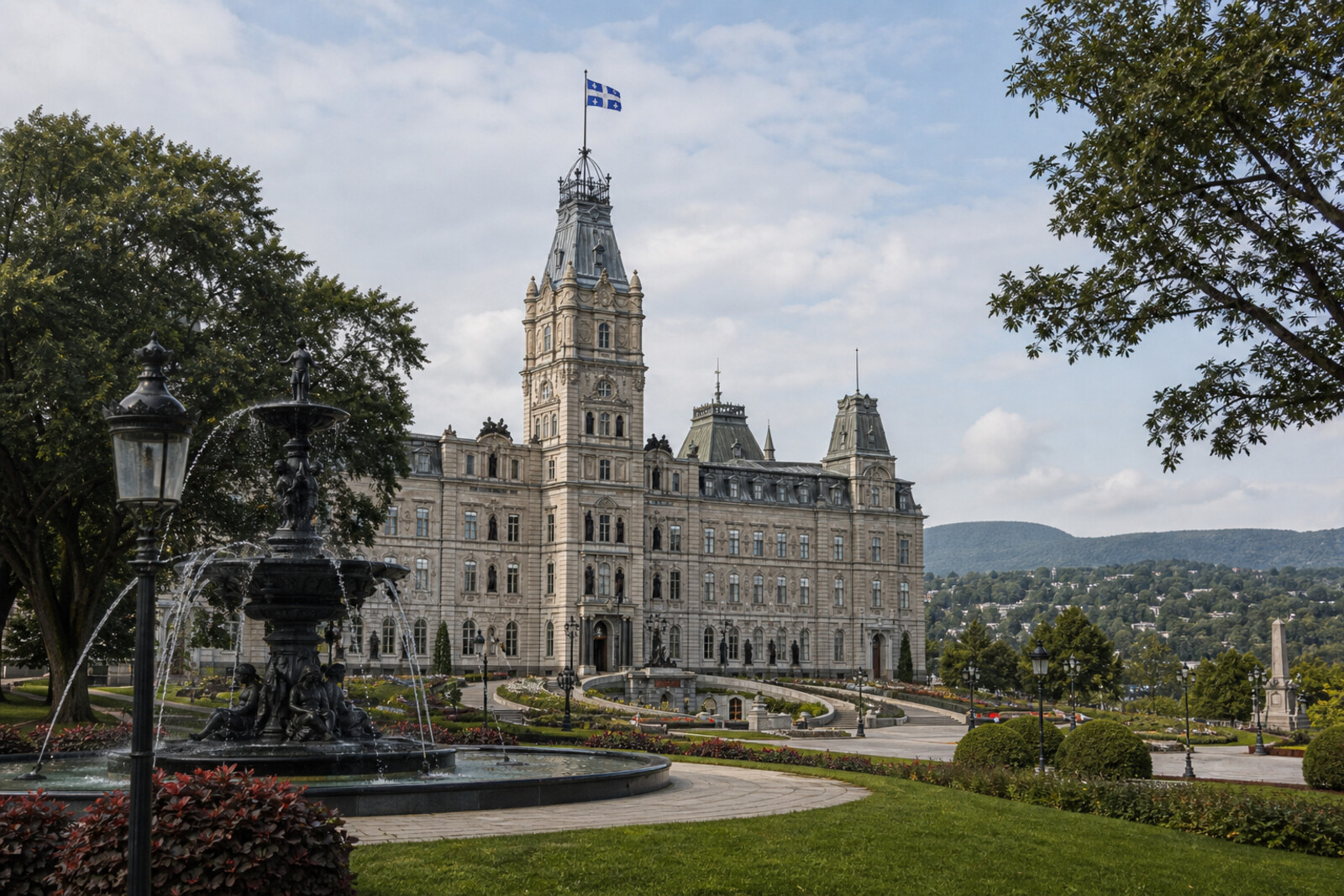
From Fontaine de Tourny through Parliament Building and the Plains of Abraham to the National Museum of Fine Arts of Québec
Guide On Map on your phone
Open the walk like a regular app
It takes about 10 seconds to install. No app store needed.
The whole path
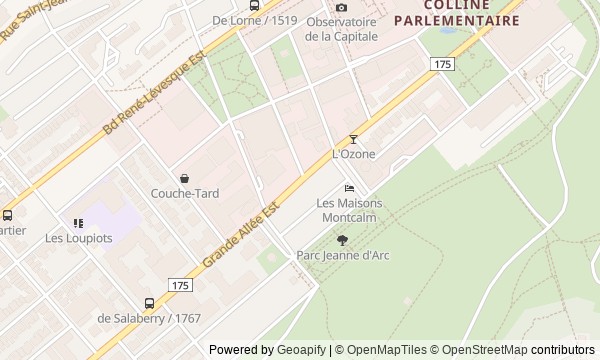
Route map
About the walk
You will begin at the fountain in front of Parliament Building and pass through the government quarter toward Grande Allée. Then the city facades will fall behind, and the road will continue across the Plains of Abraham—to a tower on the slope and the National Museum of Fine Arts of Québec.
This is not a walk through the postcard views of Old Québec. It follows places where public memory was assembled, remade, and sometimes saved at the last moment.
Why did a monument have to change its height? What survived behind a closed fire door? Why was one wall of a tower made thinner than the other? The story will lead you through small mismatches like these—calmly, without ceremonial speeches or answers handed out in advance.
By the end, you will see how Québec City connects power, military memory, and art: not through one grand legend, but through a fountain, a panel, a soot-blackened forge, a thin wall, and a painting returned from a Parisian life cut short.
Why this order
The fountain will raise the first question: how does an imported object become part of a capital? Parliament Building opposite will immediately show the public setting chosen for it. The Promenade des Premiers-Ministres continues the conversation, no longer about the building of power but about the way memory of those who held it is arranged beside it. From a bronze figure, the route reaches the Voltigeurs de Québec Armoury: personal monuments give way to the memory of a regiment and a saved collection. Grande Allée adds a private industrialist's house to the state and military facades; a short return to the armoury then takes you from a residential street into a former military building that became the Plains of Abraham Museum. After the museum's account of the area's name, you will enter the park itself and see a real defensive structure. From Martello Tower 1, the former military line leads farther west to the National Museum of Fine Arts of Québec, where the route ends with another form of public recognition.
Those interested in the history of power without a list of rulers Those who enjoy the fates of buildings and objects Those who want to combine a city quarter with a walk in the park
Those looking only for the Old Québec and its fortification gates Those who need a route without difficult historical episodes Those who do not like retracing a short section of the route
Before you go
Decide in advance whether you want to keep to an outdoor walk or go inside Parliament Building, the Plains of Abraham Museum, Martello Tower 1, and the National Museum of Fine Arts of Québec: each visit noticeably changes the pace. Access to historic and government buildings cannot be taken for granted, so check with the venues themselves and arrange a separate visit where required. Pay particular attention to the museum complex at the final stop: the Riopelle Pavilion is scheduled to open in October 2026, and plans and accessible spaces may change. Comfortable shoes and weather-appropriate clothing will help for the park section, where much of the story unfolds outdoors.
When to go
Follow the route in one direction, allowing more time for the Parliament Building facade, the armoury, and the museum finale: that is where the details are especially dense. One extended outing is enough for an outdoor-only walk; count an interior visit to even one venue as a separate part of the program. Daylight makes the sculpture and architecture easier to examine, while Grande Allée is worth catching closer to evening, when its present-day public life becomes more apparent.
Backup plan
If the interiors are unavailable, do not cancel the walk: the fountain, the parliamentary sculpture, the panels of premiers, the restored armoury, the facades of Grande Allée, and the tower's outer form make a complete story on their own. At the Plains of Abraham Museum, focus on the building's former military purpose and the battlefield landscape itself. At the National Museum of Fine Arts of Québec, compare pavilions from different eras and the former prison with the open park around it. In bad weather, shorten the slow reading of panels and the park section, and spend the time instead in whichever museum you have been able to confirm access to in advance.
Route conditions
Surface. Paved — 2.3 km (data covers 84% of the route)
Facilities. Toilets — 2; drinking water — 5
Elevation. Ascent — 46 m; descent — 31 m
OpenStreetMap extract of July 9, 2026: database data, not a check on the ground. Data © OpenStreetMap contributors, ODbL licence
Walk plan
Open in maps ↗- 1
Fontaine de Tourny
This is where the story begins of how a dismantled urban object found a new place in front of Québec City's main political facade. - 2
Parliament Building
This stop presents the parliament not only as a place where laws are passed, but also as a space for personal decisions in moments of attack. - 3
Promenade des Premiers-Ministres
Here you will see how an official memorial was altered after its design collided with the everyday life of the street. - 4
Voltigeurs de Québec Armoury
This stop is here for the story of what was carried out of the fire and why one closed door decided the archive's fate. - 5
Grande Allée
A private mansion adds to the government facades the story of a family building an expensive home at a dangerous moment for its business. - 6
Plains of Abraham Museum
Here, the name of a famous landscape will connect with several former functions of a single military building. - 7
Martello Tower 1
The tower will turn the museum’s discussion of war into an examination of a specific decision made without the authorities’ permission. - 8
National Museum of Fine Arts of Québec
The finale will show how a museum exhibition gave a rejected artist public recognition and changed his standing in his homeland.
Route features
Everything you need stays in the browser
Progress, saves and your trip plan are stored on this device.
Add Guide On Map to your home screen so the walk opens outside the browser.
How we handle sources, maps and corrections: our editorial standards