 Guide On Map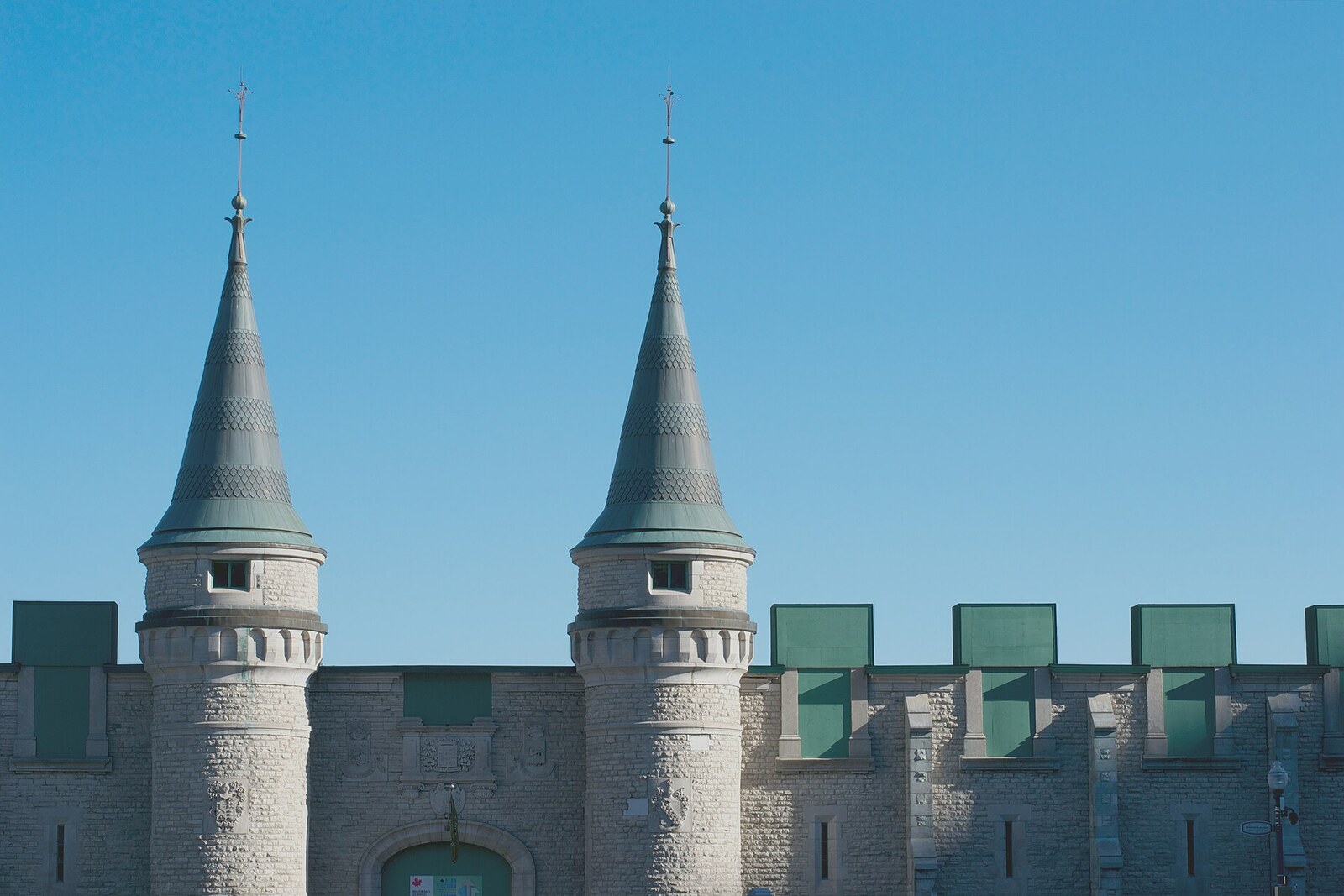
Look around first
What to notice
- Central stone portal
- Two turrets
- Steep roof
- Place George-V
The story of the place
In local military terminology, a manège was a covered space for drill training. The Canadian government commissioned its construction for the Voltigeurs de Québec, a reserve light-infantry regiment founded in eighteen sixty-two. Under the steep roof, reservists trained and gathered, parades were held, and documents and regimental relics were stored. The stone portal with two turrets by Place George-V was preserved during reconstruction, and the large hall now once again serves the regiment and hosts public events.
On April fourth, two thousand eight, Raymond Falardeau, the curator of the regimental museum, was leaving here after a workday. The building was under renovation, and before leaving he carefully closed the fire doors. An hour later, a fire began in the attic above the main hall. The investigation established the cause: a portable halogen lamp had been improperly used during the installation of automatic sprinklers.
Falardeau was told about the fire at around ten p.m. The wooden roof structures were already burning, and it was impossible to enter. Only after firefighters had contained the flames did they give the curator protective gear and allow him into the museum wing. There were about fifteen centimeters of water on the floor. Behind the doors he had closed before leaving, the archive room had survived.
Falardeau, firefighters, military personnel, and museum volunteers carried out forty-three boxes—more than sixteen thousand pages of documents, some dating from the early nineteenth century. They then recovered the regimental banner associated with the Voltigeurs de Québec's first campaign in eighteen eighty-five. After leaving the burned-out building, Falardeau unfurled it before the volunteers and soldiers, who had considered the collection lost. By then, Falardeau had begun a thirty-five-hour shift without sleep.
In the end, the entire archive and about ninety percent of the museum objects were saved. The fire destroyed the exhibition spaces, storage areas, and nearly the entire main hall. The regiment had to move to another building for ten years.
The Voltigeurs de Québec are a reserve light-infantry regiment founded in eighteen sixty-two; they are the oldest active French-Canadian regiment. Historically, the word “voltigeurs” referred to light riflemen. The Canadian government commissioned this armoury for them, and it was completed in eighteen eighty-seven. In local military usage, an armoury is a covered drill hall: reservists gathered and trained here, held parades, and stored the archive and regimental relics. This is why the building bears the regiment's name rather than that of an architect or a battle.
After the fire, the central stone portal and the two turrets beside it remained standing from the front section. They were preserved during the reconstruction; the restored armoury opened in two thousand eighteen. The Voltigeurs de Québec returned their administrative and ceremonial spaces here, while the main hall is now rented out for public and cultural events.
The regimental collection holds another object from that night: a bugle presented to the Voltigeurs de Québec by the city in eighteen sixty-six in recognition of services rendered. When a fire was spotted in Québec City, this bugle was used to summon soldiers to help fight it. In two thousand eight, the bugle was carried out of the burning armoury. Its soot marks were left in place.
Useful on site
Exterior viewing is available from the city side. Interior spaces open according to the schedules of events, rentals, and individual programs; no permanent unrestricted access is intended.
Checked: June 30, 2026. Check the official source before visiting.The façade can be fully appreciated from the street. The large hall is used for events, so you need to check separately whether it is possible to enter, without counting on unrestricted access.