 Guide On Map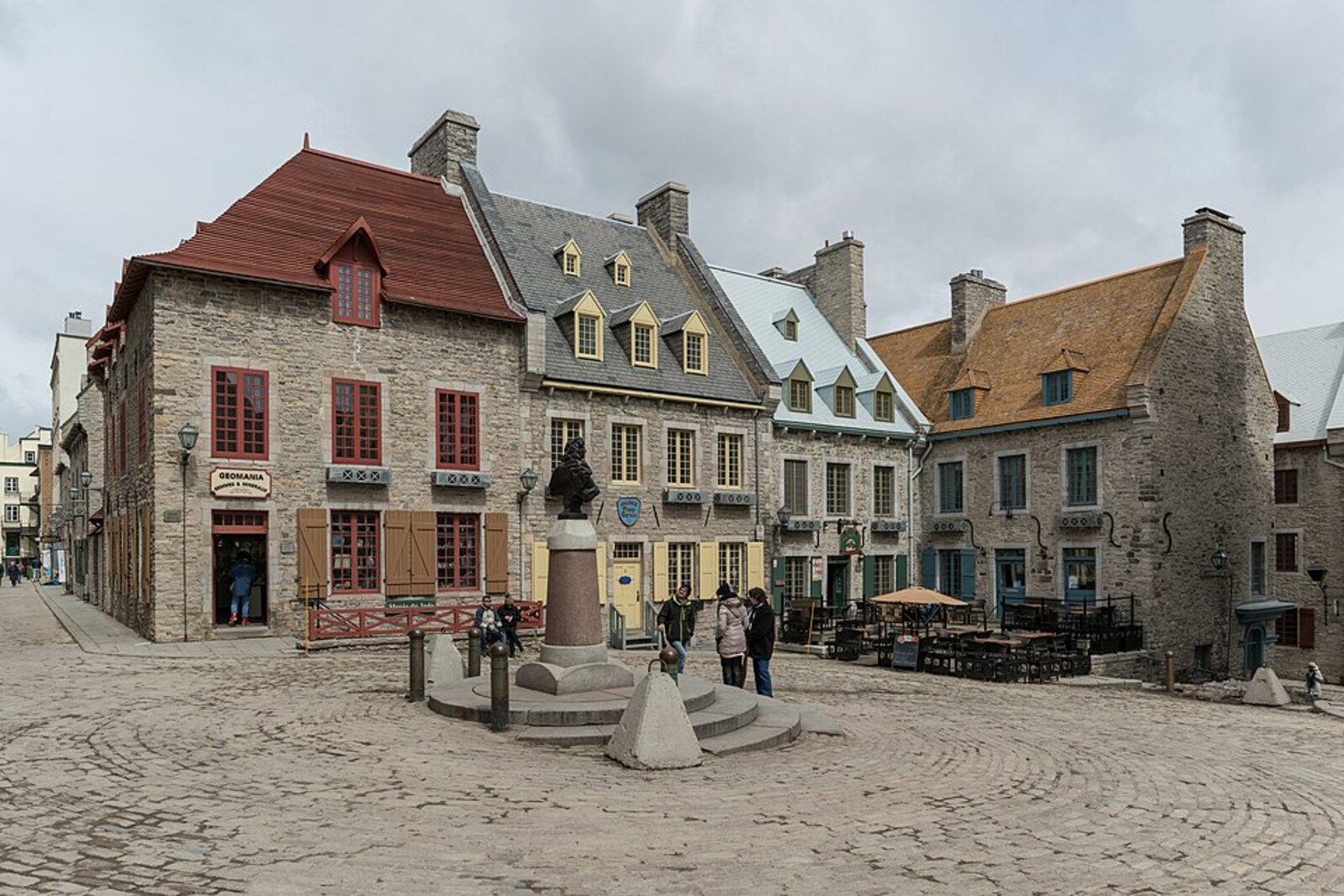
Look around first
What to notice
- Bronze bust of Louis XIV
- Stone houses
- Pedestal
- The open space of the square
The story of the place
A bronze bust of the French king Louis XIV stands in the middle of Place Royale. The first bust at this site remained there for about fourteen years: merchants succeeded in having it removed.
Until sixteen eighty-six, this was Market Square. The port of Lower Town stood nearby, so goods were brought here by water and then delivered to the shops. Trading took place in the square every week, a town crier announced news, and officials posted orders. The open space in front of the houses brought the local merchants a quite literal income.
In sixteen eighty-six, Jean Bochart de Champigny arrived in Quebec City. He became intendant of New France—a royal official responsible for the courts, civil administration, and finances. Champigny brought a bronze copy of a portrait of Louis XIV from France. The king wanted the colony to have a square in his honor, and Champigny intended to show the inhabitants the face of the monarch in whose name they were governed.
The bust was raised on a pedestal in the middle of the market. After that, the square came to be called Place Royale—Royal Square. The royal design quite literally hindered the merchants. Carts carrying goods had to go around the pedestal, and there was less space for unloading. In a letter of October fifteenth, seventeen hundred, Champigny himself reported that the inhabitants had complained many times: the square, occupied by the bust, had become almost useless for transport.
After these complaints, the bust was moved to the Intendant's Palace. The merchants regained access to their shops, and Louis never returned to the square. What became of the first sculpture is unknown. Champigny may have taken it to France when he left the colony in seventeen hundred two; it may have been destroyed in the fire at the Intendant's Palace in seventeen hundred thirteen. The documents do not allow one version to be chosen.
Without the bust, the name Place Royale also fell out of use. In the eighteenth and nineteenth centuries, it was again called Market Square or Lower Town Square. In eighteen ninety, the historian-archivist Pierre-Georges Roy, who was studying the records of the Sovereign Council of New France, found an entry about the royal monument and published this story.
The Government of France gave Quebec City a new bronze bust, and in nineteen thirty-one it was placed on the site of the former one. A few years later, the city officially confirmed the name Place Royale. The present Louis is a later copy. Nothing remains here of the bust that gave the square its name and obstructed the merchants' carts.
Useful on site
An open city square. Access is free, but in summer and during events the place quickly fills with tour groups and café visitors.
Checked: June 29, 2026. Check the official source before visiting.Do not look for all of the early history on the surface: the foundations of Habitation de Québec lie below the modern level, and the visible unity of the quarter was created largely through restoration.