 Guide On Map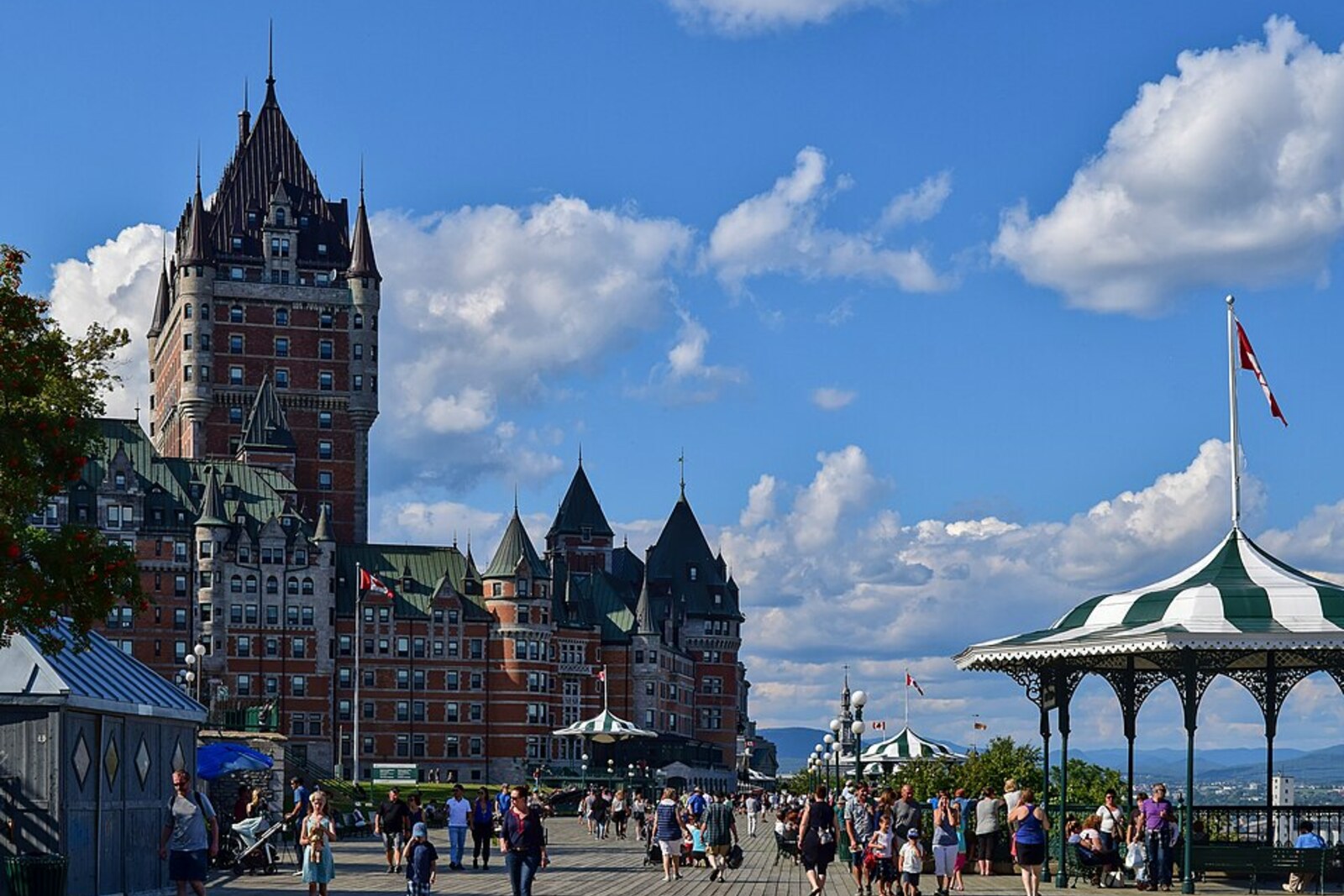
Look around first
What to notice
- Wooden boardwalk
- Green-and-white pavilions
- Iron railing
- St. Lawrence River
The story of the place
The green-and-white painted pavilions and the iron railing shape the edge of the cliff into a long urban promenade above the St. Lawrence River. Today’s line grew from a short platform and then stretched toward the citadel along the preserved fortress walls. The six pavilions were not installed for decoration: five opened views of the river, while the sixth was intended for music. The railing’s pattern on the new section was repeated from the old model, so the terrace looks unified even though it was built in stages.
The wooden boardwalk runs along the edge of Cape Diamond for about four hundred thirty meters. People stroll along it; street performers appear here in summer, and a toboggan slide operates nearby in winter. The site was opened for public access after the fire of eighteen thirty-four destroyed Château Saint-Louis, which stood here—a residence of the colonial governors with a closed walking platform above the river.
Four years later, Governor John Lambton, Lord Durham, ordered a public terrace built on the ruins. It was given his name—Durham Terrace—and occupied only fifty meters along the cliff. The earthen platform soon had to be covered with boards: so many people came here that in eighteen fifty-four the boardwalk was extended to eighty-five meters.
Another seventeen years later, the British garrison left Quebec City. The old walls and narrow gates no longer protected the city, but they did obstruct carts, trade, and the growth of new neighborhoods. City engineer Charles Baillairgé was paid precisely to carry out this kind of modernization—roads, water supply, sewers, and public buildings. Under him, the fortifications began to be dismantled. At the same time, Baillairgé proposed extending the popular Durham Terrace: residents wanted to get rid of the military barriers, but had no intention of losing the walking platform.
In eighteen seventy-two, Canada’s new governor general, the diplomat Frederick Blackwood, Lord Dufferin, arrived in Quebec City. He sought to halt the demolition. A simple ban was not enough: the narrow passages really did slow traffic, and Dufferin was an appointed representative of the Crown and could not dictate indefinitely to the city how to lay out its streets. So he proposed replacing the narrow gates with broad arches, preserving the walls, and laying a pedestrian route along them. For the project, he invited an Irish specialist in old fortresses.
Dufferin first disagreed with Baillairgé over dismantling the fortifications, then supported his plan for this very boardwalk. The engineer had the opportunity to carry out a prestigious project instead of his usual sewers and fire stations. The terrace was to be extended about another three hundred meters toward the Citadelle of Québec, the old iron railing was to be retained and repeated along the new section, and six pavilions were to be placed along the edge—five for viewing and one for music.
Dufferin’s term ended in eighteen seventy-eight. His last public act in Canada was laying the terrace’s first stone. He then left to continue his diplomatic career and did not stay to see the opening. Baillairgé brought construction to completion, and in the summer of the following year the city’s residents received a walking boardwalk four hundred thirty meters long. Durham’s former name was replaced by Dufferin’s.
The green-and-white iron pavilions remain from Baillairgé’s project, and the railing’s pattern repeats that of the short Durham Terrace. Dufferin saw only the beginning of the work; his name was given to the completed walking platform.
Useful on site
An open municipal terrace. The crypt of Fort Saint-Louis and Château Saint-Louis beneath the boardwalk is a separate seasonal site: in 2026, Parks Canada lists May 16–October 12 daily and October 13–25 from Wednesday through Sunday, 9:30–17:00.
Checked: June 29, 2026. Check the official source before visiting.The main account unfolds on the surface. The archaeological site beneath the boardwalk is visited separately; it is best to check its availability in advance.