 Guide On Map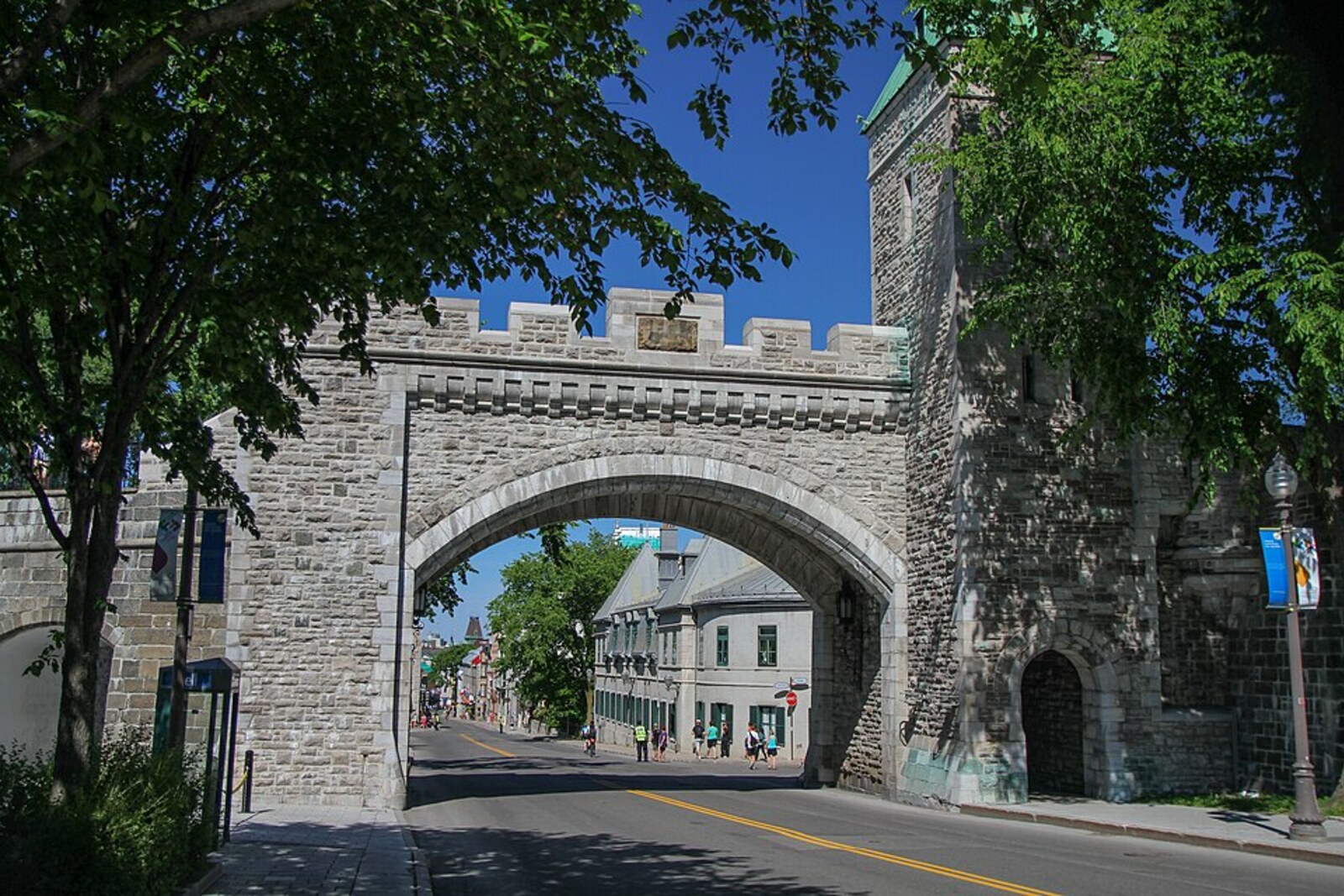
Look around first
What to notice
- Wide carriage arch
- Decorative turrets
- Stone wall
- Path above the gate
The story of the place
On the morning of September thirteenth, seventeen fifty-nine, Louis-Joseph de Montcalm returned to Saint-Louis Gate on horseback with the retreating soldiers. He commanded the French regular troops in Canada and was meant to prevent the capture of Québec City. Only a few steps remained to the city wall when Montcalm was mortally wounded.
A few hours earlier, British soldiers under General James Wolfe had climbed the slope west of the city and formed up on the Plains of Abraham. Montcalm hurried there from the camp at Beauport. He feared that the British would have time to dig in and bring up artillery. Colonel Louis-Antoine de Bougainville was leading reinforcements from the west that could have struck the British in the rear, but Montcalm decided not to wait for them.
About four and a half thousand men went into the attack. Some regular soldiers ran in from Beauport and barely had time to catch their breath; inexperienced militiamen had been added to the battalions shortly before the battle. The formation broke apart while still approaching. The British infantry let the attackers come closer, fired coordinated volleys, and moved forward. The French units ran toward the wall. Canadian militiamen, firing from the flanks from behind cover, forced the pursuers to stop and gave the retreating men time to reach the city.
Montcalm rode behind his soldiers and tried to rally them. At the very entrance to the gate, a shot caught him. The wounded man was carried inside; he died the following morning. Bougainville reached the field when the battle had already ended. Five days later, the garrison command surrendered Québec City to the British.
At that time, narrow real fort gates stood here. Guards checked those passing through, the leaves were locked at night, and during a siege an additional fortification was built in front of the entrance. The western road passed through this opening, so after the defeat the entire mass of retreating men had to enter the city here.
The gate's name predates Montcalm. It took its name from Saint-Louis Street. The official version links the street's name to the French king Louis XIII; researchers of urban place names suggest another chain: the street was named after Fort Saint-Louis, and Samuel de Champlain dedicated that fort to the canonized king Louis IX. The dispute over which Louis is concealed in the name has not yet been settled.
The arch through which Montcalm was carried was dismantled in eighteen seventy-one: after the British garrison left, residents were getting rid of narrow passages that held up traffic. Construction of the present gate began on the same site seven years later. It was given a wide carriage arch and decorative medieval turrets, and some of the old stone was reused. Montcalm's arch disappeared. What remained was the line of the wall and the same passage that he almost managed to reach.
Useful on site
The exterior passage is always open. The top of the wall and associated tour spaces depend on the season and the park service's schedule.
Checked: June 30, 2026. Check the official source before visiting.Compare the scale of the gate with the flow of modern traffic, and cross the street only at the marked crossing. Old stones do not mean that the entire composition dates from the era of sieges.