 Guide On Map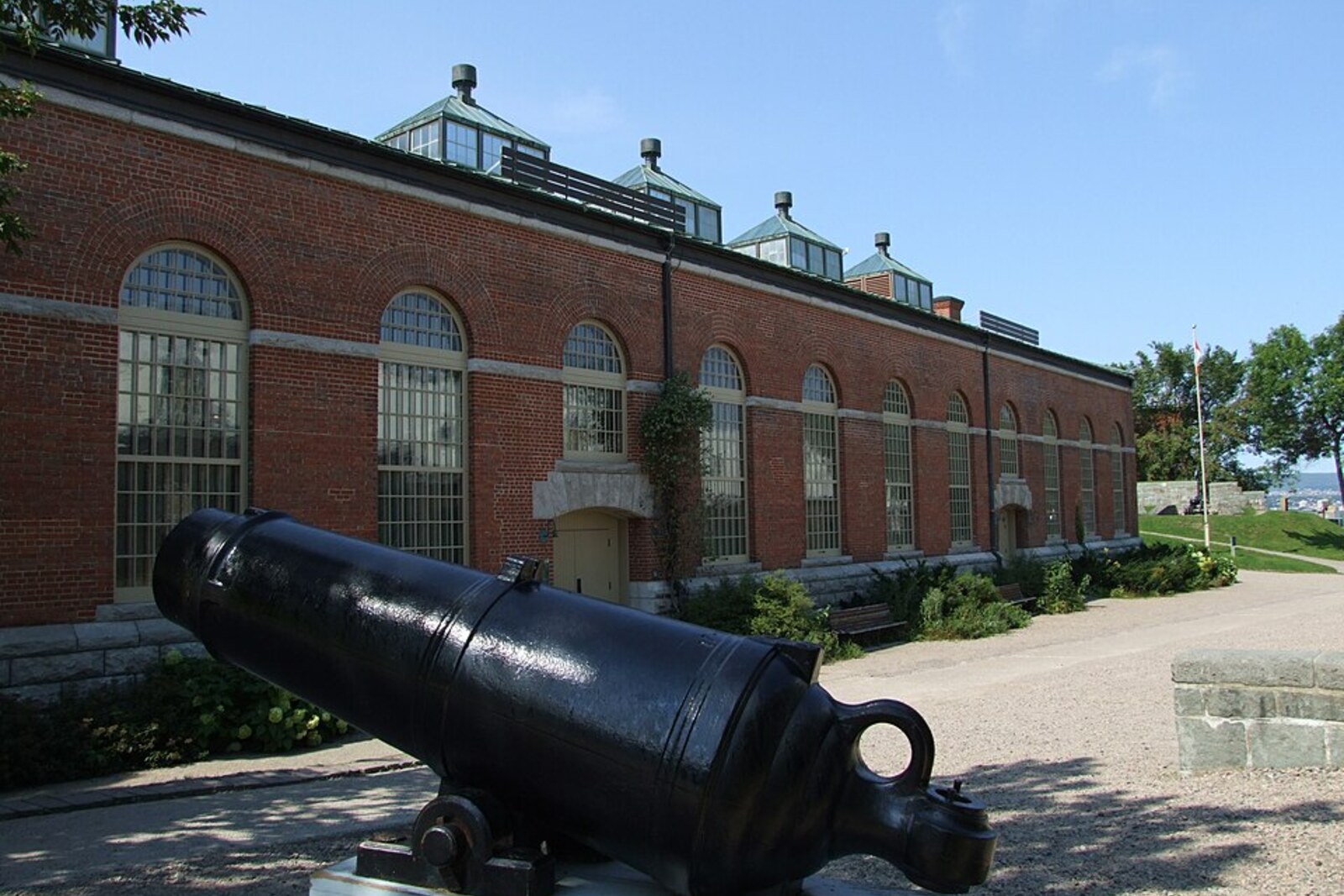
Look around first
What to notice
- French redoubt
- Stone buttresses
- Foundry building
- Officers' house
The story of the place
A century after the British garrison left, restorers nearly built part of a fortress here that had never existed.
In nineteen seventy-two, the Canadian government created Artillery Park. The name remained from the Royal Regiment of Canadian Artillery, which was stationed here from seventeen eighty-four to eighteen seventy-one. The artillerymen occupied this corner of the fortifications because from here they could watch both the open plateau west of the city and the Saint-Charles River, along which an enemy could bring a landing force. Around the parade ground, they set up barracks, arms rooms, a powder magazine, workshops, and sheds for gun carriages.
When Parks Canada specialists began saving the deteriorating buildings, work was already underway: walls were being shored up, concrete was being inserted into the stone masonry, and the fortifications were being anchored to the rock. The project of nineteen seventy-four proposed restoring the complex to a coherent eighteenth-century French appearance. To achieve this, they planned to demolish the industrial facades of the New Barracks, which had appeared at the turn of the nineteenth and twentieth centuries. The old redoubt was to be cleared of some later alterations and supplemented with a stone projection that a French engineer had left only in drawings from seventeen twelve.
Historian Marc Lafrance joined Louis Richer's team to verify such decisions against archival plans, estimates, and reports. This was how he earned a living: builders needed his department to establish what had actually stood here in different years. But historians could have been left in the role of suppliers of dates for a project that was already complete. Lafrance and his colleagues demanded the right to take part in choosing what would be preserved and what would be destroyed.
They regarded the industrial additions as just as much evidence of the past as the French masonry. After the British military left, the government housed a cartridge factory in the barracks. Later it became the Dominion Arsenal: the parade ground was occupied by a machine shop, while a foundry and rolling works appeared nearby. By removing these facades, restorers would have erased the explanation for why a factory building stands beside the barracks and why machinery for manufacturing munitions is still inside.
The historians' arguments changed the project. In nineteen seventy-six, the new concept required preserving traces of every period. Lafrance and his colleagues then secured the abandonment of the full stone projection: visitors were to be shown the engineer's idea in a model, rather than have a modern construction passed off as old. The remains of the unfinished structure uncovered by archaeologists were protected and left in place.
The restoration still proved controversial. After it was completed in nineteen eighty-one, even participants in the project acknowledged that the new materials were difficult to distinguish from the old ones in places. A museum complex now operates here: the French redoubt, British stone buttresses, the officers' house, and the Arsenal foundry have survived. There is no full projection at the redoubt—neither the eighteenth-century French engineers nor the twentieth-century Canadian restorers completed it.
Useful on site
In 2026, Artillery Park is open from June 19 to September 7, daily from 9:30 to 17:00. Tours and languages vary by schedule; outside the season, the courtyard and buildings may be inaccessible.
Checked: June 30, 2026. Check the official source before visiting.Even without entering the buildings, spend some time in the courtyard and take in the length of the complex. Museum rooms may not always be accessible; treat closed doors and service areas as the boundary of an exterior visit.