 Guide On Map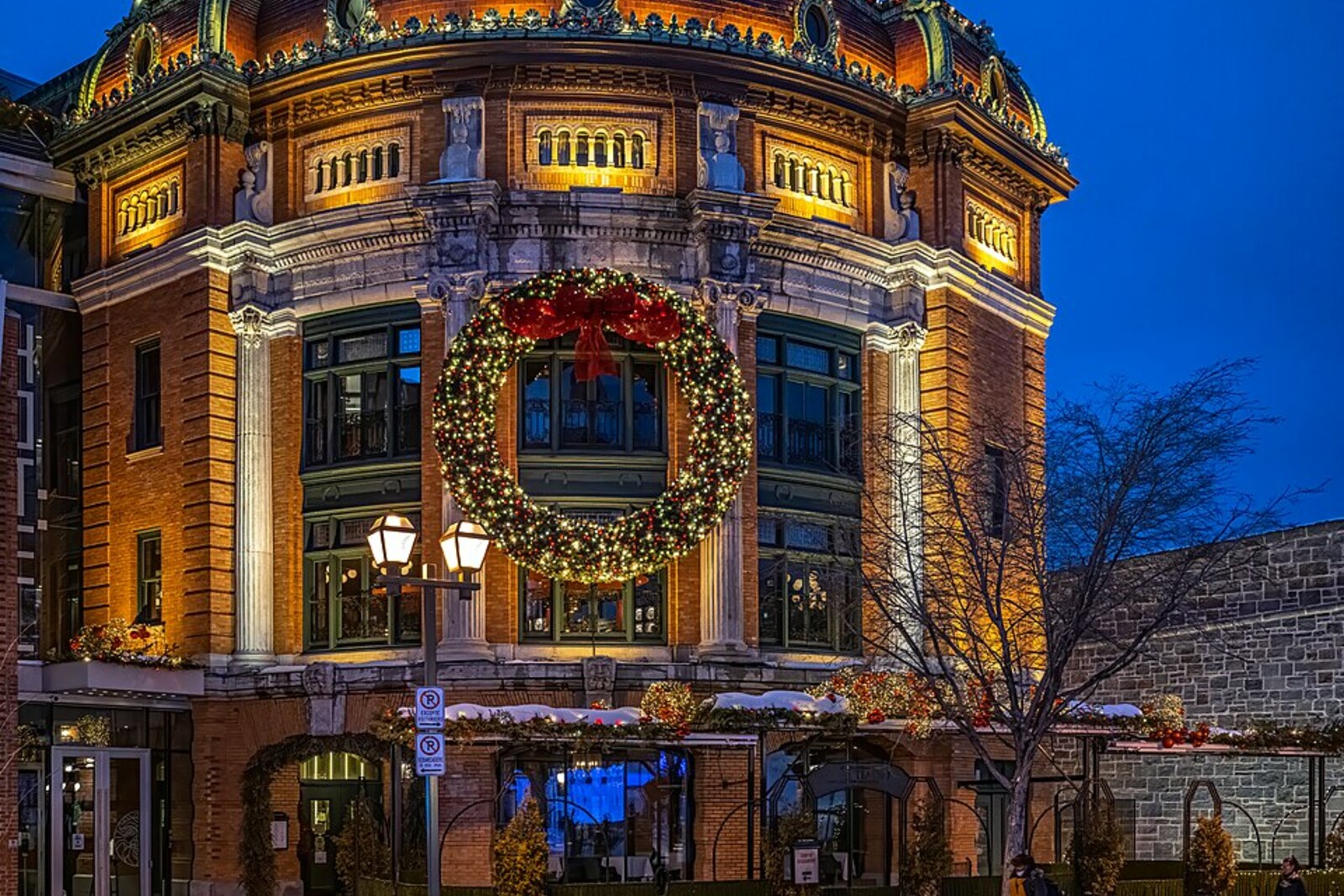
Look around first
What to notice
- The façade of Palais Montcalm
- The fortification wall
- The arch of Saint-Jean Gate
The story of the place
In front of the façade of Palais Montcalm lies an open square that was once the commercial heart of the neighborhood by Saint-Jean Gate. Meat and provisions were sold in the covered pavilion, carts stood along wooden sidewalks, and residents of the city and suburbs gathered upstairs. When the market moved to Lower Town, its base became a support for the concert building, while the open site in front of it eventually turned into a skating rink and a place for street performances. Beneath the building, archaeologists find traces of an even older layer: stones from the outer wall of the fortification ditch probably became part of the market’s foundation.
On the site of today’s skating rink, in the middle of the eighteenth century, lived carpenters, masons, a blacksmith, a tanner, a tavern keeper, carters, and day laborers. Some earned their living through a trade; others hired themselves out by the day and depended on every new job. They settled outside the city wall: inside, space was tight and strict rules applied, while Saint-Jean Gate closed at nightfall, leaving the suburb without city services or protection.
In seventeen seventy-five, American troops approached Québec City. The British military council ordered the houses in front of the fortifications demolished so that the attackers could not use them for shelter. People lost their homes and outbuildings. After the siege, they returned and most often rebuilt on the same foundations.
Around eighteen fifteen, the military cleared the strip in front of the wall again. They created a glacis here—an open, gentle slope that could not be built on, so that defenders could see the approaches to the fortifications. Yet by the eighteen thirties, a wooden house had appeared on the slope. During the great fire of eighteen forty-five, it burned down, and its residents built a brick one in its place. Archaeologists found a child’s plate, a miniature cup, and marbles: from these objects, it can be concluded that a family once again lived on land the military had tried to keep empty.
After the British garrison left, the city dismantled the glacis. The old market near the cathedral was no longer enough for growing Québec City, so the cleared site by the gate was given to merchants. Montcalm Market opened on May fifth, eighteen seventy-seven. The pavilion housed meat and grocery stalls; outside, vendors set up carts along the wooden sidewalks, while residents of the city and the suburb gathered on the second floor. Offcuts from button blanks found during excavations show how some merchants occupied their hands between customers.
At the beginning of the nineteen thirties, during the economic crisis, city leaders moved the market to Lower Town and decided to occupy the old site with a construction project that would provide work for the unemployed. Palais Montcalm, with a concert hall, a library, and a public swimming pool, was built on the site of the market pavilion. An open area—the present square—was left in front of the façade. Later, a skating rink was created here; new theater halls opened around it, and the space where market carts had once stood began to be used for street performances.
Beneath Palais Montcalm, a material link among all these transformations remains. According to archaeologists’ conclusion, stones from the outer wall of the old fortification ditch probably became part of the market’s foundation, and the base of the market pavilion was then used to support the concert building.
The square officially received the name d’Youville in nineteen sixty-five. It came here by way of D’Youville Street, named as early as eighteen seventy-six: the street led to the chapel of the Sisters of Charity of Quebec.
Marguerite d’Youville founded the original community in Montreal. After her husband’s death, she was left with nothing but debts and had to renounce the inheritance; she supported two sons and, together with three assistants, began taking in the poor in her home. Later, they were entrusted with the ruined and dilapidated Montreal General Hospital. D’Youville restored its operations: wealthy female residents paid for their lodging, the nuns sold goods they made themselves, and farms, a mill, and a bakery brought in income.
In eighteen forty-nine, the Montreal community she had founded sent Marcelle Mallet and five other sisters to Québec City to take over the local orphanage. Mallet founded an independent Quebec community; the sisters built a convent, an orphanage, and a chapel. The chapel survives, although it is now hidden behind modern buildings. The sign bearing the square’s name continues the line of the street laid out to it from the former market by the gate.
Useful on site
The square is always open. In winter, there is a seasonal city skating rink here; on the date of verification, the city page stated that the rink was closed for the season.
Checked: June 30, 2026. Check the official source before visiting.Step away from the gate toward the middle of the accessible part of the square: the distance helps convey the scale of the former glacis. The square is part of ordinary city life, so do not linger in the paths of pedestrians and events.