 Guide On Map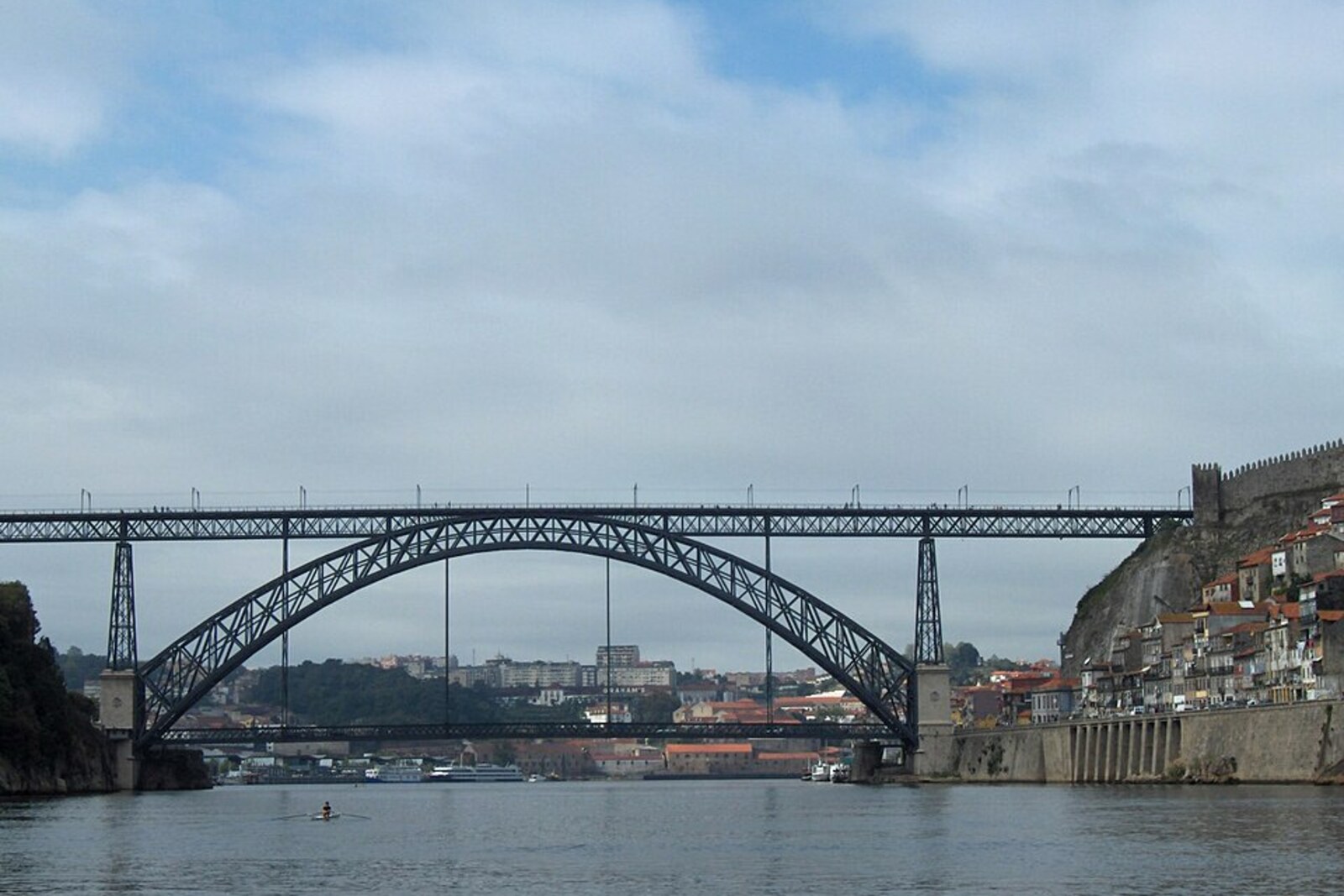
Look around first
What to notice
- Metal arch
- Upper deck
- Lower deck
- Stone portals
The story of the place
At the entrance on the Porto side stand two stone obelisks left from the former suspension bridge. From them, a huge iron arch stretches over the Douro, carrying roadways at different heights between the waterfronts and the upper terraces of the slopes. Metro cars run along the upper roadway alongside pedestrians; the lower one is used by cars and by people walking between Ribeira and Gaia.
This arch is often attributed to Gustave Eiffel. But Théophile Seyrig won the bridge competition—an engineer who had previously been Eiffel's partner, invested his own money in Eiffel's venture, and brought there the design calculations for an arch already tested over the Douro.
It was Seyrig's proposal that helped Eiffel's firm obtain the contract for the Maria Pia railway bridge, farther upriver. The partners linked the banks with one large metal arch, with hinges at its bases. Four years later, Eiffel received the commission for the French Garabit Viaduct, based on the same idea. Seyrig demanded his due share of the profits. Eiffel refused and terminated their contract. The engineer sued his former partner, but never received compensation. He joined the Belgian construction company Willebroeck and soon returned to Porto—now as Eiffel's rival.
The city needed a new crossing in place of the old suspension bridge. Here, two pairs of banks lie one above the other: below are the waterfronts of Ribeira and Gaia; above are the terraces by Porto Cathedral and Serra do Pilar. A single roadway would connect only half the city. So Eiffel's proposal with a single movable deck was rejected, and a competition was announced for a bridge with two levels.
In November eighteen eighty, ten foreign companies submitted twelve designs. Eiffel submitted his again. Willebroeck presented Seyrig's calculations: one arch carried a lower roadway by the river and an upper roadway between the tops of the slopes. In January of the following year, the commission chose that option. Seyrig received an independent commission exactly where his design had previously won a contract for his former partner's firm.
The arch was assembled simultaneously from both banks. Metal parts were delivered by river, raised above the water, and attached to the two growing halves. Until they met in the middle, temporary tie rods and steel cables held them in place. Thus, a span more than one hundred seventy meters long gradually took shape over the Douro. The upper deck opened on October thirty-first, eighteen eighty-six.
That was the birthday of Luís I of Portugal, the King of Portugal at the time: the bridge received its name in his honor. On the stone portals of the lower deck, the name is carved in the old Portuguese spelling—“Luís I Bridge,” without the honorific “Dom.” It is said that the residents removed the title because the king did not attend the opening. This is an urban legend. Newspapers called the bridge that even during construction; the neighboring Maria Pia Bridge also officially bore the queen's name without a title.
Today, metro cars and pedestrians use the upper deck, while cars and people walking between the two waterfronts use the lower one. Near the entrance on the Porto side, two stone obelisks from the former suspension bridge have survived. Above them, the halves of Seyrig's arch meet; Eiffel's design for this crossing remained on paper.
Useful on site
The pedestrian deck is open as an urban space; passage may be restricted during works or events.
Checked: June 25, 2026. Check the official source before visiting.Stay in the pedestrian zone and do not step onto the metro tracks. For the story, it is enough to walk along the Gaia section of the upper deck and look along the span.