 Guide On Map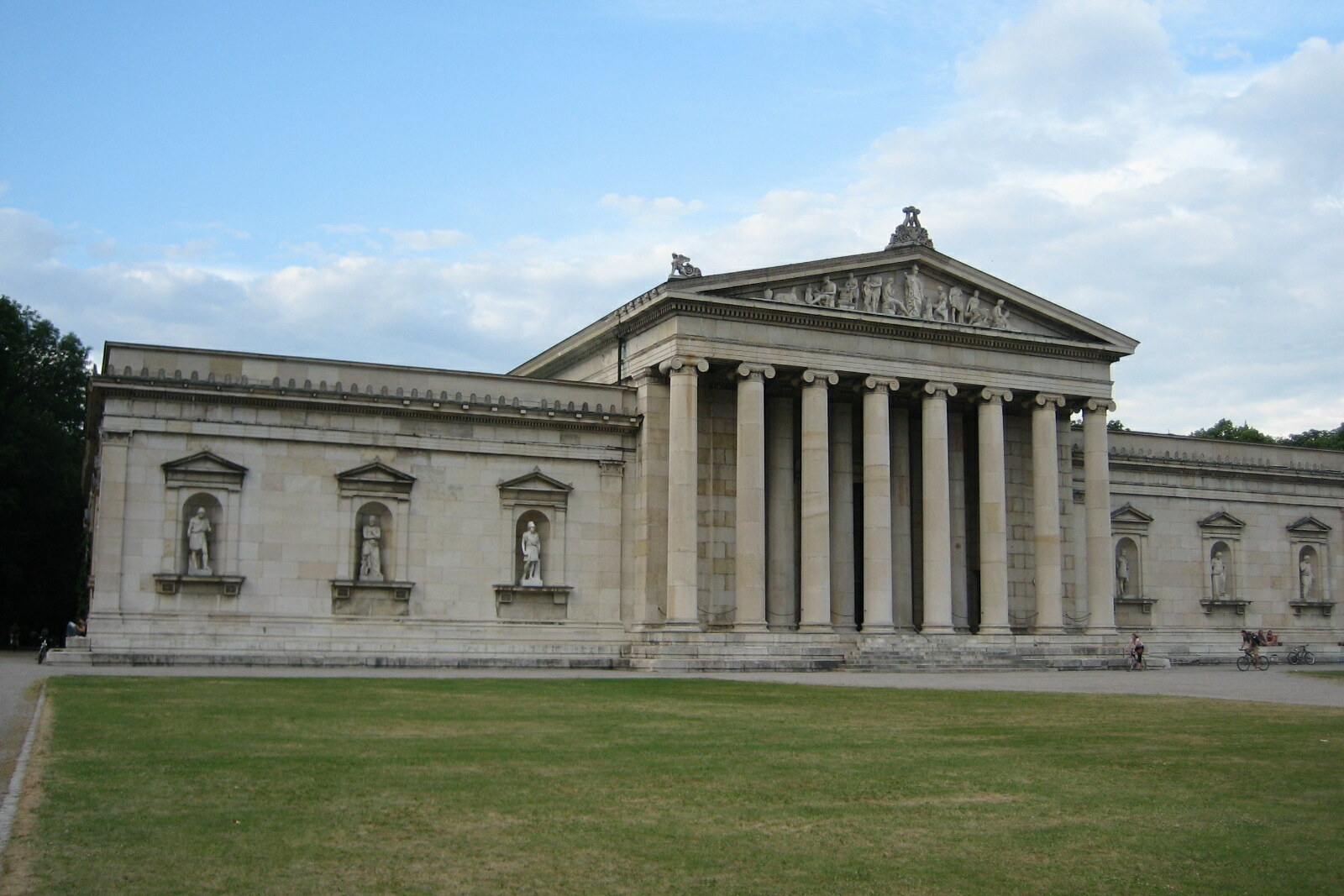
Look around first
What to notice
- Temple façade
- Brick halls
- Warrior figures without limbs and weapons
- Smooth cuts in the marble
The story of the place
In nineteen sixty-two, the archaeologist Dieter Ohly took charge of the Glyptothek with a duty to preserve ancient originals. To fulfill that duty, he ordered the removal from the museum’s chief treasure of the marble arms, legs, weapons, and other details that had been considered part of the monument for almost a century and a half.
These were the Aeginetan pediments—the figures from the triangular pediments of the Temple of Aphaia, dedicated to the goddess, on the Greek island of Aegina. The warriors depicted battles for Troy, with Athena standing at the center of each group. Researchers found the shattered sculptures in eighteen eleven. The Bavarian Crown Prince Ludwig I of Bavaria was collecting the finest antiquities for a future public museum, and the following year he bought the find at auction. He paid for the collection and the construction from his own funds.
The court architect Leo von Klenze erected a building for it with the façade of a Greek temple. Ludwig called the museum the Glyptothek: the word, formed from Greek roots, means a repository for carved sculptures. The Aeginetan pediments were installed here in eighteen twenty-seven, before the museum opened.
But they arrived from Rome far more complete than they had been from Aegina. Ludwig commissioned the Danish sculptor Bertel Thorvaldsen to make up the losses. Working from his models, craftsmen carved new marble parts and fitted them to the ancient fragments. To make the joins secure, they sometimes shaved down the original edges. The result was complete figures fit for Klenze’s elegant hall, although a nineteenth-century man determined a substantial share of their poses and equipment.
Doubts arose even before Ohly. In nineteen one, Adolf Furtwängler, director of the Glyptothek and an archaeologist, returned to the Temple of Aphaia to check the reconstruction. The discovered statue bases showed that Thorvaldsen had positioned several figures incorrectly. Furtwängler displayed a scale model of his own version beside them, but did not touch the original group: the additions had already become part of the museum’s history, along with the painted hall.
During the Second World War, staff moved the antiquities to monasteries. In the summer of nineteen forty-four, bombs destroyed the ceilings and interior decoration of the Glyptothek. The sculptures survived in shelter, but the hall for which Thorvaldsen had given them their finished appearance disappeared.
Ohly had the opportunity to reassemble both the building and the Aeginetan pediments. As director of a state museum, he was responsible for preserving the collection; as an archaeologist, he was staking his professional reputation on an irreversible decision. Between nineteen sixty-six and sixty-nine, restorers removed Thorvaldsen’s additions. It was no longer possible to return the sculptures to their state at the time of excavation: the cut-away ancient marble could not be restored.
To reduce the share of conjecture, Ohly began excavations on Aegina again, comparing mounting holes, bases, and discovered fragments. The figures were then arranged anew. Archaeologists accepted the new composition, while critics accused Ohly of destroying Thorvaldsen’s independent work. The Glyptothek reopened after restoration in nineteen seventy-two. Ohly continued to study the Aeginetan pediments until his death and managed to complete only the first volume of a planned three-volume catalogue.
Behind Klenze’s temple façade now lie plain brick halls with large windows and single-color floors. In the hall of the Aeginetan pediments, the ancient figures again stand in groups, but the warriors lack limbs and weapons. Smooth cuts made for Thorvaldsen’s marble additions remain on some breaks.
Useful on site
A city route stop; if you plan to go inside, check the opening hours and visiting rules on the venue’s official website.
Checked: date not specified. Check the official source before visiting.The façade can be viewed without entering. The Barberini Faun and the Aeginetan pediments can be seen only during a separate visit to the museum.