 Guide On Map
Königsplatz and Kunstareal: Art, Power, Memory
From Lenbachhaus via Königsplatz to Pinakothek der Moderne
Guide On Map on your phone
Open the walk like a regular app
It takes about 10 seconds to install. No app store needed.
The whole path
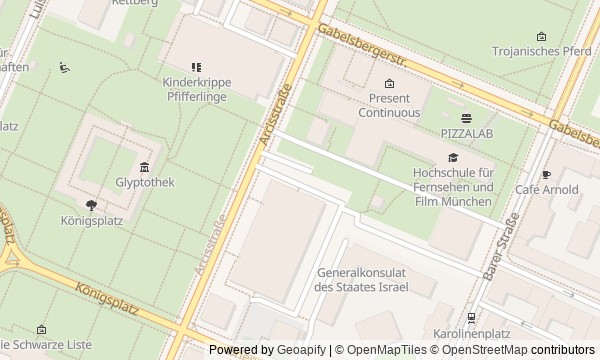
Route map
About the walk
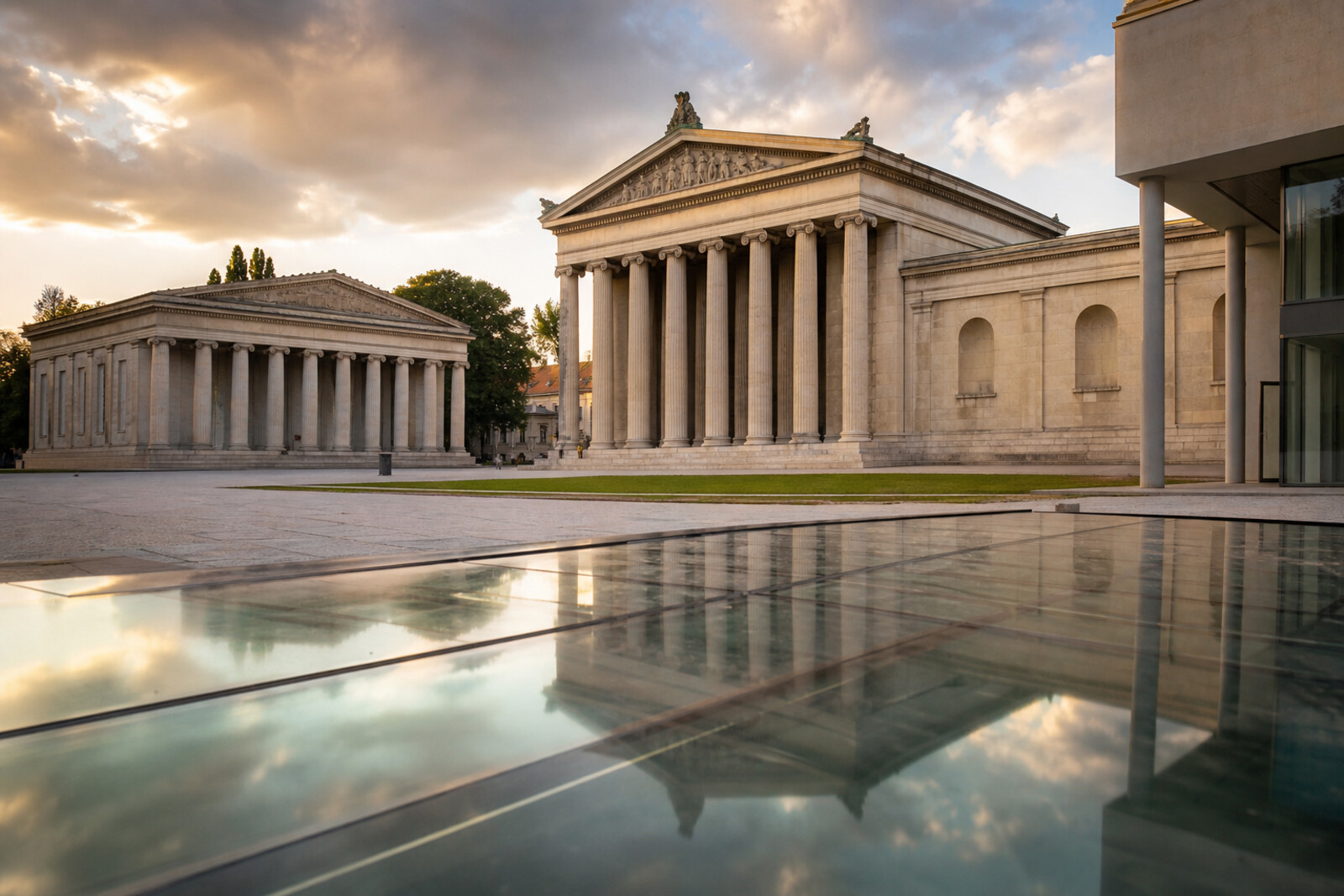
You will begin at the villa of a portrait painter, walk out to the Propylaea, and cross Königsplatz between two museums with temple-like facades. Then the route heads toward the white Documentation Centre for the History of National Socialism, a black obelisk, and two Pinakotheks.
This is a walk through Munich's Kunstareal, where monarchs, party members, museum professionals and city residents repeatedly changed the purpose of squares, collections and buildings. Why would paintings have to be hidden in a basement? Why remove marble arms from ancient warriors? Where will the name of a general, once intended for a monument, disappear?
The story unfolds through people's decisions: what to preserve, what to remove, what to declare authentic, and who gets the right to exhibit art. No museum solemnity. You will test the words against the lawn, inscriptions, cuts of marble and different kinds of brick.
After the walk, you will be able to recognize the royal stage set, the Nazi redesign and the postwar seam in this very district.
Why this order
After Lenbach's private home, Königsplatz moves the question of control over art into the realm of the state: the villa leads to the Propylaea, beyond which opens a royal ensemble later appropriated by the Nazis. The Glyptothek on the north side continues the theme inside the museum object itself: power over the past appears in the decision to remove someone else's restoration. The museum opposite follows because the same ensemble served not only antiquity, but also modern artists' struggle for the right to exhibit. The white Documentation Centre for the History of National Socialism at the eastern edge explains who turned the square into a party stage. Nearby Karolinenplatz shows that Bavarian kings also knew how to repurpose uncomfortable memory. From the obelisk, Barer Straße leads to the Alte Pinakothek: after a rewritten inscription, you will see a building where postwar loss was left visible. The final crossing to Pinakothek der Moderne shifts from saving a ruin to new construction and completes the route at a shared entrance created with public and private money.
Those who want to understand Kunstareal, not just walk through its museums Art-history lovers interested in decisions and conflicts Those who notice inscriptions, traces of restoration and different brickwork
Those looking for an easy walk without a conversation about National Socialism Those who want a list of major masterpieces rather than the story of a museum district Those who do not enjoy lingering over facades, inscriptions and repair marks
Before you go
Think of this route first and foremost as a walk through outdoor spaces, and choose no more than one museum in advance for a full visit. Check official institution pages for admission conditions, access to individual galleries and temporary exhibitions. Stories inside the Glyptothek, State Collections of Antiquities and the Pinakotheks require separate visits; from the street, the important facades and relationships between the buildings are still clear. Bring headphones and leave extra time for Königsplatz: several stops are close together, but each asks you to change your point of view.
When to go
Go in daylight: the facade materials, memorial markers and postwar seams are easier to make out. Do not rush across the square—its scale reveals itself only after a short pause between the buildings.
Backup plan
In rain, keep the route's meaning through three anchor points: begin at Lenbachhaus, continue to the Documentation Centre for the History of National Socialism, and finish in one of the Pinakotheks. You can travel or walk between them without long stops in the open squares. If you cannot get inside, do not try to replace a visit with a retelling of the exhibitions: look instead at the contrast of old and new at Lenbachhaus, the white volume of the Documentation Centre for the History of National Socialism, and the restored sections of the Alte Pinakothek. That is enough to hold onto the central thread—from a private home through political memory to a museum that does not conceal the history of its own creation.
Route conditions
Surface. Paved — 1.4 km; unpaved — 597 m (data covers 94% of the route)
Stairs. Flights: 3, 15 m in total
Access. Wheelchair — no; stroller — limited (stairs)
Facilities. Toilets — 2
Elevation. Ascent — 9 m; descent — 16 m
OpenStreetMap extract of June 18, 2026: database data, not a check on the ground. Data © OpenStreetMap contributors, ODbL licence
Walk plan
Open in maps ↗- 1
Lenbachhaus
To begin with a private house where commissioned portraits and rescued avant-garde art created two different museum histories. - 2
Königsplatz
To see how a royal ensemble was first adapted for Nazi ceremonies, then remade again. - 3
Glyptothek
To understand a restoration after which there is no return either to the fragments as found or to the nineteenth-century version. - 4
State Collections of Antiquities
To recognize, in today’s museum of antiquities, a former venue in the struggle for the right to show modern art. - 5
Documentation Centre for the History of National Socialism
To move from ceremonies in the square to the party headquarters, where the purge changed the structure of National Socialist power. - 6
Karolinenplatz
To compare the Nazi remaking of the square with an earlier royal reworking of uncomfortable military memory. - 7
Alte Pinakothek
To see the postwar restoration that did not hide the site of destruction. - 8
Pinakothek der Moderne
To conclude the route with a contemporary answer to an old question: how to give different collections a shared home.
Route features
Everything you need stays in the browser
Progress, saves and your trip plan are stored on this device.
Add Guide On Map to your home screen so the walk opens outside the browser.
How we handle sources, maps and corrections: our editorial standards