 Guide On Map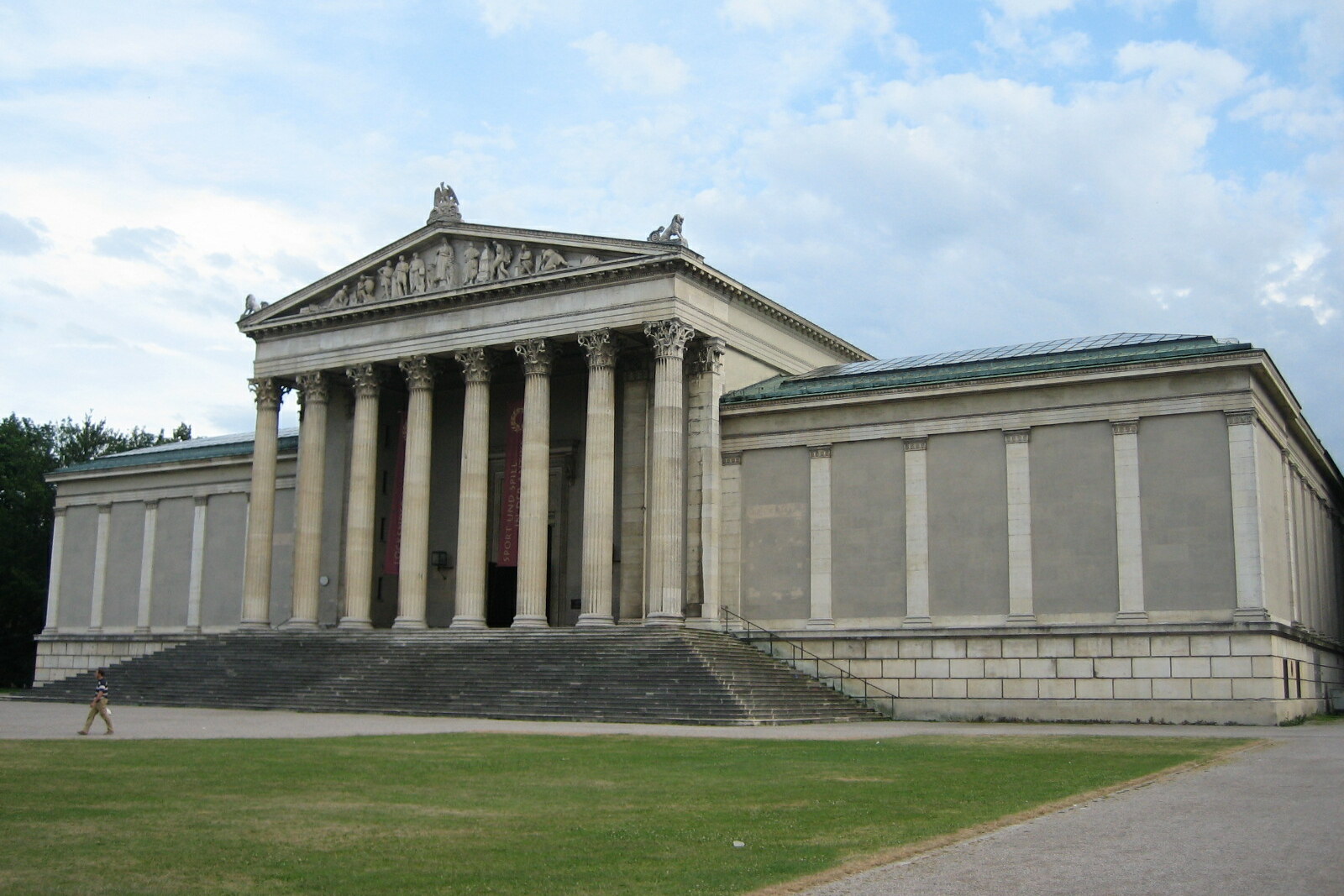
Look around first
What to notice
- The pediment with the figure of Bavaria
- Artists and artisans on the pediment
- The bust on a cart
- The vase in the craftsman’s hands
The story of the place
Above the entrance, Bavaria receives wreaths, while a craftsman carries a vase and an assistant wheels a king’s bust, as though bringing an entire exhibition to the doors. The façade preserves the memory of a building where artists and artisans presented their works, although behind it are now gathered Greek, Etruscan, and Roman vessels, bronzes, terracottas, gold, and glass from the formerly separate collections of the House of Wittelsbach. After the war, the interiors had to be arranged anew, while large stone sculpture was left in the Glyptothek on the other side of the square. Thus antiquity took up residence inside the former exhibition building.
In the summer of nineteen oh four, paintings were hung in these halls, sculptures were arranged, and art objects were selected for the first exhibition of the German Artists’ Association. There were no antique vases here then. The building was called the Royal Art Exhibition Building, and its organizers intended to prove that artists could show new art without the permission of a conservative jury.
Munich artists had been moving toward this confrontation for twelve years. The old Munich Artists’ Association controlled the city’s principal exhibitions. Thousands of works took part in its vast shows, and an individual work could be lost among the rest. For an artist, this was a matter of livelihood: an exhibition gave access to buyers and commissioners. In eighteen ninety-two, ninety-six participants left the association and founded the Munich Secession. The word “secession” meant separation. They sought the right to decide for themselves whom and what to show.
At first, the new group had no suitable halls. Frankfurt offered it exhibition space and five hundred thousand gold marks on condition that it relocate. The artists remained in Munich, held their first independent international exhibition in a temporary pavilion, and from eighteen ninety-eight occupied this building on Königsplatz.
Here they invited the newly formed German Artists’ Association to take part. It was meant to unite the scattered secessions of different cities and give a place to young artists and movements rejected by official organizers. The exhibition of nineteen oh four became the association’s first public test. After it, the association began holding annual shows in different German cities: a dispute with one Munich jury led to the emergence of a nationwide German exhibition venue.
The Munich Secession used these halls until nineteen sixteen. During the Second World War, the interiors were badly damaged, and during their restoration they had to be completely rebuilt. In nineteen sixty-seven, Bavarian museum professionals opened the State Collections of Antiquities here and brought together the previously scattered collections of the House of Wittelsbach. Greek, Etruscan, and Roman vases, bronzes, terracottas, gold, and glass are now displayed inside. Large stone sculpture was left in the Glyptothek opposite.
The building’s original purpose is written on the pediment. At the center stands allegorical Bavaria, handing out wreaths, while artists and artisans bring her their works. A sculptor’s assistant rolls an enormous bust of Ludwig I of Bavaria on a cart, a bronze caster raises a statue, and a porcelain maker holds a vase. Ancient Greek vessels stand in the museum cases; above the entrance, the Bavarian craftsman still carries his vase to the exhibition of eighteen forty-eight.
Useful on site
A city route stop; if you plan to go inside, check the schedule and visiting rules on the venue’s official website.
Checked: date not specified. Check the official source before visiting.From the street, you can see the building’s original role as a ceremonial showcase. The vases, bronzes, terracottas, and jewelry require a separate entry.