 Guide On Map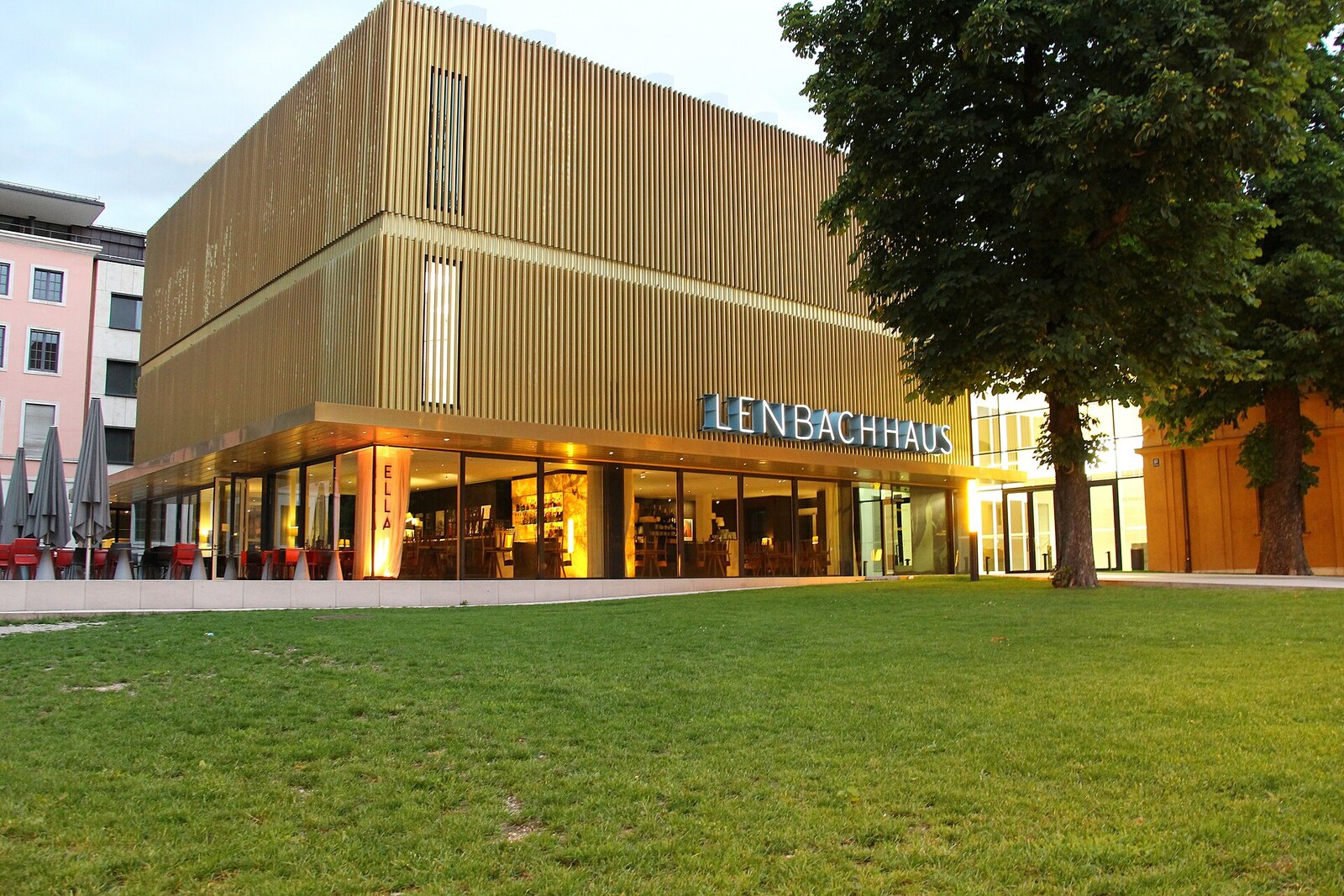
Look around first
What to notice
- The old villa's balcony
- The formal studio
- Recreated reception rooms
- Original furniture
The story of the place
The old villa, with its balcony and formal studio, became the city's art museum. On its first floor, reception rooms were recreated from photographs and furnished again with original furniture. Behind the elegant halls, an almost factory-like infrastructure once operated: an electric generator, steam heating, and a photographic studio. Here, a private house gradually became a place where the city keeps its art.
The name on the facade belongs to Franz von Lenbach: in German, “Lenbachhaus” means “Lenbach's house.” He was a portrait painter who lived on commissions from people who needed an official face for a palace, an office, or a family gallery. The son of a city stonemason and the thirteenth child in his family, Lenbach attained a position in which a pope, emperors, kings, industrialists, and the most prominent figures in Munich society sat for him.
In the late eighteen eighties, Lenbach invested his earnings in a residence of his own. He chose a plot opposite the Propylaea, beside Königsplatz and the royal art collections. A client entered directly into workrooms and reception rooms filled with antique sculpture, old paintings, rugs, and tapestries. In the formal studio, open to the public, Lenbach painted in an elegant suit. Behind the scenes were an electric generator, steam heating, and a photographic studio: photography helped him handle the stream of portrait commissions. Here, the artist sold the client both a painting and his own social standing.
The clearest episode took place in eighteen ninety-two. Prince Otto von Bismarck, who had recently left office as German chancellor, stepped onto the villa's balcony. Lenbach painted him many times and largely created the stern, recognizable image of Bismarck that spread across Germany in portraits and reproductions. Now the former chancellor received greetings from a Munich crowd from the balcony of his portrait painter. Lenbach achieved exactly what he had built the house for: his studio became a fitting stage even for a man whose image Lenbach had previously created on canvas.
After Lenbach's death, his widow Lolo von Lenbach had to take charge of the villa. She was an artist who sought to establish a municipal gallery here. In nineteen twenty-four, she sold the buildings and land to the city, while also transferring the furnishings and numerous works by her husband. Municipal officials brought together the city's scattered art holdings here, added another wing, and opened the museum on May first, nineteen twenty-nine. Lenbach's surname remained in its name, while the private rooms and studios became exhibition spaces.
Another woman artist determined the museum's present role. Gabriele Münter took part in the Blue Rider, a Munich association of the early twentieth century whose members moved from familiar representational painting toward Expressionism and abstraction. Her house in Murnau held her own paintings, works by Wassily Kandinsky, and works by their fellow artists. Under the Nazi regime, Münter hid this collection in the basement: the art of the Blue Rider was considered degenerate, and its discovery could have ended in confiscation.
Personal trust decided why the rescued paintings came here. Münter's companion, the art historian Johannes Eichner, studied her work and became friends with Hans Konrad Röthel, the future director of Lenbachhaus, who wanted to restore early Munich modernist painting to a place in the museum. In nineteen fifty-six, Münter allowed Röthel to see the entire hidden stock for the first time. The following year, for her eightieth birthday, she gave Lenbachhaus more than a thousand works: around ninety oil paintings by Kandinsky, hundreds of his drawings and watercolors, her own works, and works by other members of the Blue Rider.
On the first floor of the old villa, museum staff recreated Lenbach's reception rooms from photographs and arranged the original furniture there. The halls of the same museum hold the world's largest collection of the Blue Rider—paintings Münter kept in the basement for many years before giving them to the city.
Useful on site
A city route stop; if you plan to go inside, check the opening hours and visiting rules on the venue's official website.
Checked: date not specified. Check the official source before visiting.From outside, the meeting of the villa and the new wing is easy to make out; plan the Blue Rider collection as a separate museum visit.