 Guide On Map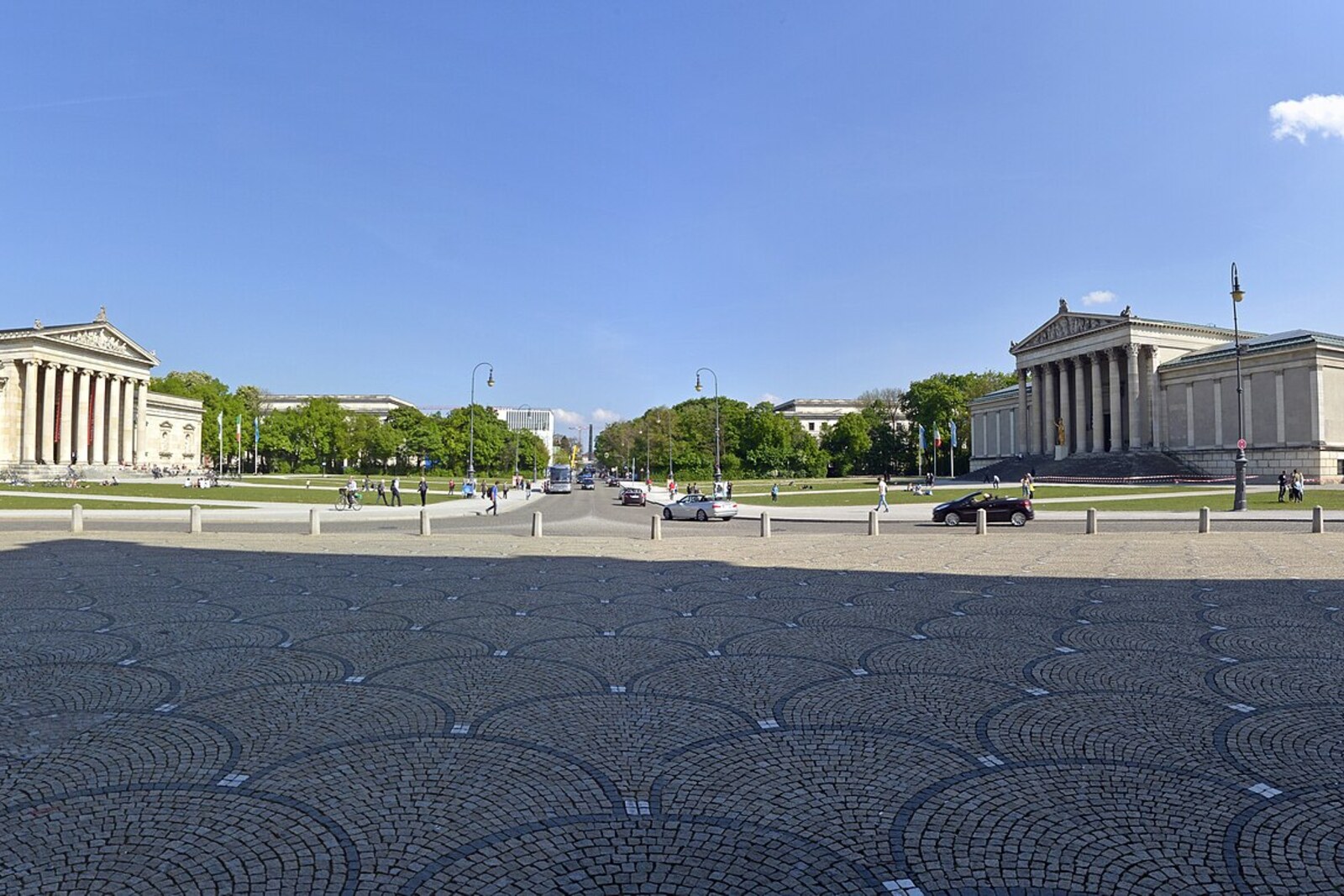
Look around first
What to notice
- Lawns
- Propylaea
- Round “Black List” memorial
- Stone foundations at the eastern edge
The story of the place
The name Königsplatz appeared when Bavaria became a kingdom. Crown Prince Ludwig envisioned surrounding the open space with the Glyptothek, the State Collections of Antiquities, and the Propylaea, examples of Greek architecture. Through these facades, he wanted to give the young monarchy the authority of antiquity and leave the middle free for large official gatherings. The present lawns were restored after the granite covering, while stone foundations of two later structures remain beneath the bushes at the eastern edge.
On the evening of May tenth, nineteen thirty-three, university trucks brought books here. Students took them from libraries and bookshops according to Black Lists drawn up in advance. Shortly before midnight, participants in a torchlight procession filled Königsplatz and began throwing works by Sigmund Freud, Heinrich Mann, Erich Maria Remarque, Kurt Tucholsky, and other authors declared “un-German” into a bonfire.
The main organizer of the Munich action was Karl Gengenbach, a student of law and political science who headed the Bavarian branch of the German Student Union. The union was already controlled by the National Socialists; its leaders sought a prominent role in the new state. The initiative for the burning came chiefly from them, rather than being an order passed down to students by party officials.
That same evening, the rectors of Munich’s universities ceremonially granted student unions new rights. The unions received official status within the structure of the universities, but Jewish students were excluded from these organizations. After the ceremony at the university, the procession came here. Gengenbach turned the burning into a mass spectacle involving professors, city officials, and party leaders. For writers who made their living from literature, the bonfire was followed by bans on publishing and on their profession. Many left Germany; some of those whose books were destroyed were later killed by the Nazis.
The choice of this square is explained by its original purpose. Königsplatz means “Royal Square.” The name appeared under Maximilian I Joseph of Bavaria and was meant to emphasize the new status of Bavaria, which became a kingdom in eighteen oh six. His son, Crown Prince Ludwig, the future Ludwig I of Bavaria, made building the square his personal cause. He wanted to surround the open space with examples of Greek architecture and link the Bavarian monarchy to the authority of antiquity. That is how the Glyptothek, the State Collections of Antiquities, and the Propylaea appeared. The square was given enough space for large ceremonies and the facades of institutions that defined what the state regarded as culture.
Since nineteen thirty-one, the Brown House, the headquarters of the National Socialist German Workers' Party (NSDAP), had stood beside it. Soon after Adolf Hitler was appointed Reich Chancellor, he instructed his favorite architect, Paul Ludwig Troost, to redesign the eastern side of Königsplatz. The book burning took place before the main work began and showed what ceremonies the royal ensemble could be used for.
By nineteen thirty-five, the grass had been replaced by about twenty thousand granite slabs, and traffic was blocked. On the eastern side, two open Temples of Honour were erected, containing sixteen sarcophagi for participants in the nineteen twenty-three putsch who had died. An SS guard stood beside them around the clock, and visitors were required to give the Nazi salute. Party processions crossed the granite field, while annual ceremonies turned the burial site into a cult of Hitler’s fallen comrades.
In nineteen forty-five, the American military returned the remains to their former graves, and two years later blew up both temples. The granite was preserved, and for decades the square became a vast parking lot. Only in nineteen eighty-seven and nineteen eighty-eight did city authorities remove the slabs and lay out lawns again.
The present grass appeared after that remaking. At the eastern edge, near the Documentation Centre for the History of National Socialism, the foundations of the demolished temples remain beneath the bushes. In front of the State Collections of Antiquities, a round memorial called “Black List” is set into the ground: the titles of books by three hundred ten authors persecuted by the Nazi regime run in a spiral across its surface.
Useful on site
A city route stop; if you plan to go inside, check the venue’s schedule and visiting rules on its official website.
Checked: date not specified. Check the official source before visiting.View the square from several sides: its design can only be understood together with all three facades. The memorial marker is easy to miss beneath your feet.