 Guide On Map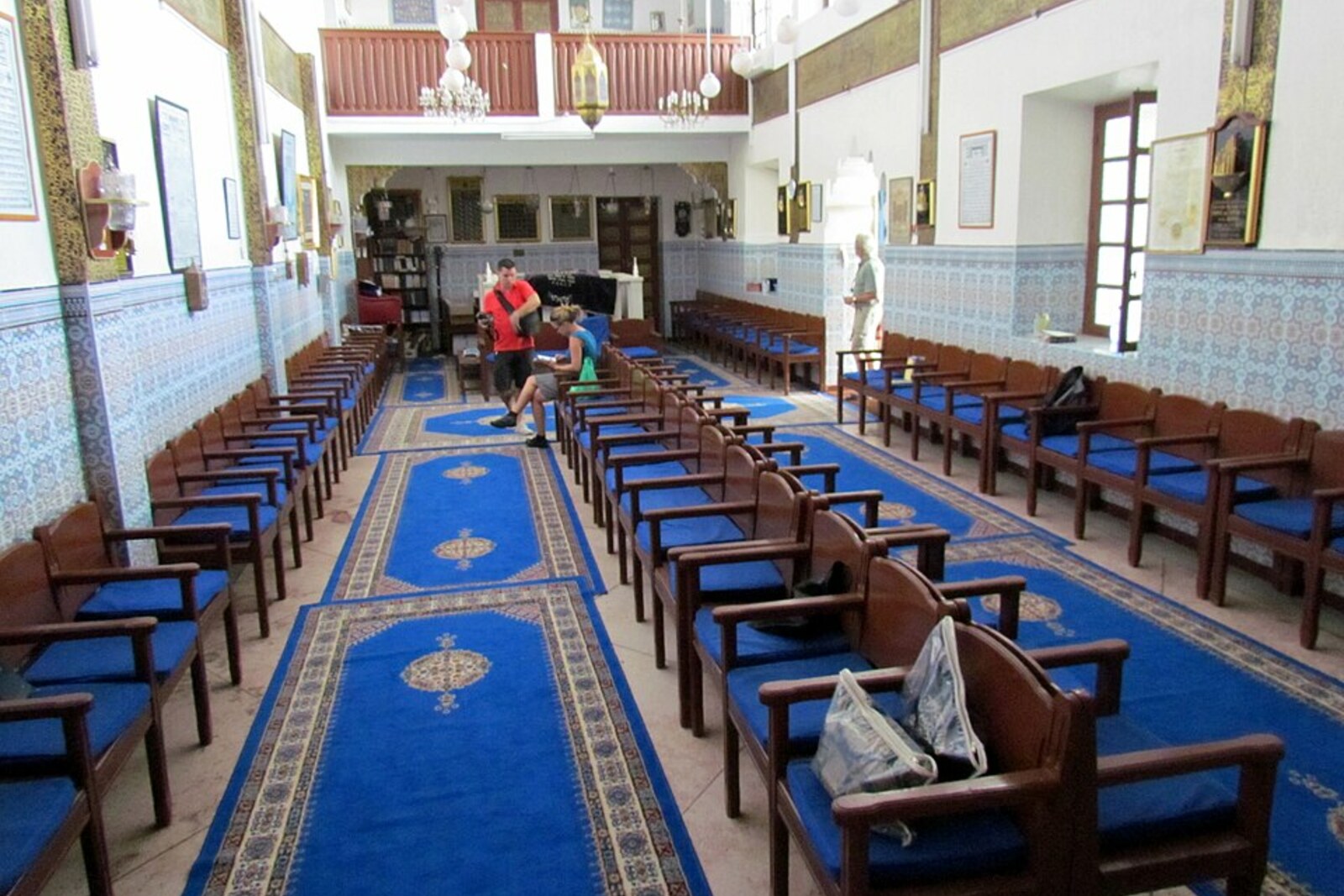
Look around first
What to notice
- The courtyard
- The prayer hall
- The former classrooms
- The inscription “1492” by the exit
The story of the place
Small rooms run around Lazama’s courtyard: one part of the complex contains a prayer hall, while museum display cases occupy the former classrooms. The synagogue took shape within the walled Mellah, where the Jews of Marrakech were relocated in fifteen fifty-seven; the sultan’s stables had stood here before. These rooms long served as a school: children from the quarter and gifted boys from the Atlas Mountains studied here, and local families housed and fed them until the holidays. The inscription by the exit still gives fourteen ninety-two—the date local memory links with Lazama’s beginning, although documents do not confirm it.
In the summer of two thousand twenty-three, Lazama’s manager was trying to gather people for the Saturday service. A minyan—ten adult Jewish men—is needed for the public reading of the Torah. The required number still was not there, and the manager had to decide whether to continue the prayer without the parts that require a minyan.
An elderly Muslim woman, who lived in one of the rooms in the complex and helped the community with food, set off to look for the missing participant at the Mellah market. Soon she ran into the prayer hall: she had found an American tourist and persuaded him to leave his route. The manager went out to meet the guest, but returned alone. The American was not Jewish. He thought he was being invited into the museum, which occupies the neighboring rooms. The Torah reading had to be postponed again.
Such a mistake is possible because of Lazama’s present layout. People pray in one wing, the former classrooms around the courtyard have been turned into a museum, and visitors’ donations go toward maintaining the complex. When there are too few congregants, a tourist may be more needed here as a participant in the prayer than as a ticket buyer.
Lazama is usually called “the synagogue of the exiles.” The exact origin of the word has not been established; there is also a version linking it to the Arabic word for “greatness.” However, this community’s connection with the expulsion from Spain is confirmed by its history.
On March thirty-first, fourteen ninety-two, Isabella, Queen of Castile, and Ferdinand, King of Aragon, seeking religious unity in their kingdoms, ordered all Jews to convert or leave by the end of July. Those who remained were threatened with death and confiscation of property. Houses, vineyards, and workshops could be sold, but gold, silver, and coins could not be taken away. Some of the exiles reached Morocco, including Marrakech.
The Jews already living here called themselves toshavim—residents. The arrivals came to be called megorashim—the exiled. The newcomers differed in language, clothing, and the order of prayer. Disputes over religious customs led to estrangement, and the megorashim formed their own community with the familiar Spanish rite. Lazama arose from this division.
Tradition names Isaac Delouya, a Spanish rabbi who led the exiles of Marrakech and wanted to establish a separate prayer life for them, as its founder. He is credited with founding the synagogue in that same year, fourteen ninety-two. No documents have been found to confirm either the date or Delouya’s involvement. Moreover, the Mellah on this site appeared only in fifteen fifty-seven, when Sultan Abdallah al-Ghalib moved the Jews of Marrakech into a walled quarter on the site of the former sultan’s stables.
Later, the rooms around the courtyard were divided according to stages of study. Children from the Mellah and gifted boys from the Atlas Mountains studied here; Marrakech families gave the arrivals a bed and fed them until the holidays. The year fourteen ninety-two is now displayed at the exit, the same year is hidden in the password for the local wireless network, museum display cases stand in the former classrooms, and a full service in the neighboring hall still requires ten adult men.
Useful on site
The synagogue and cemetery depend on the religious calendar, the caretaker, and current community practice.
Checked: June 28, 2026. Check the official source before visiting.Do not count on access to Lazama being guaranteed; if it is open, follow the caretaker’s rules and do not disrupt religious life.