 Guide On Map
Kasbah of Marrakech: Palaces and Power
From Bab Agnaou through the kasbah and Mellah to Bahia Palace
Guide On Map on your phone
Open the walk like a regular app
It takes about 10 seconds to install. No app store needed.
The whole path
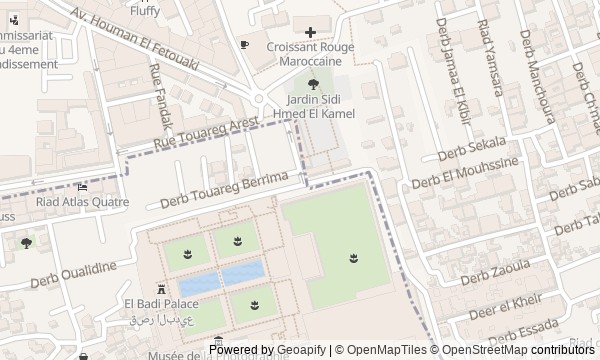
Route map
About the walk
You will enter the southern Kasbah of Marrakech through Bab Agnaou and walk from Moulay al-Yazid Mosque to the Saadian Tombs, then through El Badi Palace, stripped back to its earthen walls, and across the craftspeople’s square into the Mellah. The finish is Bahia Palace, the residence of a grand vizier.
The scale will keep shifting: a narrow passage, the square before the mosque, enclosed tombs, a vast empty courtyard, workshops, and residential lanes. What could turn an inscription about safe entry into a threat? Why did a palace need sugar and Italian marble? Why did a serving synagogue need an accidental tourist? The answers remain inside the stories.
The approach will be calm and documentary. A legend will remain a legend, and a surviving object will prove only what it truly can.
After the walk, you will be able to explain why power in Marrakech is best seen in what could not be carried away: gates, earthen walls, pools, and painted ceilings.
Why this order
Bab Agnaou comes first because you enter the Kasbah of Marrakech by the same public route the gate was built to serve. Just beyond it, Moulay al-Yazid Mosque shows where palace power received religious recognition; the tombs joined to its southern wall continue the story through dynastic burial. From there, a short walk east leads to El Badi Palace, built by the same dynasty, so after the mausoleum you see the material result of its victory and later ruin. El Badi Palace opens directly onto Place des Ferblantiers: the wealth carried out of the palace gives way to metal whose value craftspeople restored. The square stands at the entrance to the Mellah, so the next step moves from the name of a craft to the community that sustained it, and to Lazama Synagogue. From the Mellah’s residential lanes, the route reaches neighboring Bahia Palace: the ending returns from communities and workshops to a palace, but this time to rooms emptied after their owner’s death.
Those who choose histories of power through specific places and actions Those interested in palaces after their owners have vanished Those who want to connect the Kasbah of Marrakech, the Mellah, and the crafts quarter in one walk
Those looking only for an easy walk through the markets Those who do not want to enter several major monuments in succession Those who prefer architecture without stories of executions, coups, and confiscations
Before you go
Set out in the first half of the day, and check visiting conditions for the Saadian Tombs, El Badi Palace, Bahia Palace, and Lazama Synagogue in advance: access can change, and the synagogue remains a religious space, not an ordinary museum hall. The route views Moulay al-Yazid Mosque from the square; if you are not Muslim, do not expect to enter. Bring water and sun protection: the open courtyard of El Badi Palace and the walks between stops offer little shade. Choose quiet, modest clothing for the mosque, tombs, and synagogue; do not disturb prayer, and ask permission before photographing people, attendants, or sacred places. Allow extra time for entrances and narrow passages.
When to go
2.5–3 hours with entry to three paid monuments; about 1.5 hours if you view everything only from outside.
Backup plan
If you cannot get inside the tombs, keep the stop at the entrance: the story of the wall, the keys, and the complex’s return to the city’s memory still links the mosque to El Badi Palace. If El Badi Palace is closed, view its outer walls and do not try to replace its scale with a random palace interior. If Lazama Synagogue is unavailable, walk through the Mellah, noticing the tight streets and closed facades, but do not present the quarter as a wholly preserved world of the past. If time is short, keep one major interior: El Badi Palace conveys loss and scale better, while Bahia Palace shows the arrangement of courtyards and the decoration. The route remains coherent between stops even without entry, but facades alone noticeably weaken its ending.
Route conditions
Surface. Paved — 1.6 km (data covers 59% of the route)
Facilities. Toilets — 4; drinking water — 1
Elevation. Ascent — 9 m; descent — 9 m
OpenStreetMap extract of June 18, 2026: database data, not a check on the ground. Data © OpenStreetMap contributors, ODbL licence
Walk plan
Open in maps ↗- 1
Bab Agnaou
Here you will see how the design of an entrance turned a meeting with the ruler into a supervised test. - 2
Moulay al-Yazid Mosque
This stop will show how a religious oath turned a struggle for the throne into a lawful change of sultan. - 3
Saadian Tombs
Here, a family mausoleum begins with a political assassination and a son's continuation of the war. - 4
El Badi Palace Ruins
The ruins make it possible to distinguish the grandeur that could be carried away from the structure that remained in place. - 5
Place des Ferblantiers
The square will connect the palace quarter with the Mellah craft that survived changing craftspeople and customers. - 6
The Mellah and Lazama Synagogue
One minyan that never comes together will show how a small community exists alongside a museum and a tourist route. - 7
Bahia Palace
The ending will explain why, of a court dignitary’s estate, it was above all the building’s decoration that survived.
Route features
Everything you need stays in the browser
Progress, saves and your trip plan are stored on this device.
Add Guide On Map to your home screen so the walk opens outside the browser.
How we handle sources, maps and corrections: our editorial standards