 Guide On Map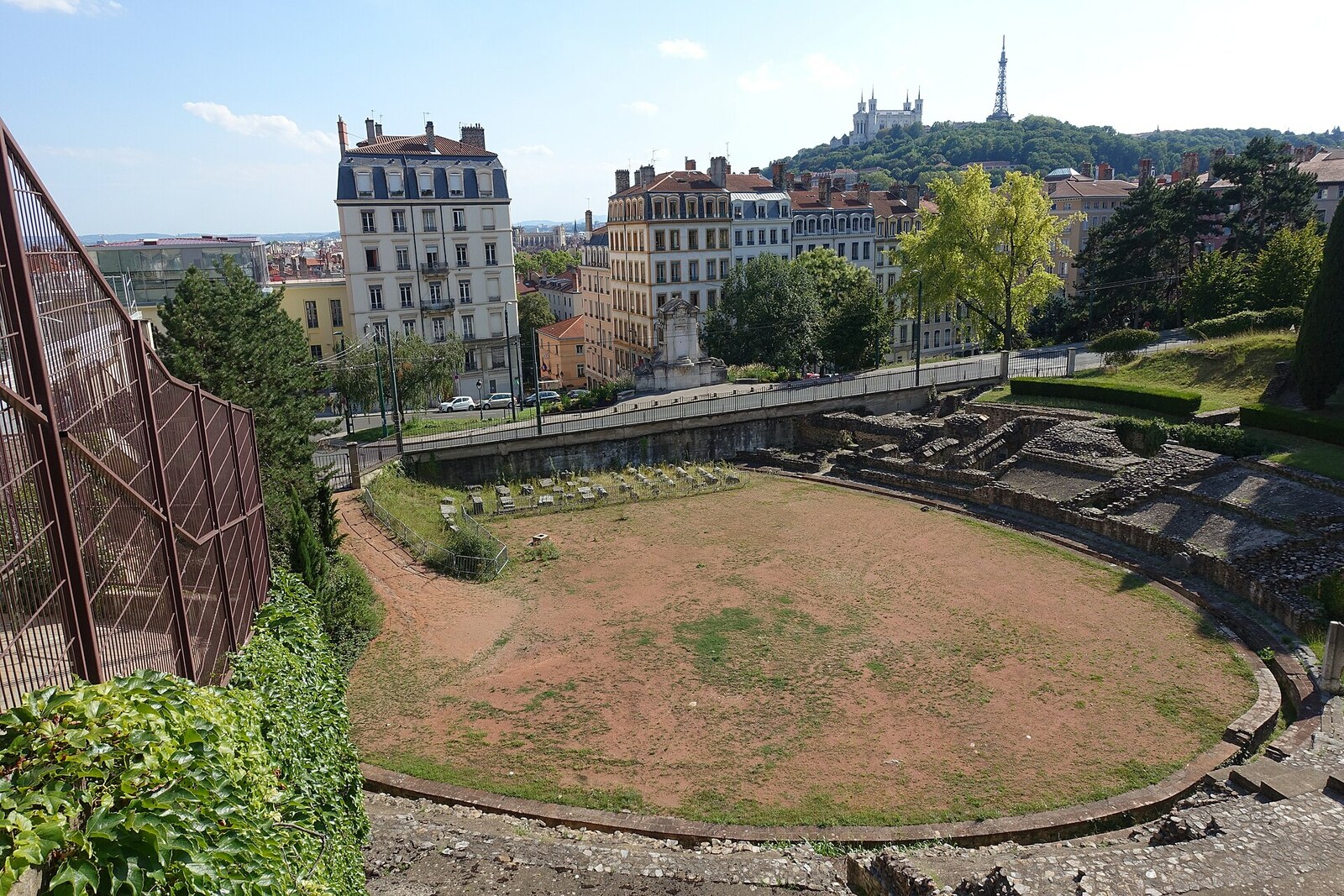
Look around first
What to notice
- Semicircle of retaining walls
- Wooden memorial post
- Stone expanse of the arena
- Slope of the Jardin des Plantes
The story of the place
The stone semicircle on the slope of the Jardin des Plantes survives from a Roman amphitheatre. The arena lies below, and the retaining walls once held the spectators' tiers; about half of those walls now remain. People from Gallic communities gathered here for annual assemblies and games, and later the seats were opened to townspeople as well. The wooden post at the center appeared many centuries later and is not part of the building's ancient structure.
In nineteen CE, Gaius Julius Rufus, a priest of the cult of Rome and the emperor from the Gallic people of the Santones, paid for the arena, the podium, and the spectators' seats here together with his son and grandson. The amphitheatre was part of the federal sanctuary, where representatives of sixty Gallic communities gathered every year. The Three Gauls in its name were three vast Roman provinces: Gallia Lugdunensis, Gallia Aquitania, and Gallia Belgica. Their delegates made sacrifices before the Altar of Rome and Augustus, discussed common affairs, and watched games staged for them. Later, the amphitheatre was enlarged to about twenty thousand seats and opened to the city's population.
In one hundred seventy-seven, this link between the provincial assembly, public games, and the great arena determined Blandina's fate. She was a slave in the household of a Christian woman, served her mistress, and herself belonged to a small community in Lyon. By then, Christians were driven out of baths and markets, beaten in the streets, and accused of secret murders and incestuous rites. Some household slaves repeated these accusations after being threatened with torture. The Roman governor demanded that those arrested renounce their faith: it was enough to stop calling oneself a Christian and swear an oath before statues of the gods.
The details survive in a letter from one of the people who survived the persecution, sent to fellow believers in Asia Minor. It is an eyewitness account written from a Christian perspective, but the execution in the amphitheatre is not considered a later legend.
Blandina's mistress was also among those arrested and feared that the exhausted slave would not withstand questioning. The executioners took turns from morning to evening, while Blandina replied that she was a Christian and that her community committed no crimes. The governor ordered her brought into this arena with Maturus, Sanctus, and Attalus. Blandina was tied to a post and animals were released. According to the letter, not one animal touched her. She was then untied and returned to prison: renouncing her faith could still save her life.
Attalus delayed the case. When it emerged that he was a Roman citizen, the governor did not dare execute him in the usual way for commoners and asked Emperor Marcus Aurelius for a decision. The reply was brief: release those who renounce their faith; execute those who continue to profess Christianity. Citizens were entitled to be beheaded; the others were sent to the animals. Blandina was a slave and did not have Roman citizenship.
By the beginning of the great festival, people from different Gallic communities had gathered in Lugdunum. The governor again held a trial before the crowd, then turned the executions into part of the spectacle. Every day, Blandina and the young Ponticus, who was about fifteen years old, were brought to watch the deaths of the others and required to swear by the names of the Roman gods. On the final day, they were brought out together. Blandina supported Ponticus while he underwent torture; he died first.
After flogging, the animals, and a red-hot iron chair, Blandina was sewn into a net and thrown beneath a bull's hooves. The bull tossed her several times, after which an executioner cut her throat. The organizers did not stop there. They kept the remains of those executed unburied for six days, then burned them and swept the ashes into the Rhône, so that Christians would have no graves or relics left.
About half of the amphitheatre's retaining walls survive today. The wooden post in the middle of the arena was erected in memory of the martyrs; it is a modern marker, not the post to which Blandina was tied. Her grave is not here either—the Roman executors of the sentence achieved precisely that.
Useful on site
The archaeological site is visible from outside; stay behind the barriers and do not expect free access across the arena.
Checked: June 28, 2026. Check the official source before visiting.View the monument from publicly accessible areas and do not go beyond the barriers. Even without reaching the masonry itself, the shape of the amphitheatre can be made out from outside.