 Guide On Map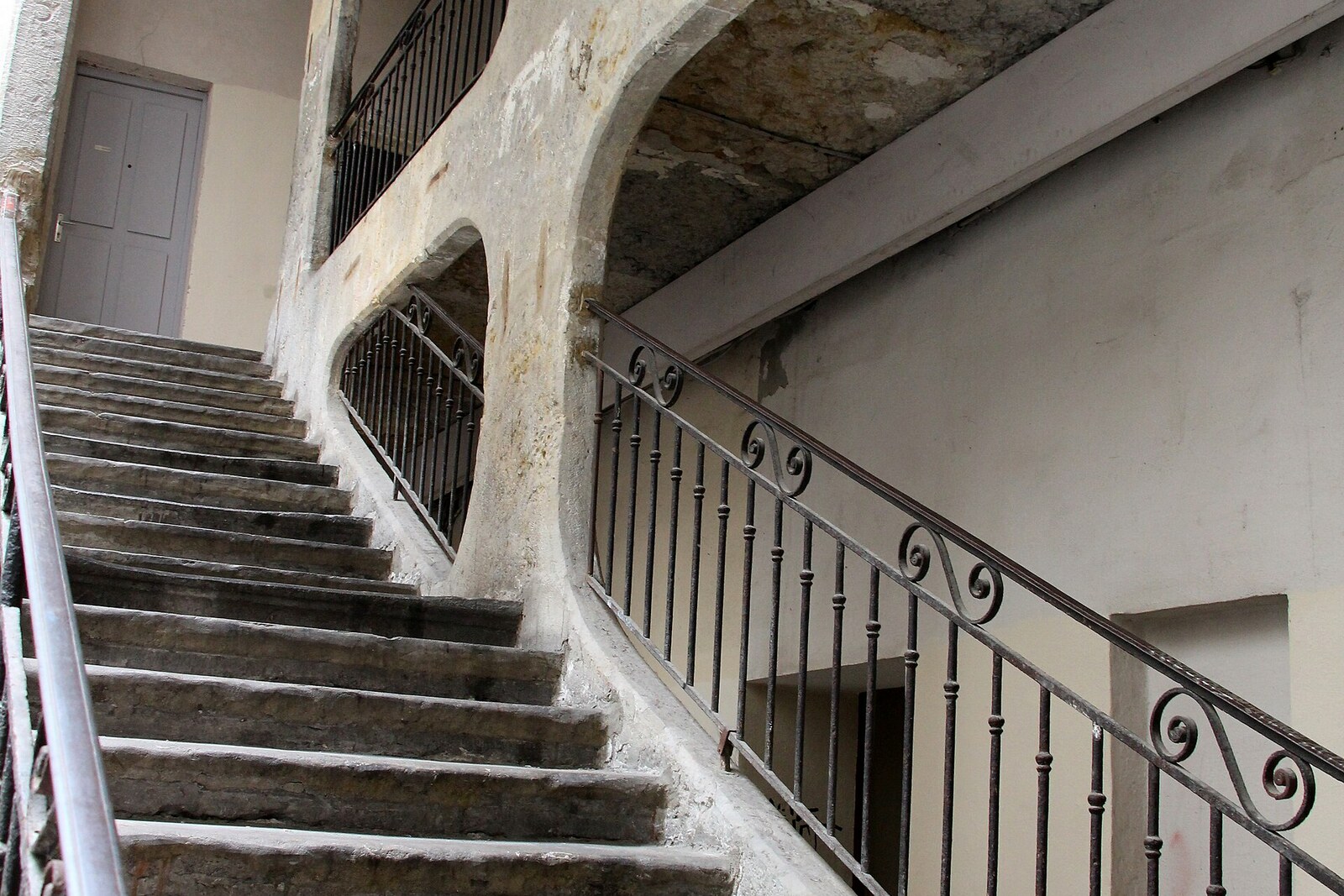
Look around first
What to notice
- Open stone flights
- Residential galleries
- Lower through-passage
- Tall courtyard wall
The story of the place
Ordinary life continues behind the tall walls of this courtyard: galleries lead to apartments, and open stone flights carry the entire climb up the slope. At the end of the twentieth century, about two hundred fifty people lived here, mainly families with modest means; the buildings lacked even bathrooms and toilets, while the staircase and floor structures needed reinforcement. During the renovation, the residents were not rehoused: the building was renewed while they remained in their homes, and the apartments were kept for people with low incomes.
The stone staircase occupies almost the entire wall of the courtyard. Residents climb its open flights to the galleries and apartments, while the lower passageways link Place Colbert with Montée Saint-Sébastien and Rue Imbert-Colomès. This is a residential complex and a traboule—a throughway running through buildings on a steep slope.
The name is associated with Les Voraces, a group of armed republican canuts that emerged on Croix-Rousse in eighteen forty-six. After the monarchy fell in February eighteen forty-eight, they occupied the city fortifications above the slopes and began dismantling the wall that separated Croix-Rousse from Lyon. Emmanuel Arago, a representative of the new government, persuaded them to withdraw, promising that the demolition would continue officially. The following year, the army suppressed another uprising, and the society of Les Voraces disappeared.
Urban tradition links the courtyard to this group. Les Voraces probably gathered here, but documentary evidence does not support accounts of fighting on the staircase or rebels being rescued through the traboule. Some scenes appeared much later in Lyon literature. Something else did verifiably happen here—this time over the fate of the residents.
By the end of the nineteen eighties, about two hundred fifty people lived in sixty-three apartments, mainly poor families. The apartments lacked bathrooms and toilets, there was no shared heating, and the floor structures and staircase needed reinforcement. Major repairs threatened to displace people: temporary housing in the center was expensive, and the charges here might also rise after the renovation.
Bernard Dever led the project—a priest who also headed a development company and the Habitat et Humanisme association. He worked to ensure that the building retained social housing after the repairs. A cooperative was created for the owners, with an obligation not to change this use for many years, and payments were calculated according to the families' circumstances. After negotiations with the residents, Dever made the key decision: not to evict a single family during the works and to carry out the renovation together with them.
From nineteen ninety to nineteen ninety-two, builders reinforced the staircase, removed the metal supports, replaced the utilities and floor structures, and installed kitchens, bathrooms, and central heating. The residents stayed. Apartments still stand behind the restored galleries: the association uses fifty-six of them for families, young workers, elderly people, and other residents with low incomes.
Useful on site
Traboule and residential courtyard; access may change. If the passage is closed, do not try to open the door; read this stop from outside at Place Colbert.
Checked: June 28, 2026. Check the official source before visiting.This is a residential space: speak quietly, do not photograph people, and do not stand by apartment doors. If the entrance is closed, limit yourself to the view from the public street.