 Guide On Map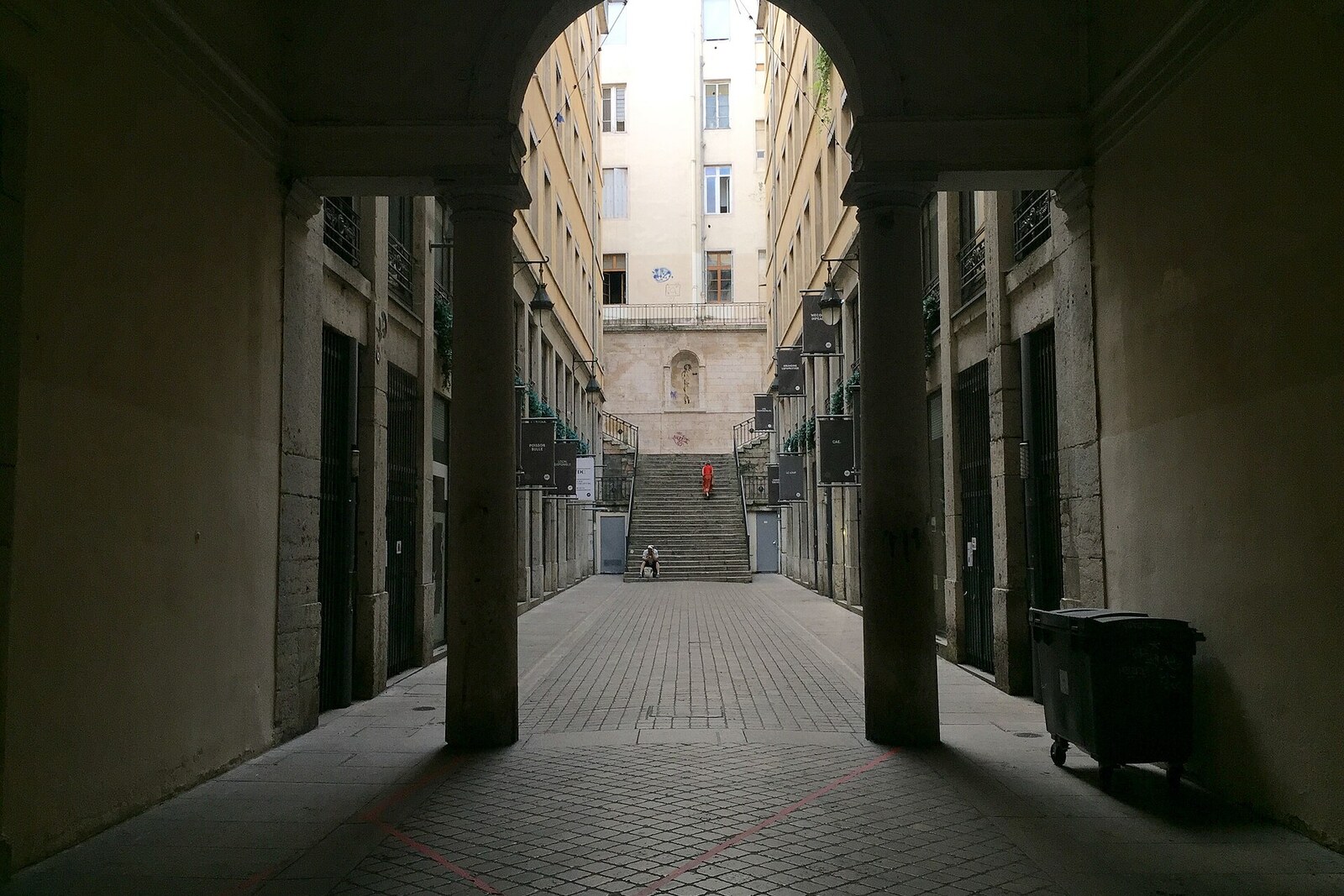
Look around first
What to notice
- The portico with lion heads
- Two diverging staircases
- Five-story blocks
- Workshop display windows
The story of the place
By the end of the last century, residents and merchants were leaving these blocks, while scattered owners could not pay for their repairs. City organizations bought up most of the premises and kept some apartments as social housing. The portico with lion heads opens onto a courtyard around which five-story blocks rise; from it, two staircases diverge toward the upper street. Small shops and workshops are once again operating below, and the passage through the building connects Rue René-Leynaud with Rue Burdeau.
Thiaffait is the surname of the man who paid for this entire complex. In eighteen twenty-three, the Lyon notary François-Félix Thiaffait bought a plot from a former monastic estate. The slope was quickly gaining people who made their living from silk, while it lacked a direct pedestrian route between Rue Vieille-Monnaie, now Rue René-Leynaud, and Rue du Commerce, now Rue Burdeau. Thiaffait acted as a property owner: he built apartments and shops that were meant to bring in rental income, while at the same time laying a short road across his property along the slope.
In eighteen twenty-six, he began with the lower entrance. By eighteen twenty-eight, five-story blocks already stood behind the portico with lion heads, enclosing the courtyard in a U shape. Two diverging staircases led from the courtyard to the upper street. Silk merchants, fabric finishers, thread winders, and pattern designers moved into the apartments; shopkeepers occupied the ground floor. Thus Thiaffait’s private house also became a passage used by the whole neighborhood. The owner’s surname remained on it after his death.
By the end of the twentieth century, residents and merchants were leaving the dilapidated blocks, and private owners could no longer manage the repairs. In the nineteen nineties, city organizations bought up most of the premises. Some apartments were retained as social housing, while the lower floors needed an occupation that could bring people here continuously: the passage lies away from the main shopping streets, and ordinary shops did not want to risk renting there.
In nineteen ninety-seven, specialists from the Institut Français de la Mode proposed giving the workshops to emerging clothing designers. After renovation, the Village des Créateurs opened here: young brands received small premises for several years, worked, and sold their goods at one address. The choice of textiles was explained by the nature of the building itself—its first residents also earned their living by processing silk and trading in fabrics.
When the previous organization closed in two thousand twenty-three, Pauline Gamore, the founder of Textile Lab, proposed continuing this work with artisans who sew from local and reused materials. Her project was selected for the new center—Passage Thiaffait, la Fabrique de la mode responsable. Now, behind the old portico, there are shops, workrooms, and shared machines for embroidery, fabric printing, and knitting. The staircases still connect Rue René-Leynaud with Rue Burdeau, and the premises along the courtyard are once again occupied by people whose income depends on fabric.
Useful on site
The passage is usually treated as an open city passageway, but the Village des Créateurs shop windows follow the schedules of individual boutiques; do not count on uniform opening hours.
Checked: June 28, 2026. Check the official source before visiting.Walk through freely, but keep in mind that some premises are working spaces or homes. Access inside the workshops and participation in their programs must be arranged separately.