 Guide On Map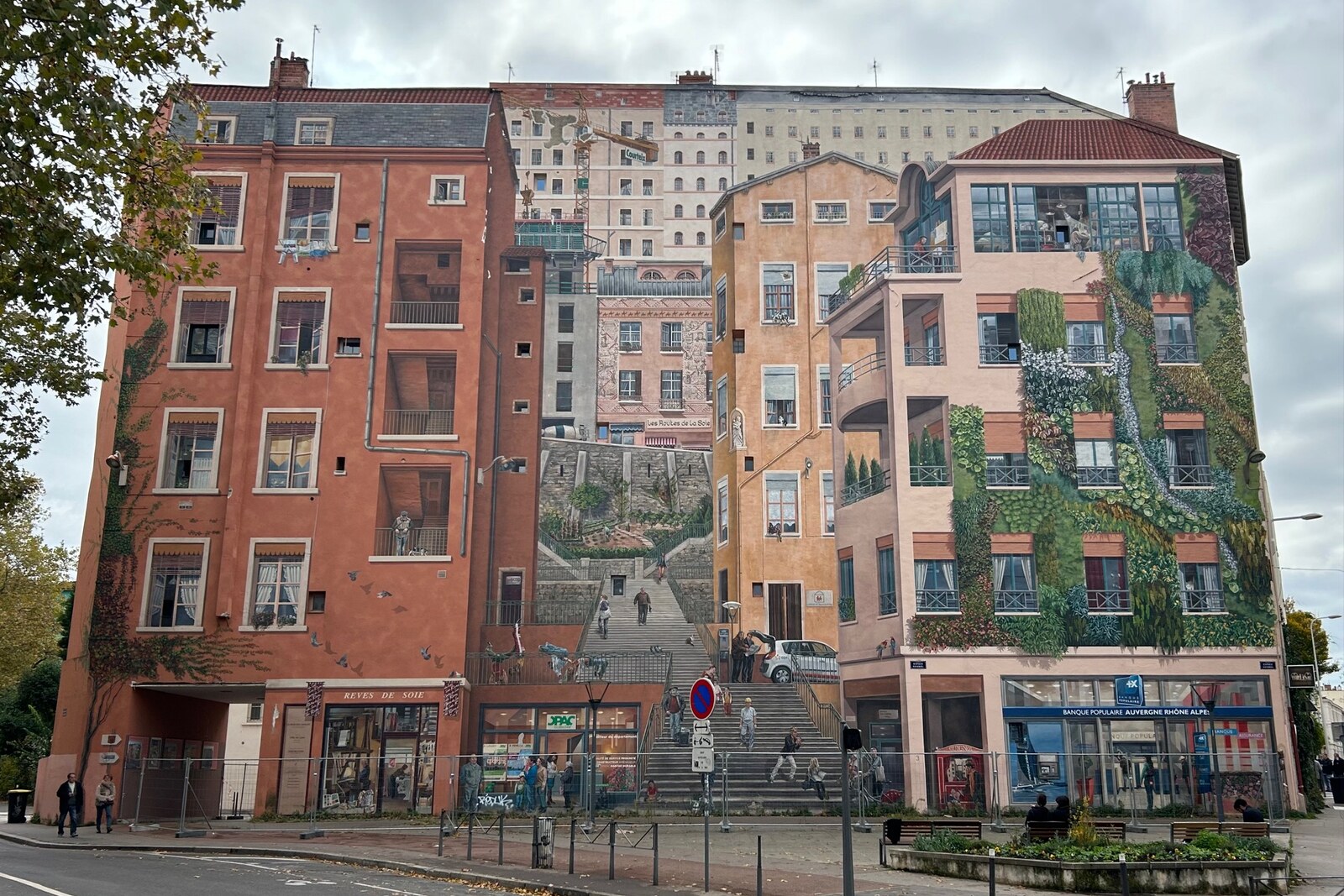
Look around first
What to notice
- The painted staircase
- A family with a bicycle and a scooter
- The Rêves de soie shop window
- Tall workshop windows
The story of the place
An entire piece of Croix-Rousse unfolds across the façade: staircases, balconies, and tall windows form a street that does not exist behind the wall. Here, canuts were the silk weavers who worked at home on hand looms. For the looms and daylight, the district's workshops had ceilings nearly four meters high and huge windows; their rhythm continues in this painted architecture. Among the shopfronts below, a shop with a hand loom remains.
In nineteen eighty-seven, artists from the Lyon cooperative Cité de la Création were commissioned to cover a huge blank gable end. It had remained after demolitions that cleared space for the boulevard. On a concrete surface of about one thousand two hundred square meters, the artists painted an extension of Croix-Rousse: houses, balconies, shopfronts, and a staircase that seems to rise up the slope.
The models were residents of the district. Among them was a young Marc Carbonare-Delpal. In the first version, he was climbing the painted steps with a bicycle on his shoulder. The contract provided for regular restoration of the mural, but the artists decided not to bring back the old image. Ten years later, they repainted both the district and its inhabitants. Marc reappeared as a father, with his little daughter Sara beside him.
By the next major update, in two thousand thirteen, Sara had grown up. Now she sits on the steps with a notebook, while her brother Joris rides a scooter behind her. Their mother Christine photographs her husband, and Marc holds a city rental bicycle. One family occupied the façade for a quarter of a century: the artists added children and changed the parents' ages in step with their real lives.
The name “Mur des Canuts” means “Wall of the Canuts.” In Lyon, canuts were the craftsmen who wove silk on hand looms. Merchant-manufacturers supplied them with yarn and an order, then paid for the finished cloth. The looms stood right in the workshop apartments, so on the Croix-Rousse plateau they built floors with ceilings about four meters high and large windows: the complex machinery needed space, and the weaver needed daylight. The artists repeated such windows on the wall.
During the nineteen ninety-seven update, they placed a real craftsman, Georges Mathelon, in a painted shop. His family hand-weaving workshop operated until nineteen ninety-six. Mathelon died in two thousand four, but the artists did not remove him in the next reworking. In the current mural, Marc holds a rental bicycle, while below, behind the window of Rêves de soie, Georges Mathelon still sits at a hand loom.
Useful on site
Open-air street mural; view it from the opposite side of Boulevard des Canuts and do not stand in the roadway.
Checked: June 28, 2026. Check the official source before visiting.Step back far enough to see the entire illusion, then come closer and compare the painted shadows and openings with the real ones. Do not block the sidewalk for a photograph.