 Guide On Map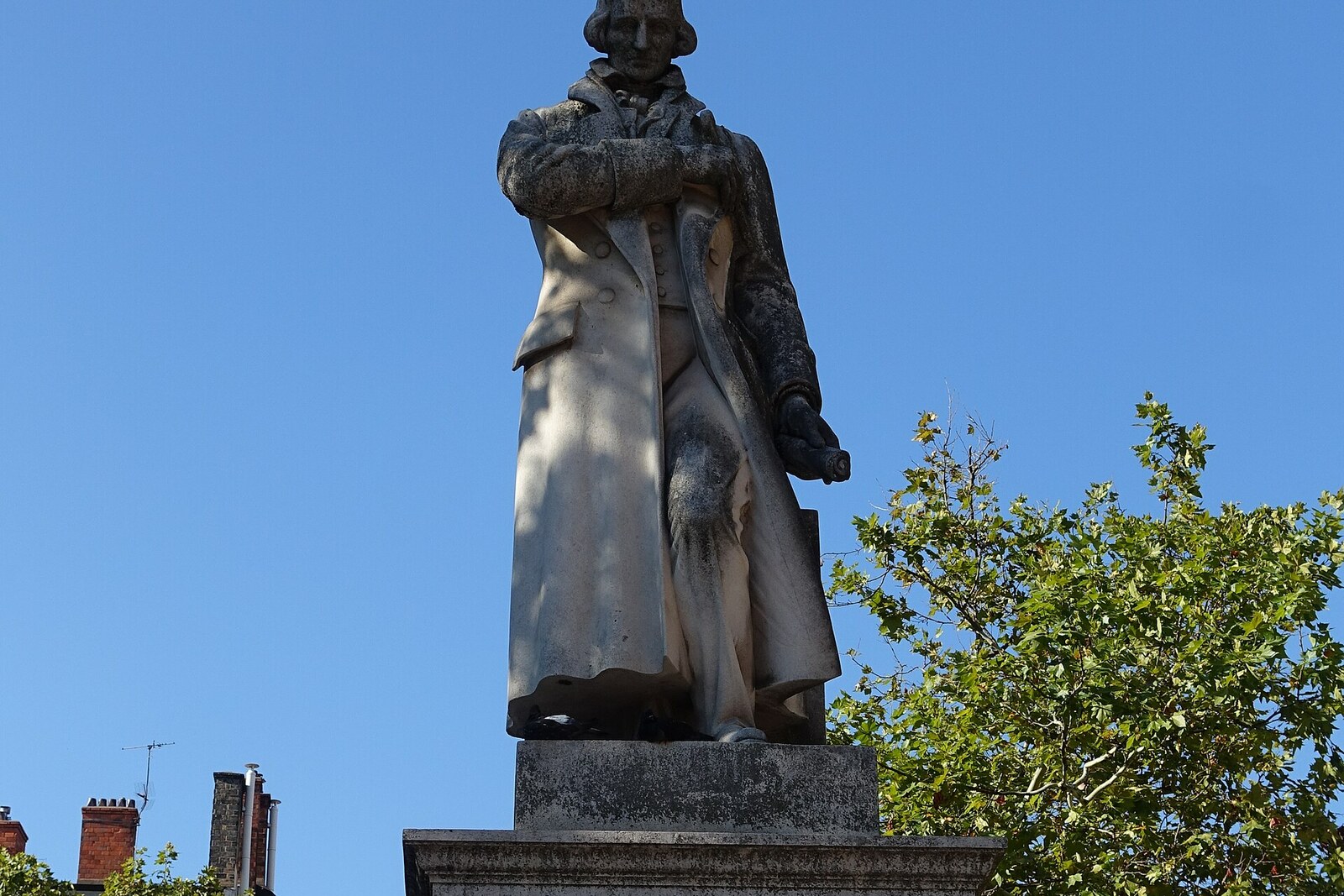
Look around first
What to notice
- Stone statue of Jacquard
- The broad line of the boulevard
- The edge of the plateau above the descent
The story of the place
On the morning of November twenty-first, eighteen thirty-one, several hundred canuts gathered at the edge of this square. At the time, the Croix-Rousse plateau was a separate commune, and Lyon began below it. A fortification wall and city gates stood between them.
A stone cross still stood in the square. Its predecessor had been placed here at the end of the sixteenth century, made from pinkish-ochre stone quarried in Couzon-au-Mont-d'Or. Such stone was called russet—"rousse." The suburb, then the commune, and finally the square took their names from the cross. In seventeen ninety-two, the cross was smashed; under the First Empire, it was restored in gray stone.
The canuts gathering near it demanded enforcement of an agreement on which their earnings depended. The owner of a weaving workshop owned the looms and paid assistants, but received the silk and the order from a merchant, who set the price for the finished length of cloth. The looms could run all day, yet the proceeds would still not cover the workshop and the family.
Prefect Louis Bouvier-Dumolard, who was trying to reconcile the weavers and the merchants, secured approval of minimum rates. More than one hundred manufacturers refused to observe them: they regarded the mandatory tariff as a violation of freedom of trade. On November twentieth, the association of workshop owners declared a general work stoppage.
The next day, the canuts passed through the gates and began descending Montée de la Grande-Côte. A detachment of the National Guard blocked their way. After the shots, three weavers lay in the street. The others returned to the plateau, roused their neighbors, obtained rifles, and began building barricades.
By the night spanning November twenty-second and twenty-third, the insurgents had occupied Lyon, and the mayor had fled. But the canuts were seeking fair rates and had not prepared to govern the captured city. On December third, the royal army entered Lyon. The government repealed the tariff, removed the prefect, and arrested ninety weavers; the court later acquitted them. The workshop owners returned to their looms without the guaranteed pay for which they had left Croix-Rousse.
The fortification wall was demolished in the eighteen sixties. The present boulevard was laid out along its line, and a market soon appeared here. The city council removed the gray cross in eighteen eighty-one. Its place at the center of the square was later taken by Joseph-Marie Jacquard, a Lyon mechanic whose punched-card device controlled the threads of a patterned loom. The bronze figure was moved here in nineteen oh one, melted down under the Vichy regime in nineteen forty-two, and replaced in nineteen forty-seven by the present stone one. The market stalls now stand along the vanished wall; all that remains of the gates is the boundary between the square and the descent.
Useful on site
The square is always open. Croix-Rousse food market: Wed–Thu 06:00-13:00; Tue/Fri/Sat/Sun 06:00-13:30; Mon closed; check holiday and New Year's hours separately.
Checked: June 28, 2026. Check the official source before visiting.View the monument from different sides without obstructing movement through the square. If trading is going on around you, take it as the place's modern life, not as a required part of the stop.