 Guide On Map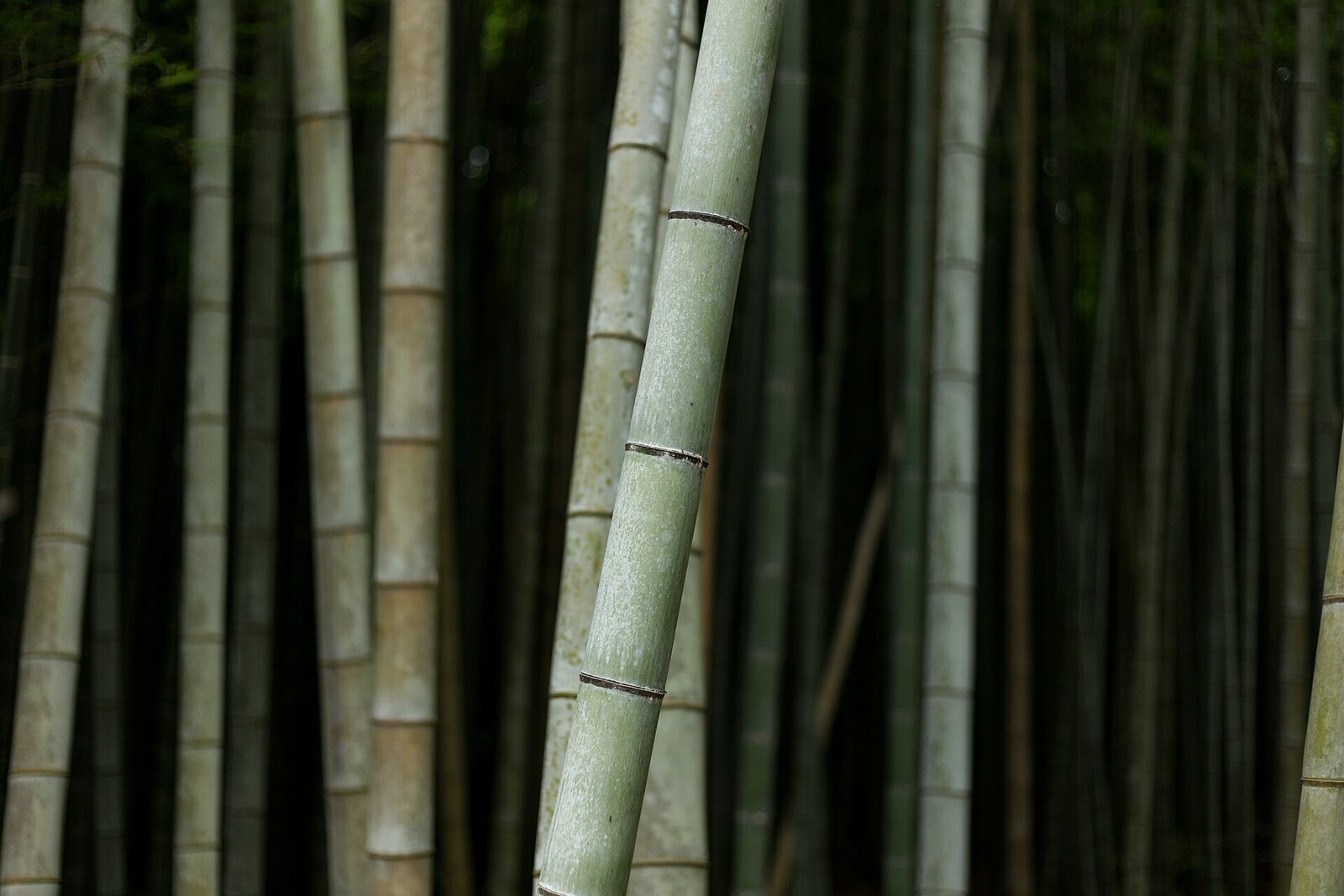
Look around first
What to notice
- Tall culms of madake bamboo
- Green canopy above the path
- Woven fences
- Gaps between the culms
The story of the place
The three-meter-wide path cuts through the Nonomiya grove and divides two sections monitored by scientists. Madake bamboo rises on both sides, a Japanese bamboo whose culms in a single grove are linked underground by rhizomes. Woven fences are visible along the edge of the path, and beyond them gaps remain between the tall culms.
At the beginning of the nineteen seventies, there was no green canopy above this path. All the culms on both sides stood dry and leafless. Sunlight reached the ground, where kudzu, wild rose, and other plants had spread; it became difficult to enter the grove itself.
Madake bamboo grew here—one species of Japanese bamboo. Its culms are linked underground by rhizomes and can flower almost simultaneously. Flowering ends their life cycle: after the aboveground culms die, a substantial part of the old rhizome dies as well. In the Nonomiya grove, this process began around nineteen sixty-seven to nineteen sixty-eight. By the autumn of nineteen seventy, the entire old stand had died.
The die-off happened shortly after people tried to protect Sagano. In nineteen sixty-six, Japanese lawmakers introduced a special protection regime for historic landscapes. Tree and bamboo cutting was restricted in this area. When the madake bamboo flowered, saving it required the opposite: removing the dead culms as soon as possible, clearing the ground, and giving the surviving underground shoots room to grow. Later, researchers explicitly named the protection restrictions as one of the reasons why care of the grove was delayed by four or five years.
When the wall of bamboo disappeared and newspapers began writing about it, Kyoto officials turned to three forestry specialists from Kyoto University—Masatoshi Watanabe, Shinnosuke Ueda, and Koichiro Ueda. They were tasked with restoring the Nonomiya grove without destroying the last rhizomes capable of recovery. Ordinary research methods were dangerous here as well: to measure growth, the scientists had to cut the very young bamboo they were trying to save. In nineteen seventy-five, they cut only four new culms for examination.
First, in nineteen seventy-one, people removed all the dead culms. From the following year, workers mowed the kudzu, applied fertilizer, preserved the thin shoots that looked more like grass, and planted new bamboo in some places. These weak shoots produced young rhizomes. By nineteen seventy-six, new growth made up almost the entire grove, and one year later the largest culms had already exceeded the average thickness of the bamboo that grew here before the die-off.
The three-meter-wide path divided two sections whose restoration the scientists monitored. It still runs between them. No tall culm above it grew here before the mass flowering: that bamboo was completely cut down in nineteen seventy-one. The walls of the present passage rose from the next generation.
Useful on site
Public path with no ticket control; neighboring paid sites and shrines follow their own schedules. Checked 2026-06-30.
Checked: June 30, 2026. Check the official source before visiting.Do not reach over the fence, scratch the culms, or leave the path. If the flow of visitors allows, stop to one side and listen to the rustle of leaves, the creaking, and the short tapping of bamboo.