 Guide On Map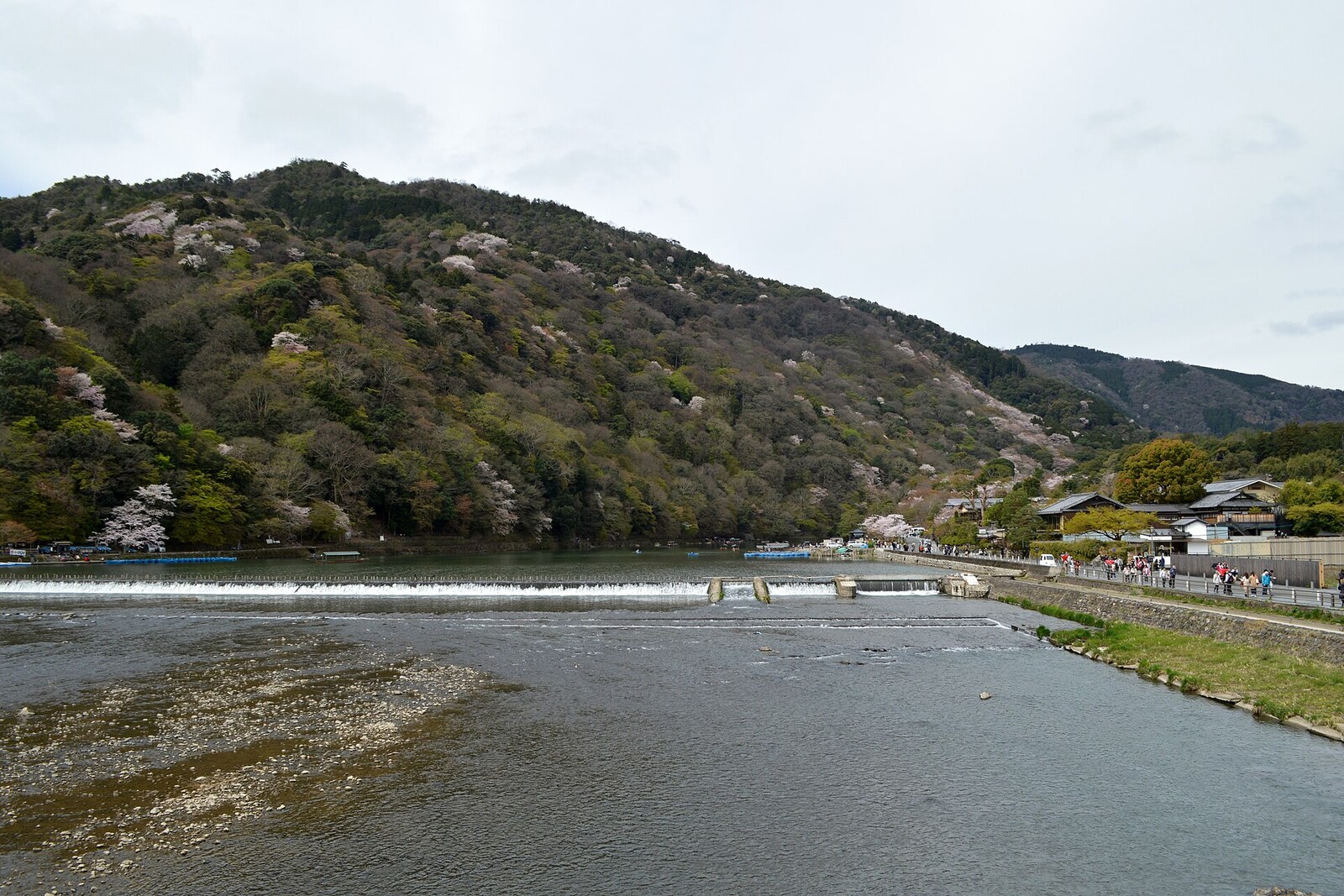
Look around first
What to notice
- Wooden railing
- Modern supports
- Hozu River channel
- Arashiyama slopes
The story of the place
The wooden railing conceals the modern load-bearing structure of this crossing: the current bridge was completed in nineteen thirty-four after a series of floods and rebuildings. The crossing once stood approximately one hundred meters farther upstream, near Horin-ji Temple, and had another name; nothing remains of the earlier wooden bridges. The Hozu River channel runs between the slopes of Arashiyama, and boats from the gorge end their journey at the bank beside the bridge. Three people work in each one: one guides the vessel with a pole, another rows, and the third holds the rudder.
In the spring of sixteen oh six, Suminokura Ryoi, a fifty-one-year-old Kyoto merchant, invested his own money in this river. He had grown rich through maritime trade with Vietnam, which Japanese merchants were permitted to conduct under special licenses, and now he wanted to establish transport within the country. Beyond Hozu Gorge lay Tamba Province, the area around present-day Kameoka: rice, vegetables, firewood, and construction timber were brought from there to Kyoto. Logs were floated downstream in rafts, but loaded boats could not pass between the rocks and shallows. All other goods had to be hauled along a mountain road.
Ryoi obtained permission from Tokugawa Ieyasu, the head of the military government, and in five months cleared a navigable channel through the gorge. Workers broke up rocky outcrops, removed boulders, and deepened the riverbed. The merchant’s family paid for the work and, in return, received the right to operate transport here. Ryoi was risking the fortune he had earned on distant sea voyages for a river along which not a single cargo boat had yet passed.
Clearing the channel alone proved insufficient. The local rafters had no intention of changing their accustomed trade. Ryoi then brought shipwrights and boatmen to Arashiyama so that they could teach farmers to build flat-bottomed boats and guide them through the rapids. The rafters continued transporting timber, while local residents gained new work. Boats carrying rice and goods began traveling along the Hozu River.
During the same work, Ryoi moved the old bridge approximately one hundred meters downstream—to the line where today’s Togetsukyo Bridge stands. No separate explanation survives for why he chose that exact line: documents link the move to the reworking of the navigable channel. Before that, the crossing stood upstream, closer to Horin-ji Temple, and was called Horin-ji Bridge. Ryoi’s wooden structure also disappeared after later floods and rebuildings. The bridge here now was completed in nineteen thirty-four; its railing was kept wooden, while its load-bearing structure was made modern.
The name survived all these replacements. According to the traditional version, it was given in the late thirteenth century by Emperor Kameyama, a retired emperor who lived in a country residence here. Seeing the moon move above the bridge from east to west, he compared it to a traveler crossing a bridge. This is how Togetsukyo Bridge acquired its name—“the bridge the moon crosses.” Kyoto historians warn that there are other versions of the name’s origin, so the story of Emperor Kameyama remains a legend. The bridge he may have seen stood farther upstream; what survives from it is the name, not the logs.
In the late nineteenth century, the railway took freight transport away from the boatmen, and they began carrying travelers instead. Now the descent along the Hozu River ends at Togetsukyo Bridge. There are three people in each boat: one pushes with a pole, the second works an oar, and the third holds the rudder. These roles took shape after Ryoi’s clearing work. A passenger boat moors beside the bridge of nineteen thirty-four—at the place where the merchant moved the crossing more than four centuries ago.
Useful on site
Open city bridge; free passage without a ticket. Stay on the sidewalk and do not linger in the roadway. Checked 2026-06-30.
Checked: June 30, 2026. Check the official source before visiting.To see the whole bridge, first look at it from the bank; do not linger in the middle of traffic on the crossing itself. From the water and from different banks, its silhouette reads differently.