 Guide On Map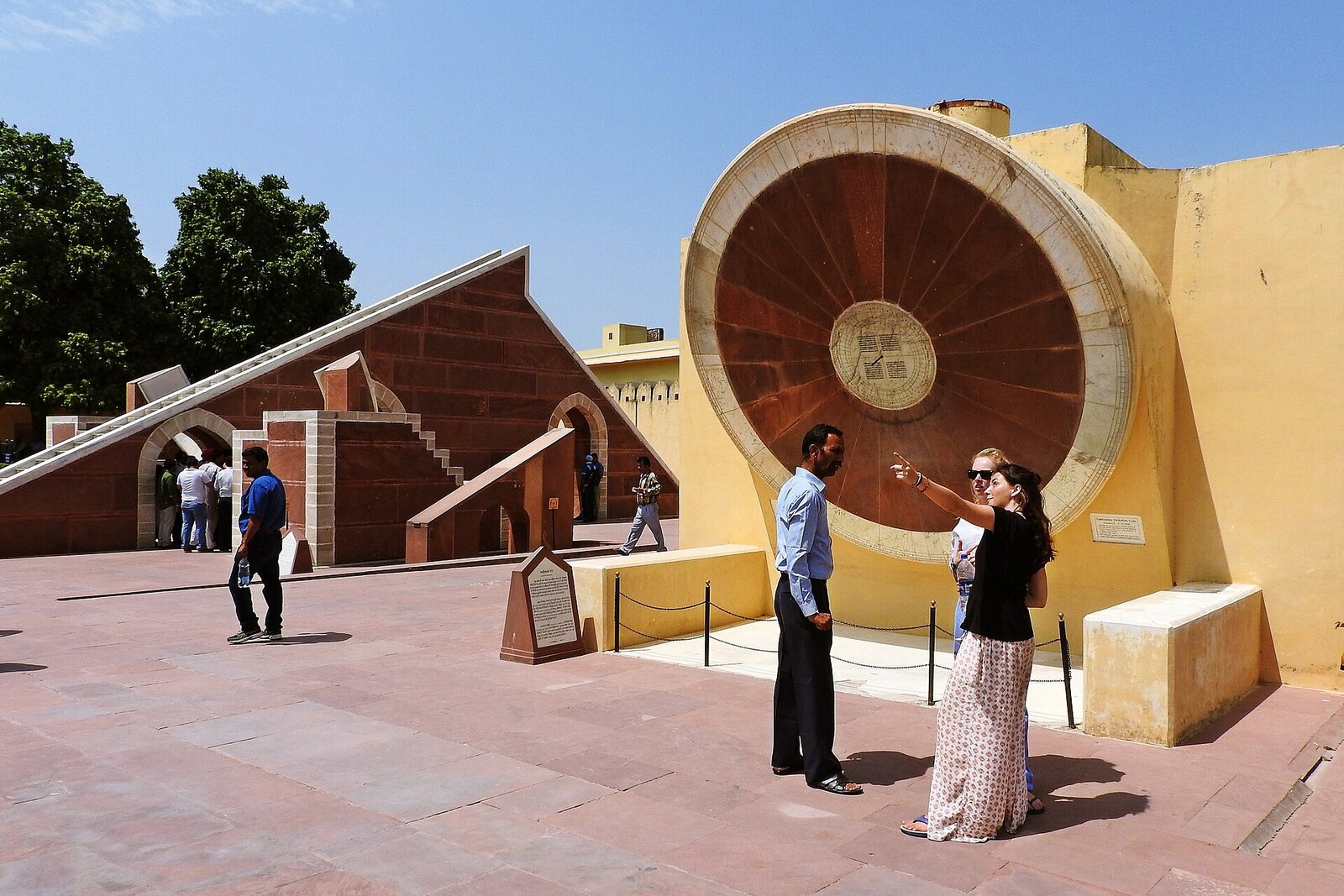
Look around first
What to notice
- The bowls of the Jai Prakash Yantra
- The Brihat Samrat Yantra
- Triangular walls
- Marble scales
The story of the place
A level site beside the City Palace was set aside for the stone observatory when a new capital was being built nearby. Rising above the other structures is the Brihat Samrat Yantra: its long sloping wall is set in the direction of the Earth's axis, with two marked arcs running along its sides. The movement of the Sun's shadow across these arcs gives the local solar hour. Time and the calendar were worked out here for the court, while townspeople learned the hour from a drum or a cannon shot.
In seventeen thirty-four, about two dozen astronomers received daily wages here. Their workplaces were stairs, walls, cylinders, and bowls the size of small buildings. In the paired hemispheres of the Jai Prakash Yantra, an astronomer descended among marked sectors and determined the Sun's position from the shadow of a metal disk. When the shadow fell into a gap between sectors, the observation continued in the second bowl: its solid sections corresponded exactly to the gaps in the first.
This team was assembled by Sawai Jai Singh II, the founder of Jaipur. He wanted to eliminate discrepancies between what astronomical tables predicted and what people observed in the sky. Such tables were called zijs: they were used to calculate the positions of the Sun, Moon, and planets, predict eclipses, compile calendars, and choose dates for court ceremonies. In the preface to his work, Jai Singh wrote that the Mughal emperor Muhammad Shah had instructed him to bring calculation and observation into agreement.
At first, Jai Singh worked with portable brass instruments. Worn axes, shifting centers, and scales lacking fine divisions did not satisfy him. He decided to fix geometry in stone and enlarge it many times over. Markings were applied to plaster and marble, triangular walls were aligned with the Earth's axis, and circles with celestial coordinates. The name “Jantar Mantar” comes from the words “yantra,” meaning instrument, and “mantrana,” meaning calculation or counsel: literally, it is a collection of instruments for calculation.
Jai Singh established his first such observatory in Delhi. The Jaipur complex became the main one when the maharaja moved his court here and built a new capital. A level site beside the City Palace was chosen for the instruments. Being close to the ruler's quarters was practical: astronomers set the local time and the calendar, while townspeople were told the hour by drumbeat or cannon shot. Observation, calculation, and the announcement of time took place in the city center, not in a distant tower.
The tallest instrument is the Brihat Samrat Yantra, the “great supreme instrument.” The sloping face of its triangular wall is parallel to the Earth's axis, and its two curved scales lie in the plane of the equator. The Sun moves across the sky, the edge of the shadow crosses the divisions, and they give the local solar time. The scale is marked at intervals of two seconds, although the blurred edge of the shadow prevents it from being read that precisely. To find its middle, a thin thread or rod is held above the scale, and the point where its own shadow disappears is marked.
Jai Singh expected that many years of observations would produce new tables. Under his direction, the Zij-i Muhammad Shahi was compiled, a collection named in honor of Emperor Muhammad Shah. A later study of the manuscripts showed that a significant part of the tables went back to the works of the Samarkand astronomer Ulugh Beg and the French astronomer Philippe de La Hire, recalculated for Indian calendars and the local meridian. The stone instruments produced fewer new figures than their patron had hoped. But the team systematically determined time, tracked celestial bodies, calculated eclipses, and supplied calendar compilers with data. Until Jai Singh's death in seventeen forty-three, Jaipur remained the center of this work.
After his death and the struggle among his heirs, funding was reduced. By the beginning of the nineteenth century, regular observations had ceased. A neighboring cannon workshop used the site as a utility annex: a pit was dug at the foot of the Brihat Samrat Yantra and a metallurgical furnace was installed, while two other instruments were dismantled to clear space for a temple.
Under Maharaja Sawai Ram Singh II, restorers restored the observatory by eighteen seventy-six. They replaced damaged plaster with stone, filled lines with lead, and remade the scales. That is why many of the white marble divisions before us are younger than the instruments themselves. But the slope of the Brihat Samrat Yantra remained aligned with the Earth's axis, and the Sun's shadow still crosses the scale where Jai Singh's daily-wage astronomer looked for the exact hour.
Useful on site
Daytime ticketed access; it is best not to put off your visit until the very end of the day, because the site is read through light and shadow, not only through labels.
Checked: June 15, 2026. Check the official source before visiting.You can fully examine the instruments and understand their relative arrangement inside with a separate ticket; do not step onto the scales or working surfaces.