 Guide On Map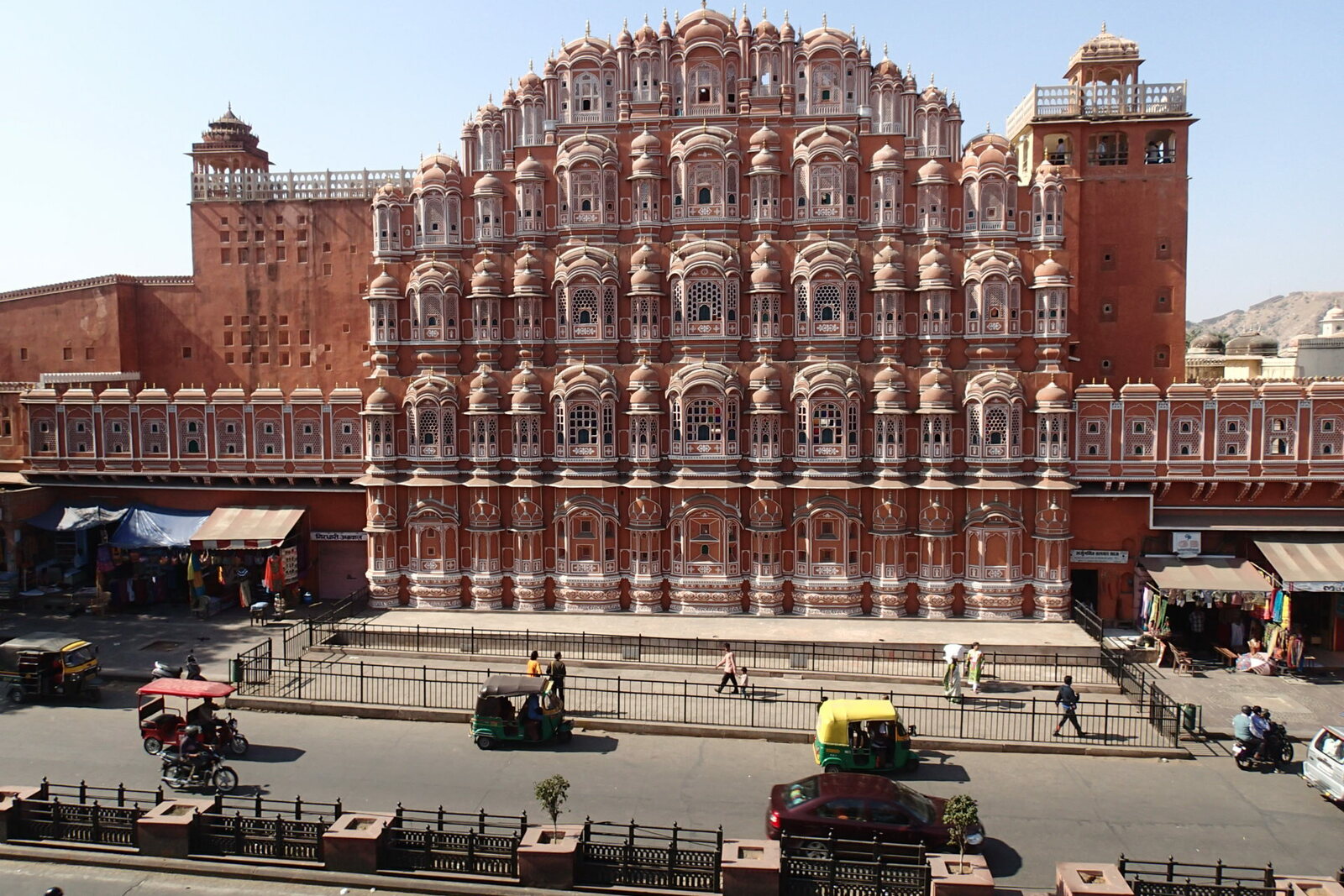
Look around first
What to notice
- Five tiers of galleries
- Latticed jharokhas
- Pink wall
- Badi Chaupar square
The story of the place
The pink wall by Badi Chaupar stands on the eastern edge of the City Palace, where the roads of several old bazaars converge. Behind it rise five tiers of narrow galleries with nine hundred fifty-three latticed jharokhas; from the square, only this outer screen is visible, while the entrance is on the palace side. Air flows continuously through the frequent openings, and the palace addition was called Hawa Mahal, the Palace of Winds.
In seventeen ninety-nine, Maharaja Sawai Pratap Singh, the ruler of Jaipur, commissioned the court architect Lal Chand Ustad to solve a palace problem. The women of his family wanted to watch city festivals and processions, yet they lived in the zenana—the women's part of the City Palace—and observed purdah. This custom separated them from unrelated men and forbade them from appearing before the street crowd. For a noble family, breaking purdah was considered a loss of family honor.
Pratap Singh chose the eastern edge of the palace beside Badi Chaupar. Here broad bazaar streets converged, along which maharajas rode on elephants and in chariots to temples and festivals. The avenues of old Jaipur could accommodate several elephants abreast: a court procession had to be visible to the townspeople. From the palace zenana, this public life remained inaccessible.
Lal Chand Ustad added five tiers of galleries to the women's quarters and enclosed them on the street side with nine hundred fifty-three small windows. Each jharokha—a projecting window—received a lattice. The women could make out people, trade, and processions below, while passersby could not discern their faces. They gained a place inside the palace from which to take part in city events as spectators; they did not have to leave the zenana or abandon purdah to do so.
The many openings also performed a second, literal function. Air passed continuously through the lattices into the galleries, so the addition was called Hawa Mahal—the Palace of Winds. Behind the ornate wall, no ceremonial entrance was made on the bazaar side: entry is possible from the opposite, palace side. The street sees the outer screen of the women's quarters, not the main façade of the large residence.
At Badi Chaupar, the roads of several old bazaars still converge. The pink wall stands where Pratap Singh had it placed: between the enclosed zenana and the busy intersection. From the square, only the lattices are visible; from behind the lattices, the square and street can still be seen.
Useful on site
The square and outer façade can be understood as a street-side stop at any time; the interior of Hawa Mahal requires a separate daytime ticketed visit and is not essential to this route.
Checked: June 15, 2026. Check the official source before visiting.The best overall view opens from the street side, but view the façade only from a safe place outside the traffic flow; an interior visit is arranged separately.