 Guide On Map
Old Jaipur: Urban Grid and Royal Quarter
From Ajmeri Gate through the bazaars and palace to Hawa Mahal
Guide On Map on your phone
Open the walk like a regular app
It takes about 10 seconds to install. No app store needed.
The whole path
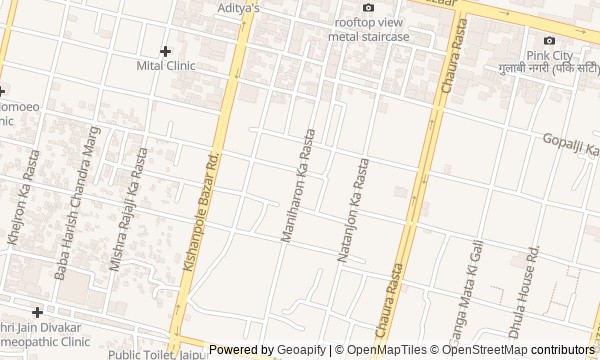
Route map
About the walk
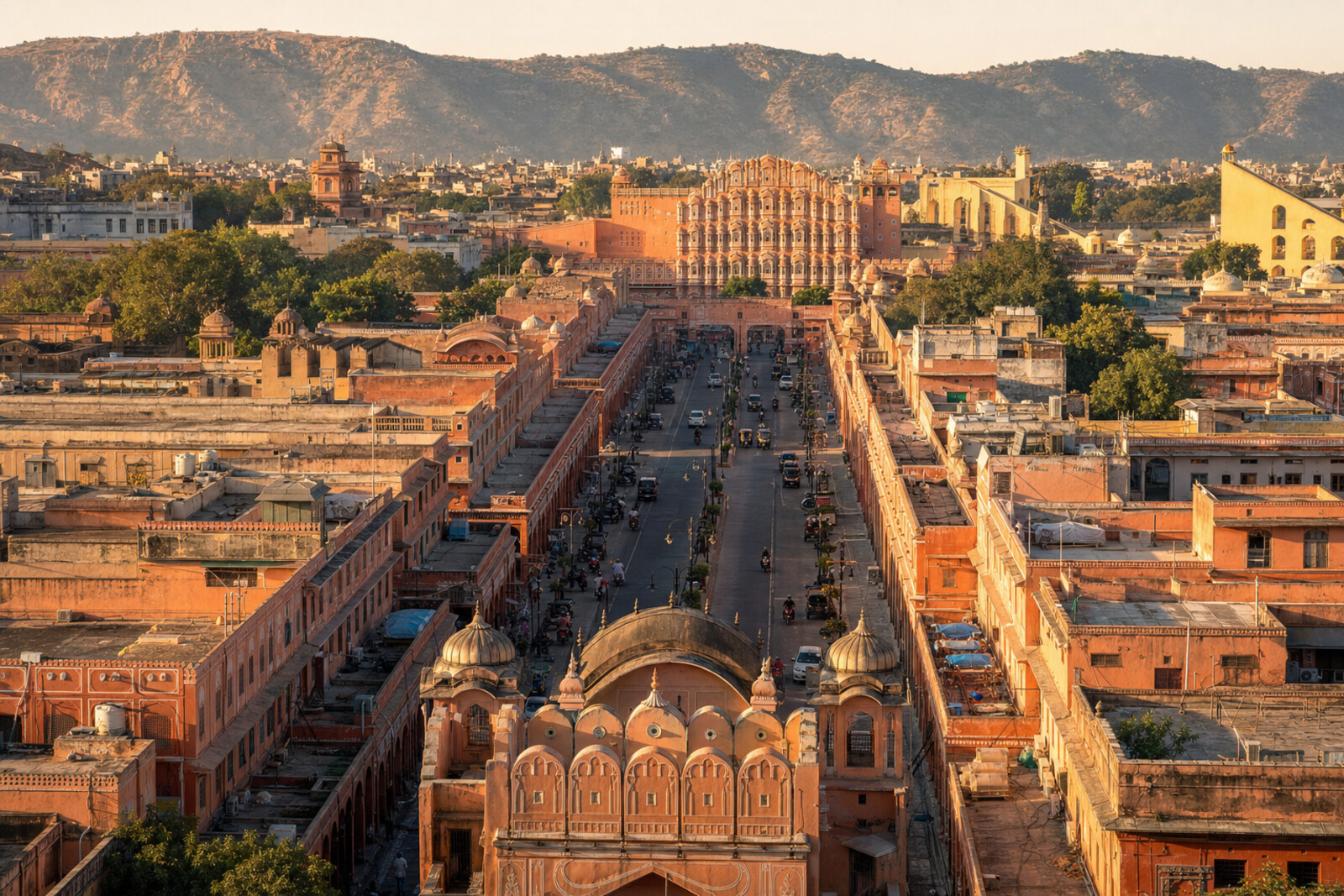
You will enter old Jaipur through Ajmeri Gate and follow straight bazaar streets to two chaupars, the royal palace, the observatory, and the pink wall of Hawa Mahal.
Beyond the first arch, a city designed for trade begins. At Chhoti Chaupar, you will learn what metro builders found beneath the intersection. At the triple palace gates, another question emerges: why some people were given their own crafts lane, while others were not allowed past the arches. Inside the palace, you will discover why ministers waited eighteen hours for orders from closed chambers. Among the stone instruments, it will become clear what happens to an observatory when its main patron dies.
The story follows the everyday consequences of major decisions, without ceremony or grandeur. By the end, the gates, squares, shop rows, and palace wall will let you reconstruct how Jaipur was divided among trade, power, water, and the secluded life of the zenana.
Why this order
Ajmeri Gate establishes the boundary of the old city, while the straight line of Kishanpole Bazaar leads to Chhoti Chaupar, the first hub where the layout served not only trade but water supply. From the square, the eastern line continues along Tripolia Bazaar: after the distributive intersection, you can see how crafts lanes and the palace exit were fitted into the same grid. The gates closed to ordinary visitors require a detour around the wall to Virendra Pol; the walk itself reveals the divide between the public bazaar and the residential part of the palace. From the palace courtyards, neighboring Jantar Mantar continues the story of court life through time and calendar calculations. The final stretch returns to the eastern bazaar street, Badi Chaupar, and Hawa Mahal, where the palace's secluded world stands right beside the route's busiest intersection.
Those who want to understand the layout of old Jaipur, not just see its facades Fans of urban history, crafts, and science Those interested in the human consequences of rulers' decisions
Those expecting a walk through quiet neighborhoods Those looking only for an overview of palace interiors Those who prefer a collection of photo stops without a connected story
Before you go
Choose morning or late afternoon: it is easier to walk across the open squares and study the relief of the facades. The gates, bazaars, chaupars, and street side of Hawa Mahal can be understood without visiting interiors; City Palace and Jantar Mantar require separate admission, so decide in advance whether you want to include one or both. Parts of the old city remain working streets: keep to a predictable path, cross the road carefully, and do not linger in shop passages. During major religious processions, the route around Tripolia Gate and the chaupars may change—treat the processions as a priority of city life, not an obstacle to the route.
When to go
Without visiting paid sites, the walk takes about 2.5–3 hours. With City Palace and Jantar Mantar, allow 3.5–4 hours.
Backup plan
If heat, crowds, or closures make the full route difficult, begin at Chhoti Chaupar. From there, you can see Tripolia Gate, the palace quarter, Jantar Mantar, and Hawa Mahal with Badi Chaupar in sequence. You will miss the story of the city's threshold at Ajmeri Gate, but keep the route's main connection: public square, royal boundary, center of power, measuring the sky, and the watchful facade. If you have time for only one interior, choose by interest: the palace for ceremonies and living dynastic history, the observatory for stone instruments and work with shadow.
Route conditions
Surface. Paved — 349 m (data covers 11% of the route)
Facilities. Toilets — 10
Elevation. Ascent — 24 m; descent — 16 m
OpenStreetMap extract of June 18, 2026: database data, not a check on the ground. Data © OpenStreetMap contributors, ODbL licence
Walk plan
Open in maps ↗- 1
Ajmeri Gate
Here you will see why the old gates ceased to be the city boundary. - 2
Chhoti Chaupar
Here, an old reservoir and a metro tunnel meet beneath a single intersection. - 3
Tripolia Bazaar and Tripolia Gate
This stop explains why the invited craftspeople were given a lane beside the palace exit. - 4
City Palace
Here, the closed private quarters will turn out to be the place where the question of the next ruler was decided. - 5
Jantar Mantar
Here you will see what astronomers calculated among the stone instruments and what happened in practice. - 6
Hawa Mahal and Badi Chaupar
The finale will connect the palace zenana with the route's busiest intersection.
Route features
Everything you need stays in the browser
Progress, saves and your trip plan are stored on this device.
Add Guide On Map to your home screen so the walk opens outside the browser.
How we handle sources, maps and corrections: our editorial standards