 Guide On Map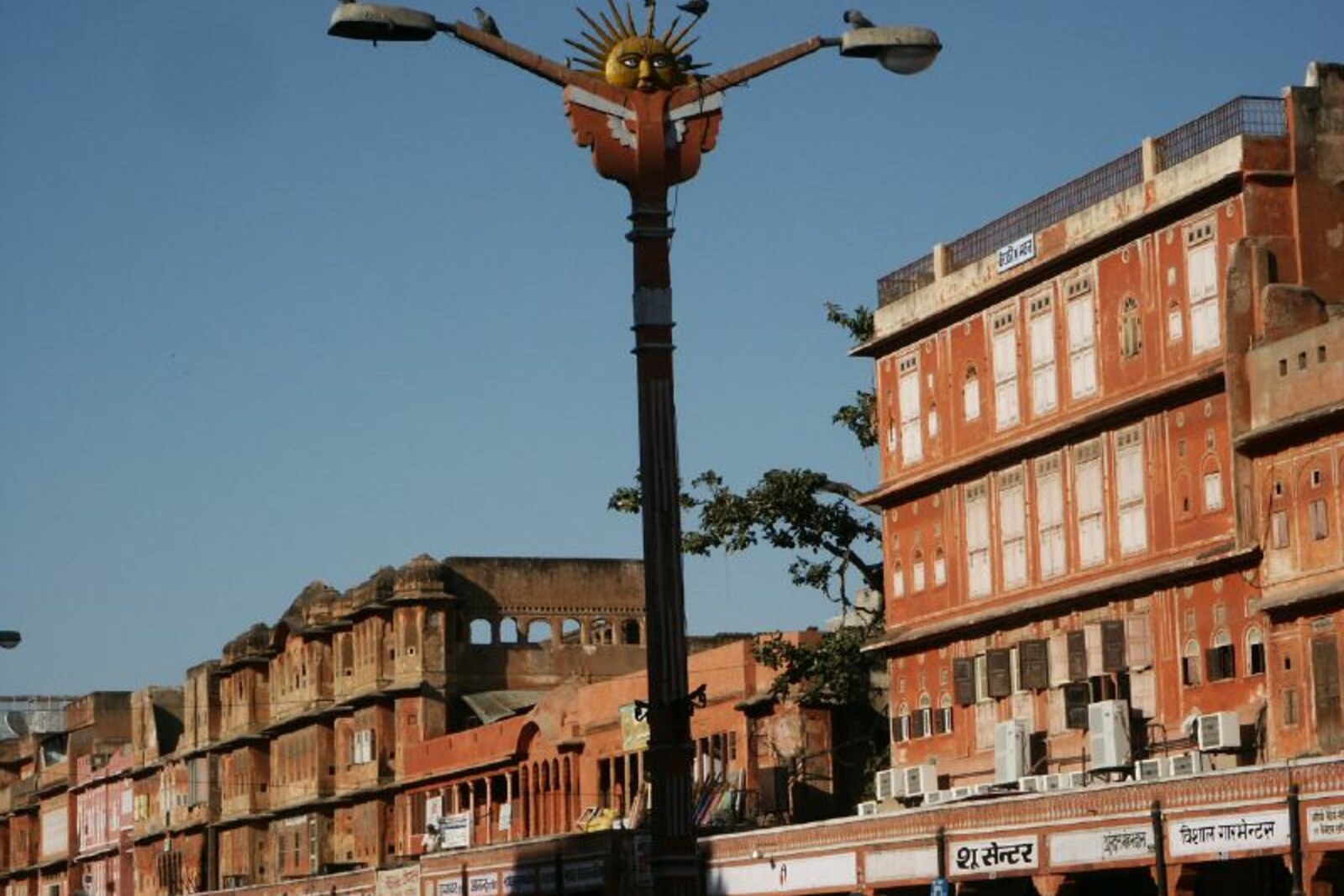
Look around first
What to notice
- Jewelry shops
- Entrances to side lanes
- Counters with jewelry
- Trading offices
The story of the place
Small workshops and trading offices still operate in Johari Bazaar, and finished jewelry lies on the counters. One of the lanes, Ghee Walon Ka Rasta, leads to the house of Banjilal Tholia, a local merchant. Under this roof, the mercantile house was at once a residence and a place for business meetings. The jewelry office is gone, and the house has become a charitable lodging house, but the merchant's name remains on the building.
“Johari” means a jeweler and a connoisseur of precious stones. When Jaipur was founded, quarters along this street were allotted to jewelers; the market took its name from their occupation. Shops face the broad thoroughfare, while houses, workshops, and offices of merchant families occupied the side lanes. Here, a stone could be bought, cut, set into jewelry, and sold with almost none of the work leaving the quarter.
In the second half of the nineteenth century, one such family produced a man who had nothing to inherit in the jewelry trade. Banjilal Tholia's father, Kalyuram Tholia, was a merchant of modest means. Banjilal was the first in the family to deal in precious stones—he was thirteen years old. In ten years, the teenager, without a hereditary jewelry firm, became a prominent merchant in Johari Bazaar.
By then, local craftsmen had long known how to make jewelry for the court and wealthy clients. Banjilal took on a different part of the risk: buying rough emeralds. Such a stone does not yet have the value of a finished setting. A cutter must decide how to turn the crystal, how much weight to sacrifice, where the internal inclusions will run, and which facet will best bring out the color. A mistake reduces the value of the whole stone, not just the payment for the work.
According to the oral history of Jaipur's jewelry families, it was Tholia who established direct imports of raw emeralds for processing in Jaipur. Family biographers also call him the first local exporter of emeralds. These claims to priority are difficult to confirm with a single surviving document, but their consequences can be seen in his business ties. Tholia traded with princely courts and firms in London and Paris. When Madho Singh II, the ruler of Jaipur, was leaving for England and wanted to have a reserve of money there, he carried a letter from Banjilal to a London partner: if necessary, the partner was to finance the maharaja himself.
Rulers' commissions remained important, but jewelers' earnings now also depended on the circulation of stones between countries. Rough emeralds were brought to Johari Bazaar, local craftsmen added value by cutting them, and merchants found buyers beyond Rajasthan. Other Jain families entered this trade after Tholia, and firms appeared that imported raw materials and exported finished stones. Johari Bazaar retained its jewelry shops while also becoming a business address for the international gemstone trade.
Banjilal also took part in creating the Jaipur Jewellers Association. Its meetings were held at his home: here, the mercantile house and the family residence were parts of a single enterprise. In nineteen twenty-five, he built a large haveli in the lane of Ghee Walon Ka Rasta—a town house with an inner courtyard. His office was here; partners were received here, and the association's affairs were discussed here.
Today, rough emeralds come to Jaipur from Zambia, Brazil, and Colombia. Large-scale production has spread across the whole city, but small workshops and trading offices still operate in Johari Bazaar. Behind finished necklaces and rings lies the less visible part of the business: assessing raw material, cutting, and reselling the stone.
Tholia's house has also survived in Ghee Walon Ka Rasta. It no longer contains a jewelry office. It is now the Seth Banjilal Tholia Dharamshala—a charitable lodging house; in India, “seth” was a respectful term for a major merchant. The building still bears the name of the boy from a modest merchant family who began working at thirteen and sent Johari Bazaar's emeralds to buyers across the sea.
Useful on site
Most shops are open from 10:00 to 23:00; they may close earlier on Sundays.
Checked: June 17, 2026. Check the official source before visiting.Do not ask to see expensive items unless you intend to examine them carefully, and do not photograph transactions. Visits to specific workshops are possible only by separate arrangement.