 Guide On Map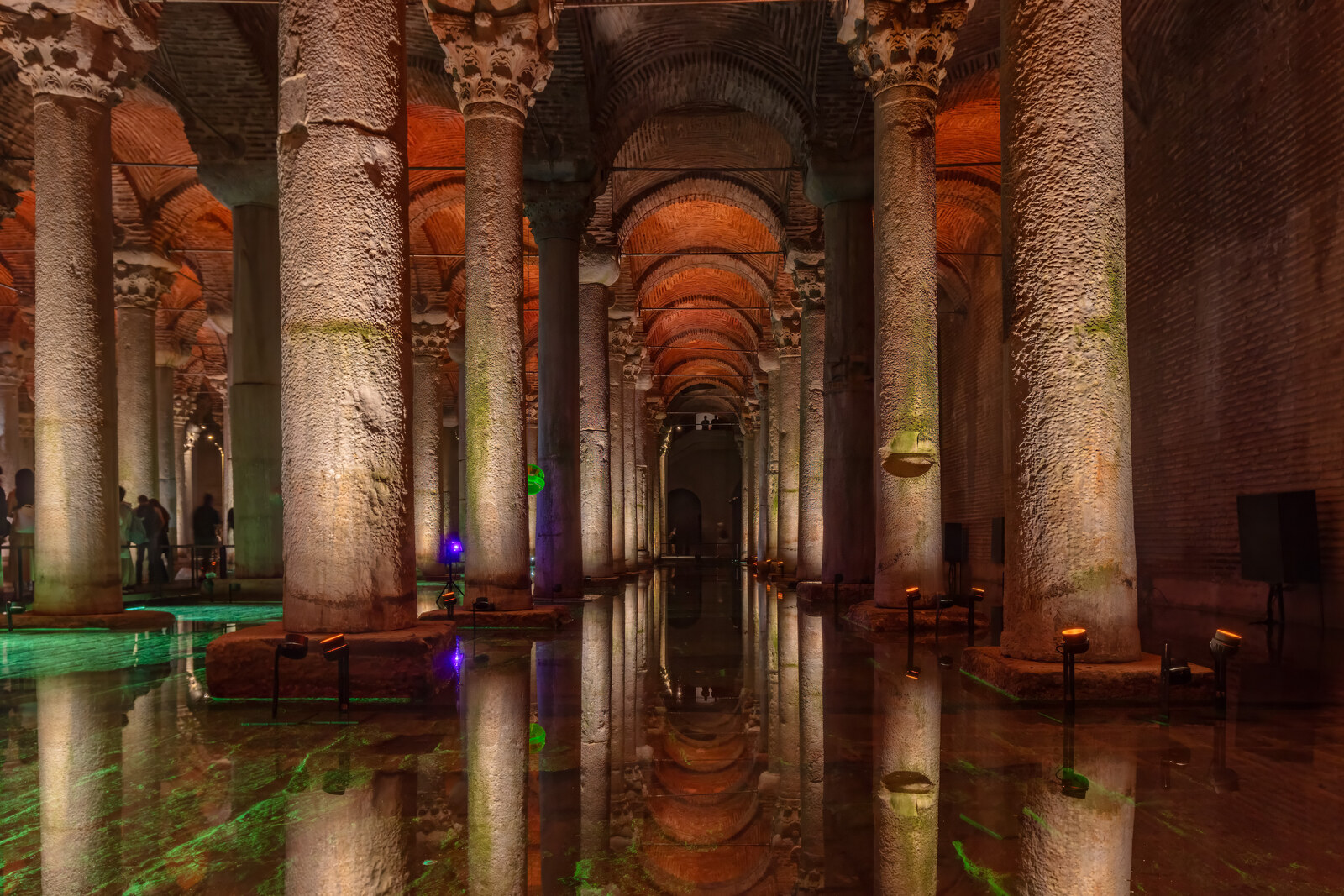
Look around first
What to notice
- Rows of marble columns
- Brick vaults
- Modern walkway
The story of the place
Beneath the modern walkway, an underground reservoir recedes into the half-light, where three hundred thirty-six marble columns support brick vaults. Its name remained from the public basilica that stood above: beneath its porticos, lawyers prepared cases for court. In the sixth century, a reserve of fresh water for the palace and neighboring buildings was created beneath the courtyard, to collect surplus from the water supply in rainy weather and save it for summer drought. The upper building disappeared, while the underground supports later carried residential houses.
In the middle of the sixteenth century, the French naturalist and topographer Pierre Gilles came to Istanbul on the orders of King Francis I. The king supported the scholar so that he would search for ancient manuscripts for his library and describe surviving structures. Gilles compared the city with ancient texts, but at the site of the former Imperial Basilica he saw residential houses.
The residents told him a strange everyday detail: they drew water directly from wells in their basements, and sometimes pulled up fish along with the bucket. One homeowner showed Gilles a descent beneath his house. A small boat stood below. The owner lit torches, seated his guest in the boat, and took him between the columns, hunting fish with a spear as he went.
That was how Gilles entered a water-filled hall whose size was no longer suspected above ground. He counted three hundred thirty-six marble columns: twelve rows of twenty-eight. In winter, he saw water from a large pipe rise almost to the capitals. For the residents, it was a well beneath their houses; Gilles recognized it as the cistern at the Imperial Basilica described by ancient authors. That is why he is often called the person who rediscovered the structure. For city residents, it had remained a source of water and fish all that time—what had been forgotten was its origin, not the basement entrances.
The word “basilica” in the name refers to the building that once stood above. It was a public complex with porticos where lawyers prepared cases for court. In the sixth century, Emperor Justinian I, who needed a reliable water reserve for the palace and neighboring buildings, ordered a reservoir built beneath the basilica’s courtyard. In summer, the city suffered from a shortage of fresh water, while in other seasons part of the flow from the water supply went to waste. The cistern received this surplus and kept it until drought. Brick vaults supported the basilica, later the houses, while water stood beneath them.
Gilles died in fifteen fifty-five and did not see his book printed. Six years later, his nephew Antoine published the remaining manuscripts. Thanks to this, the account of the homeowner, the boat, the fish, and the cistern’s winter filling survived. There is no current entrance through that private house, the upper basilica has disappeared, and people now walk along a modern walkway between the same three hundred thirty-six columns that Gilles counted from the water.
Useful on site
Officially open daily 09:00–22:00. Admission is paid; the cistern’s page separately states that bank cards and İstanbulkart are accepted.
Checked: June 27, 2026. Check the official source before visiting.The interior requires a separate admission and may take more time because of the queue. If you do not visit, listen to the account outside; the rest of the route will remain clear.