 Guide On Map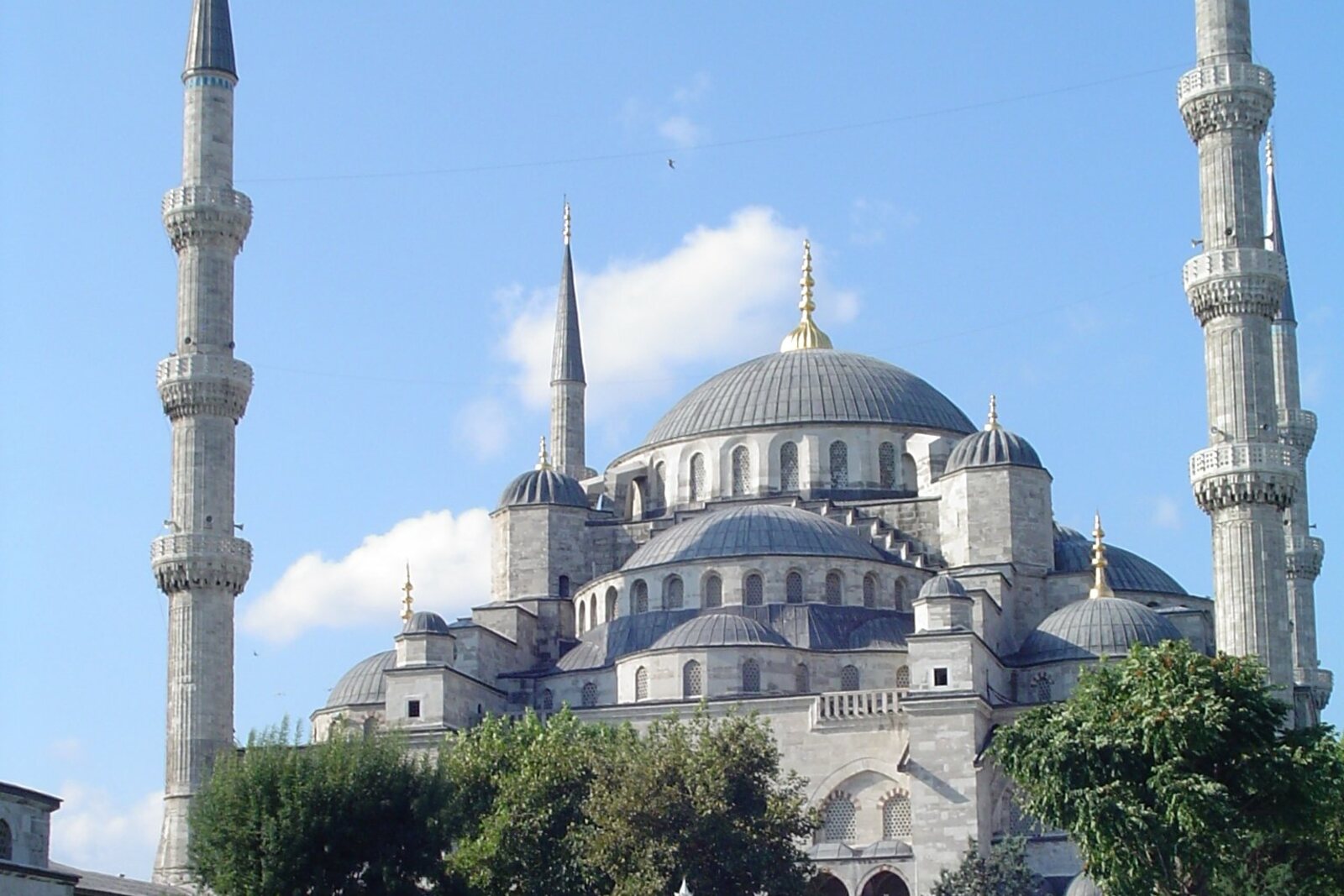
Look around first
What to notice
- Central dome
- Six minarets
- Outer courtyard
- Tomb of Sultan Ahmed I
The story of the place
Six minarets and a large central dome rise at the edge of the former Hippodrome, opposite Hagia Sophia and beside Topkapı Palace. Behind the prayer hall, an entire complex operated, with a school, hospital, kitchens, bakery, market stalls, fountains, and rooms for travelers. The outer courtyard opens onto the same open square where the whole city once gathered. Friday prayer is still held here today.
The mosque has two familiar names. It is called “Blue” because of the Iznik tiles in its interior. Its official name is Sultan Ahmed Mosque. It is the name of the man who initiated its construction without having the usual justification for such an undertaking.
In the autumn of sixteen oh nine, Ahmed I was nineteen years old. He had already occupied the Ottoman throne for six years and wanted to build a large sultanic mosque in the capital for communal Friday prayer. Usually, such an honor was linked to victory over a non-Muslim opponent: a campaign brought the ruler glory and booty, from which he paid for construction. Ahmed had won no such victory. The theologians and judges known as the ulema openly asked what had earned him the right to build a mosque bearing his name in the city.
Ahmed chose a site where the dispute could not be hidden. Construction began by Atmeydanı—the former Hippodrome, which had served as the city's main open square—opposite Hagia Sophia and beside Topkapı Palace. Here, every new dome changed the familiar view of the imperial center. The six minarets, too, were an unprecedented decision for an Ottoman sultanic mosque. Stories that the architect confused the similar Turkish words for “golden” and “six” belong to legend; they have no reliable confirmation.
At the ceremony marking the start of the work, Ahmed took a golden pickaxe and dug the earth until he sweated. The gesture was meant to present construction as the sultan's own pious labor. Then the masons and the chief architect, Sedefkar Mehmed Agha, worked for nearly eight years. Beside the prayer hall, they built a school, hospital, kitchens, bakery, market stalls, fountains, and rooms for travelers. Yet charitable institutions alone did not settle the dispute for Ahmed.
In June sixteen seventeen, the central dome was ready for completion. The sultan staged a ceremony that had not been held here before him and was never repeated afterward. Tents for Ahmed and his courtiers were set up in the outer courtyard, turning it into something like a military camp. Thousands of spectators gathered on Atmeydanı. By the sultan's order, theologians and dignitaries went up to complete the dome with prayers; in full view of the square, they installed the keystone and a gilded crescent.
Among the invited guests were ambassadors from Venice, European courts, and Safavid Iran. In the court account, their presence was presented as though rivals had come to witness Ahmed's triumph. There was no real military victory behind this scene. The sultan staged it with the means provided by the construction, the court, and the former Hippodrome: tents below, foreign representatives before them, and the new dome above them all.
The calculation worked. The dispute around the mosque gradually died down, and the structure begun without military booty became one of the city's main Friday mosques. A few months after the dome ceremony, Ahmed died before reaching the age of twenty-eight. Parts of the complex were completed under his successors.
The tents and spectator platforms have long been gone. What remain are the central dome, the outer courtyard where the sultan's camp stood, and the open strip of the former Hippodrome from which the ceremony was watched. Ahmed himself is buried in the Tomb of Sultan Ahmed I at the complex's northeastern corner. His name has been preserved by the mosque, the square, and the entire Sultanahmet district.
Useful on site
Active mosque: open daily, but the tourist entrance pauses for prayer; the pause is longer on Fridays. Admission is free; shoulders and knees must be covered, and women need a headscarf.
Checked: June 27, 2026. Check the official source before visiting.The main architectural idea is visible from the square. When entering, follow the clothing requirements, remove your shoes where indicated, and do not disturb prayer.