 Guide On Map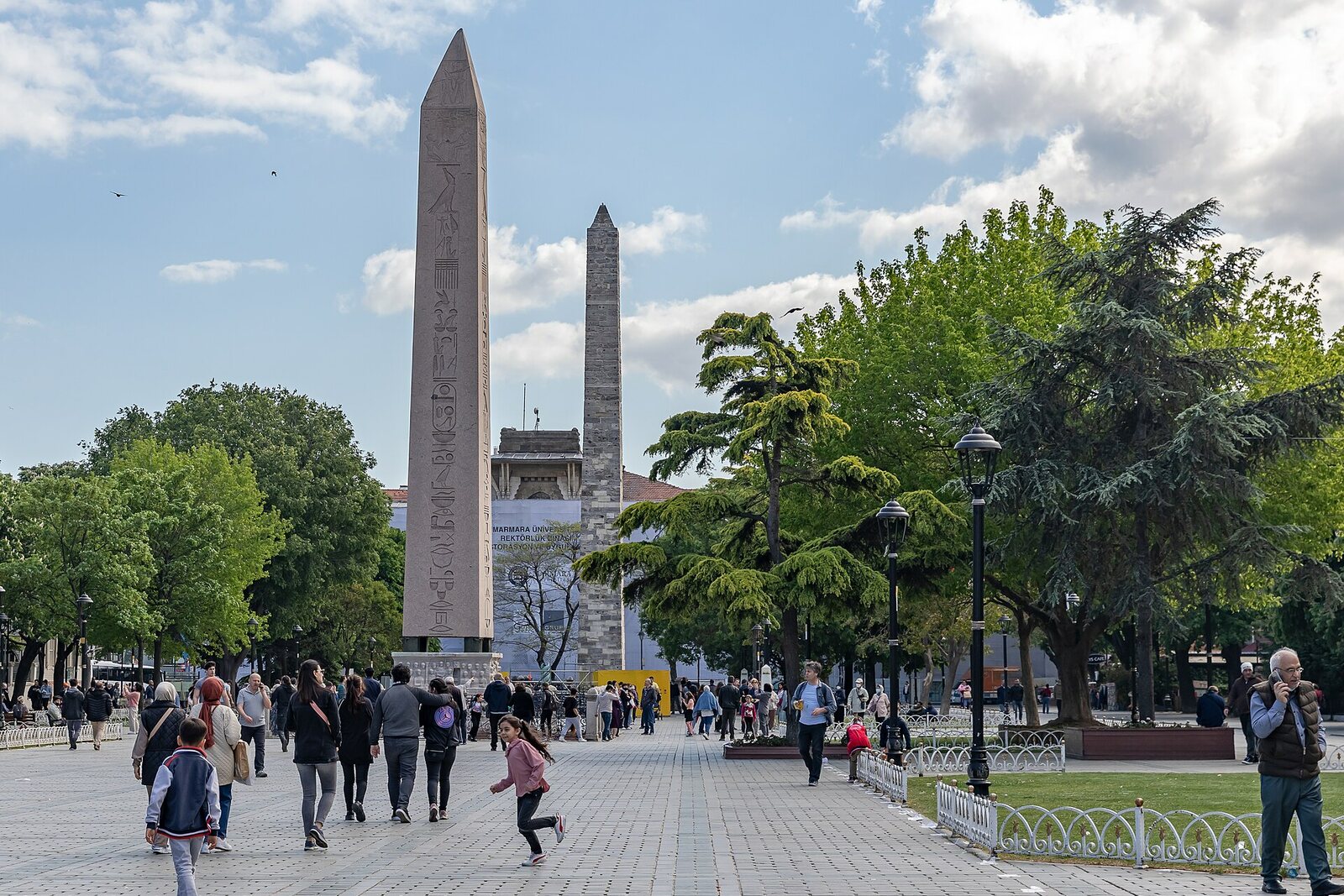
Look around first
What to notice
- Obelisk of Theodosius
- Serpent Column
- Walled Obelisk
The story of the place
The present pavement runs above the track of the Hippodrome of Constantinople. Chariots raced along its elongated arena, while tens of thousands of townspeople gathered in the stands. The Kathisma for the ruler was placed in the eastern part of the stands and connected to the Great Palace by a special passage. The Obelisk of Theodosius marks the former central strip that the chariots went around; after the arena disappeared, the Ottomans restored horse races and games with spears to this place, which is why it received the name Atmeydanı, the Horse Square.
In January five thirty-two, the wife of Senator Hypatius seized her husband and tried to keep him from leaving the house. A crowd came for him to make him emperor. Maria cried to their relatives that Hypatius was being led to his death. She was pushed aside, and her husband was taken away.
Istanbul was then called Constantinople and was the capital of the Eastern Roman Empire. Hypatius was a nephew of the former emperor Anastasius. That kinship itself made the senator a possible replacement for the reigning Justinian. Hypatius did not start the revolt and at first remained in the palace beside the emperor. But Justinian grew suspicious of him and ordered him to go home. With that decision, he handed his rival directly into the hands of the townspeople.
The revolt began with a failed execution. Participants in two groups of supporters—the Blues and the Greens—were condemned for killings during earlier unrest. They usually fought over chariot teams and occupied different sections of the Hippodrome. But two of those sentenced, one Blue and one Green, fell from the gallows alive twice. Monks sheltered them in a church. During the next races, both groups together asked Justinian to pardon the survivors. The emperor did not reply.
Then “Nika!”—“Win!”—rang out from the stands. An ordinary cry of support for a charioteer became the rebels’ password. They freed prisoners and set fire to administrative buildings and the former church of Hagia Sophia. Justinian dismissed several hated officials, but the crowd was already demanding a change of emperor.
All the action converged again on the Hippodrome, because it was designed for meetings between the ruler and tens of thousands of townspeople. Chariots raced along the long track, the Blues and the Greens answered one another from opposite sections, and in the middle of the eastern stand was the imperial box—the Kathisma. A separate passage led to it from the Great Palace. Here Justinian appeared before his subjects, received their acclamations, and started the races.
The rebels put a gold necklace on Hypatius’s head instead of a crown, proclaimed him emperor, and brought him here. Hypatius climbed specifically into the Kathisma and sat in Justinian’s place. This was no longer a street cry: the rival had taken the seat from which the ruler addressed the assembled city.
In the palace they discussed fleeing by ship, but Justinian stayed and entrusted the suppression of the revolt to two generals. Belisarius, recently returned from war and commanding battle-tested spearmen, led his men onto the packed stands. A detachment of Mundus entered the Hippodrome from the other side. The crowd, gathered for a spectacle and the proclamation of a new emperor, found itself between the soldiers. By the estimate of a contemporary witness, more than thirty thousand people died here that day.
Hypatius was dragged from the imperial seat. The next day, he and his brother were executed, their bodies were thrown into the sea, and their property was transferred to the treasury. Later, the children had their titles and the part of the property that Justinian had not yet managed to distribute returned to them. Justinian himself kept the throne.
The stands are gone now, and the ancient track lies below the present surface. The elongated middle of the arena is marked by the Obelisk of Theodosius, the Serpent Column, and the Walled Obelisk: they once stood on the dividing barrier around which the chariots turned. When, after the Hippodrome’s destruction, the Ottomans again held horse races and mounted games with spear-throwing in the space that opened up here, they called it Atmeydanı—the Horse Square. Today, it is officially Sultanahmet Square.
The imperial Kathisma has not survived. It stood in the middle of the eastern side of the vanished stands—where Hypatius took Justinian’s seat and from where, several hours later, he was led away to execution.
Useful on site
An open city square on the site of the former hippodrome; it is best to come in the morning or toward evening, when there are fewer groups and the light is softer.
Checked: June 27, 2026. Check the official source before visiting.The stop takes place outside. Do not stand in the main flow of pedestrians; it is easier to examine the details of the pedestal by walking around the obelisk.