 Guide On Map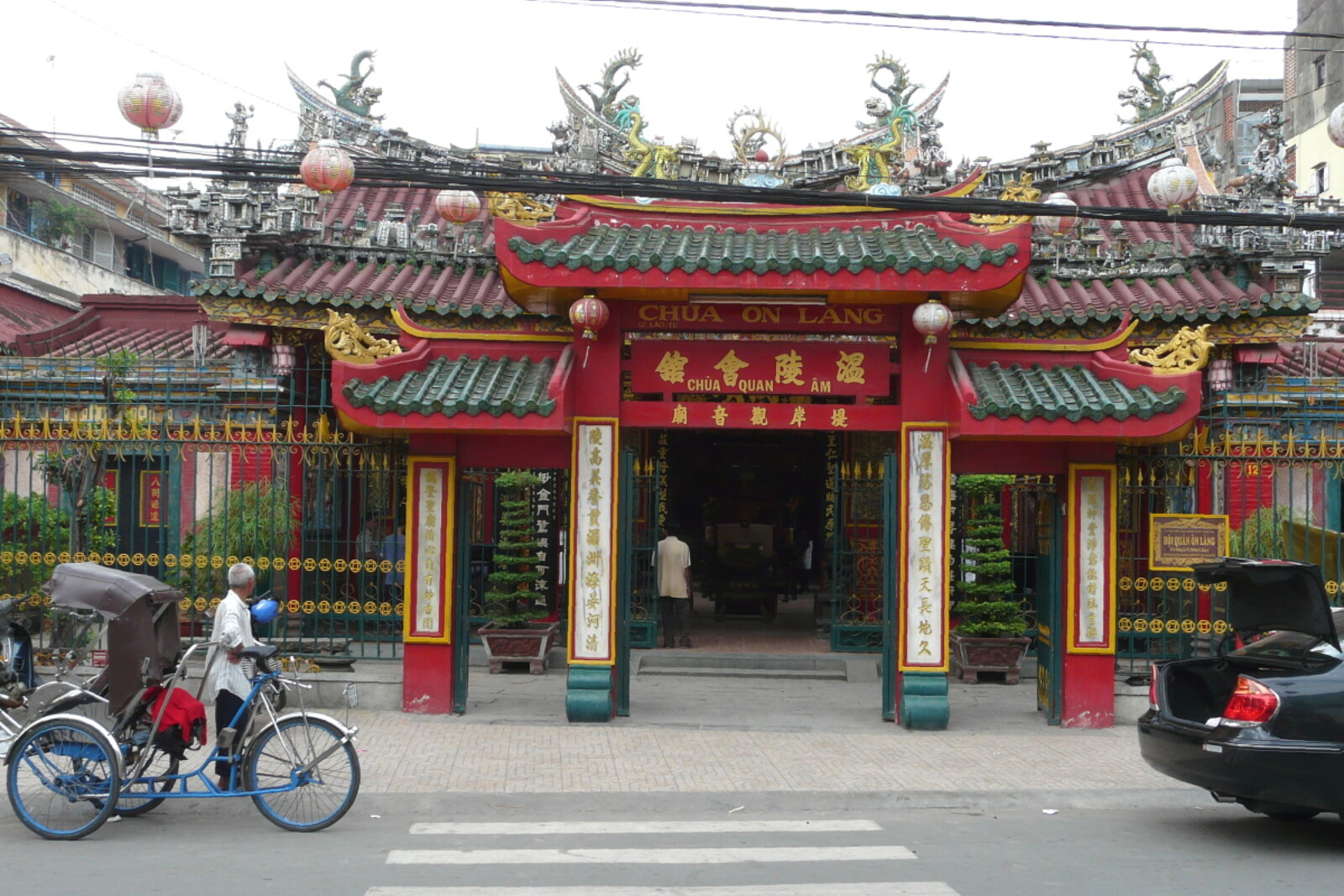
Look around first
What to notice
- The On Lang inscription on the gate
- Thien Hau's altar
- The Quan Am statue in the inner courtyard
The story of the place
This temple was once the shared hall of a native-place association. Its members performed rites here, discussed community affairs, and helped arrivals from their counties. Merchants conducted business on their own, but illness, a lawsuit, or family misfortune brought them back to their fellow provincials. Thien Hau's altar is near the entrance, while farther in, in the inner courtyard, stands an almost two-meter statue of Quan Am.
Migrants from five counties of Quanzhou, a city in China's Fujian Province, built this complex together in the eighteenth century. Many of them were merchants. They earned their living far from their relatives and, in the new city, needed people who spoke the same dialect, knew the same customs, and could help in times of trouble. The fellow provincials called their shared home On Lang, Quanzhou's old name. That is why the inscription on the gate points not to a deity, but to the founders' homeland.
They gathered here to settle shared affairs, perform rites, and support newcomers from their counties. This is precisely how the hall's purpose is stated on a stone stele from eighteen sixty-nine. Behind the carved facades, the native-place association operated: a person could trade independently, but in illness, a dispute, or a family misfortune, they could rely on their fellow provincials. The temple they built also established a circle of mutual obligations.
The founders chose Thien Hau (Mazu), the deified seafarer, as their principal patroness. People from Fujian believed that she protected those who went to sea and earned their living far from home. For merchants who had traveled south from the port city of Quanzhou to Vietnam, it was an apt choice. Her altar still occupies the front part of the main sanctuary.
Later, the fellow provincials installed an almost two-meter statue of Quan Am (Avalokiteshvara) in the inner courtyard. This is the Vietnamese name for Avalokiteshvara, the bodhisattva of compassion who, according to Buddhist teaching, hears the pleas of the suffering and comes to their aid. Worshippers gradually began to give her more attention than the original patroness. The complex acquired the colloquial name “Quan Am Pagoda,” although it officially remained On Lang Assembly Hall.
Both names can be read in the very layout of the courtyards. Closer to the entrance sits Thien Hau, chosen by the merchant migrants; farther in stands Quan Am, whom people of different backgrounds began to visit. The gate preserves the name of distant Quanzhou, while the city calls the entire complex after the statue in the rear courtyard.
Useful on site
Current sources reliably confirm the address and heritage status; exact hours differ across public listings. For integration, use a cautious visitor window of 08:00–16:00 and ask Codex to recheck before publication, checked 2026-06-29.
Checked: June 29, 2026. Check the official source before visiting.In the active sanctuary, walk around the edges of the altars and do not stand between a worshipper and an image; you may look around the garden without interfering with the ritual.