 Guide On Map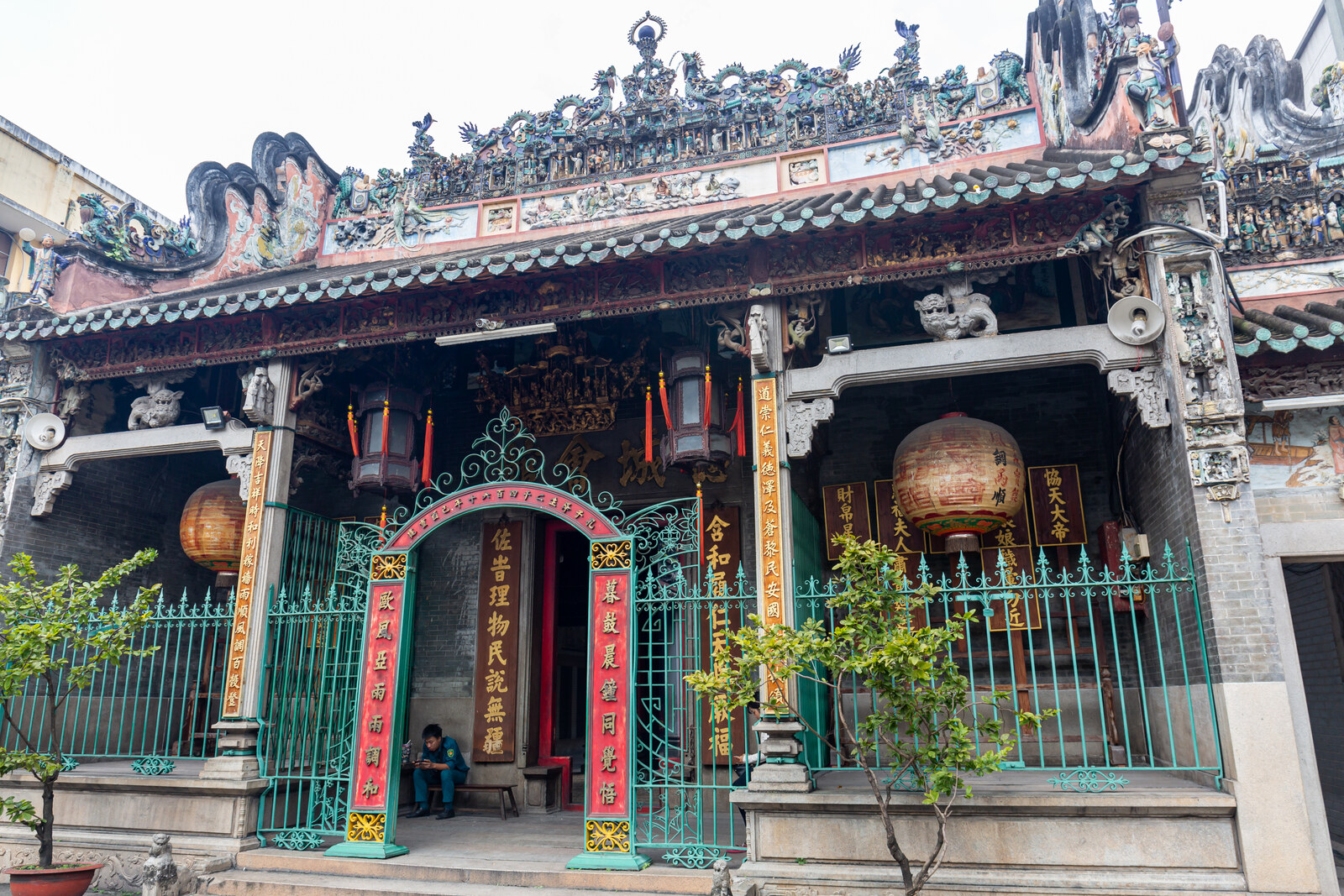
Look around first
What to notice
- Thien Hau main altar
- Spiral incense coils
- Worshippers’ notes
- School building nearby
The story of the place
Smoke from the spiral incense coils rises to the ceiling, and the notes on them are left by people who come with requests. The official name Tue Thanh has survived to this day; the old name for Guangzhou in it points to the city whose people maintained their shared hall here. In the complex's storage area, a red-and-gold palanquin and a carved boat await the festival, used to carry out the image of Thien Hau (Mazu). The neighboring school building stands on land belonging to the same community: helping people from the home region long ago extended beyond the temple walls.
In the middle of the eighteenth century, Cantonese merchants came to Cholon on sailing vessels. Their return journey depended on the seasonal wind, so after selling their cargo, merchants sometimes had to wait two or three months. They made their living from sea trade, and on a single voyage they risked goods, money, and their own lives. Several merchants pooled their money, bought land here, and around seventeen sixty built a house where they could stay, meet people from their home region, and leave an offering to the patroness of sailors.
That patroness was Thien Hau (Mazu). In Chinese legend, she was born human—a girl named Lin Mo from the coastal province of Fujian. Once, during a storm, Lin Mo fell into a trance and tried to save her father and brothers, who were drowning. Her mother thought something was wrong with her daughter and woke her: Lin Mo held on to her brothers, but did not manage to save her father. This is a legend, not an established biography. After her death, the girl came to be revered under the name Mazu, while the title Thien Hau means Celestial Empress. Cantonese merchants brought her memorial tablet with them: they chose a deity whose legend spoke precisely of the danger on which their livelihood depended.
The first building was small—two halls and a side awning. In the early eighteen thirties, the merchants decided to establish a full-fledged assembly hall here. A surviving stone inscription states that each member pledged to contribute gold every year. These contributions funded the expansion and upkeep of the premises.
Here the Cantonese discussed deals, received people arriving from China, helped people from their home region, and settled disputes within the community. A person with no relatives in Cholon found a place where they were understood, could be introduced to trading partners, and could receive support in a setback. The hall was named Tue Thanh—an old name for Guangzhou. The inscription indicated which city the people who established their shared home here had come from.
The familiar word “pagoda” describes only the religious side of the complex. Its official name is still Tue Thanh Assembly Hall, while the city name, Thien Hau Pagoda, points to the goddess at the main altar. Spiral incense coils with worshippers’ notes hang from the ceiling. On the twenty-third day of the third lunar month, the main annual offering to Thien Hau (Mazu) is held here. For the festival, a red-and-gold palanquin and a carved boat are kept for carrying out her image.
Members of the community still collect donations to help people in need and support education. The school adjoining the temple complex stands on Tue Thanh land and grew out of the Cantonese school that the merchants themselves founded here.
Useful on site
The district tourism portal lists daily 08:00–16:00. Other public pages give broader hours, so early and late visits are not guaranteed; checked 2026-06-29.
Checked: June 29, 2026. Check the official source before visiting.Do not touch the bells or temple objects. If a ceremony is underway inside, remain in the courtyard or look at the roof compositions from outside.