 Guide On Map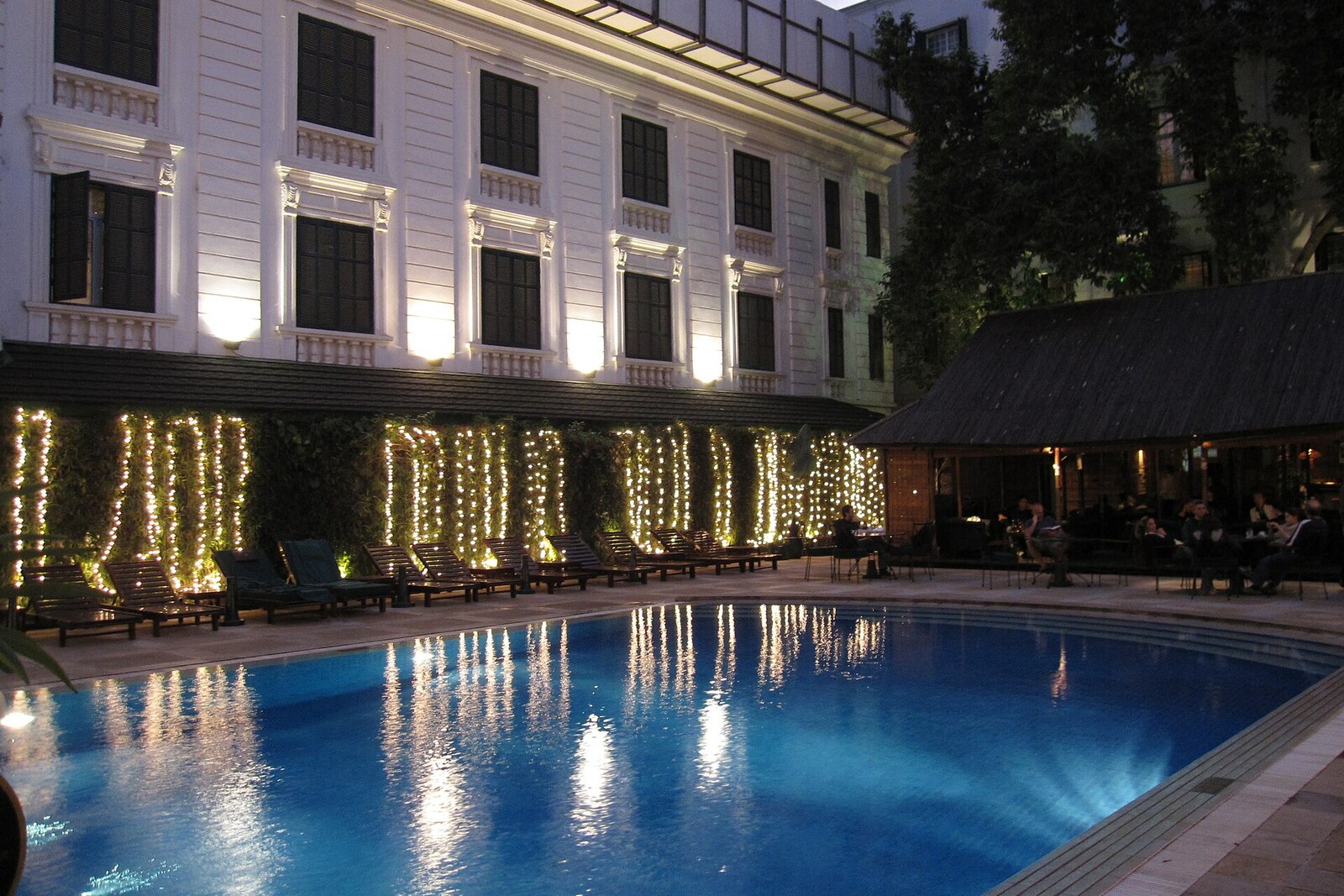
Look around first
What to notice
- The hotel’s historic facade
- The inner courtyard
- The shelter’s iron doors
- Ventilation ducts
The story of the place
A subterranean shelter has survived beneath the bar in the hotel’s inner courtyard. Behind iron doors are six concrete rooms, supplied with air through ventilation ducts; one lamp remains from the former lighting. The shelter was built for guests and staff in case of an air raid, then closed after the war for so long that its exact location was forgotten. It was remembered only during repairs to the bar, when a worker’s drill pierced the thick concrete ceiling.
French entrepreneurs opened the Grand Hotel Metropole Palace in nineteen oh one. Half a century later, the hotel was given another name—Thong Nhat, meaning “Reunification”—and became a state guesthouse for foreigners. That is why the American singer Joan Baez was accommodated here in December nineteen seventy-two.
Baez arrived with an antiwar delegation: she intended to deliver letters to American prisoners of war and to see for herself the people who were being debated in her homeland. She earned her living with her voice and guitar; her three-year-old son remained at home. The hotel managers had prepared in advance for air raids. In nineteen sixty-four, they built a concrete shelter beneath the inner courtyard for about forty people.
Baez recalled that the beginning of the bombing found her with a guitar in the hotel lobby. After the alarm sounded, guests and staff crossed the courtyard and went underground. This was repeated at night during the eleven-day strikes on Hanoi.
Nguyen Thi Xuan Phuong, a Vietnamese doctor entrusted with caring for foreign guests, was in the shelter together with the foreigners. Once, the lights went out underground, and several people cried out. Phuong asked Baez to sing: they could not stop the raid, but the doctor wanted to keep people from panicking. Baez began to sing, and someone sitting beside her began accompanying her on guitar.
Later, the singer admitted that in this shelter she had first seriously confronted the possibility of her own death. She recorded what was happening on a portable tape recorder. Some of the recordings made here—conversations, sirens, and bomb blasts—were included in the composition “Where Are You Now, My Son?” Baez combined them with song and recitative. The almost twenty-two-minute recording filled an entire side of the record released in nineteen seventy-three.
After the war ended, staff closed the shelter, and its exact location was forgotten over time. In nineteen eleven, the engineering department was rebuilding the Bamboo Bar in the hotel courtyard. One worker’s drill pierced the thick concrete roof. Flooded rooms were discovered beneath it; the water was pumped out, the passage was cleared, and in May of the following year the shelter was opened for hotel tours.
Beneath the bar, six concrete rooms, iron doors, ventilation ducts, and one of the former twelve lamps have survived. It is impossible to establish whether that very lamp was lit on the night when Nguyen Thi Xuan Phuong asked Joan Baez to sing.
Useful on site
Open urban space; choose a viewing point that does not obstruct pedestrian traffic.
Checked: date not specified. Check the official source before visiting.The bomb shelter is not visible from the street, and access to it cannot be considered unrestricted. Check with the hotel in advance about the possibility of visiting and the tour format.