 Guide On Map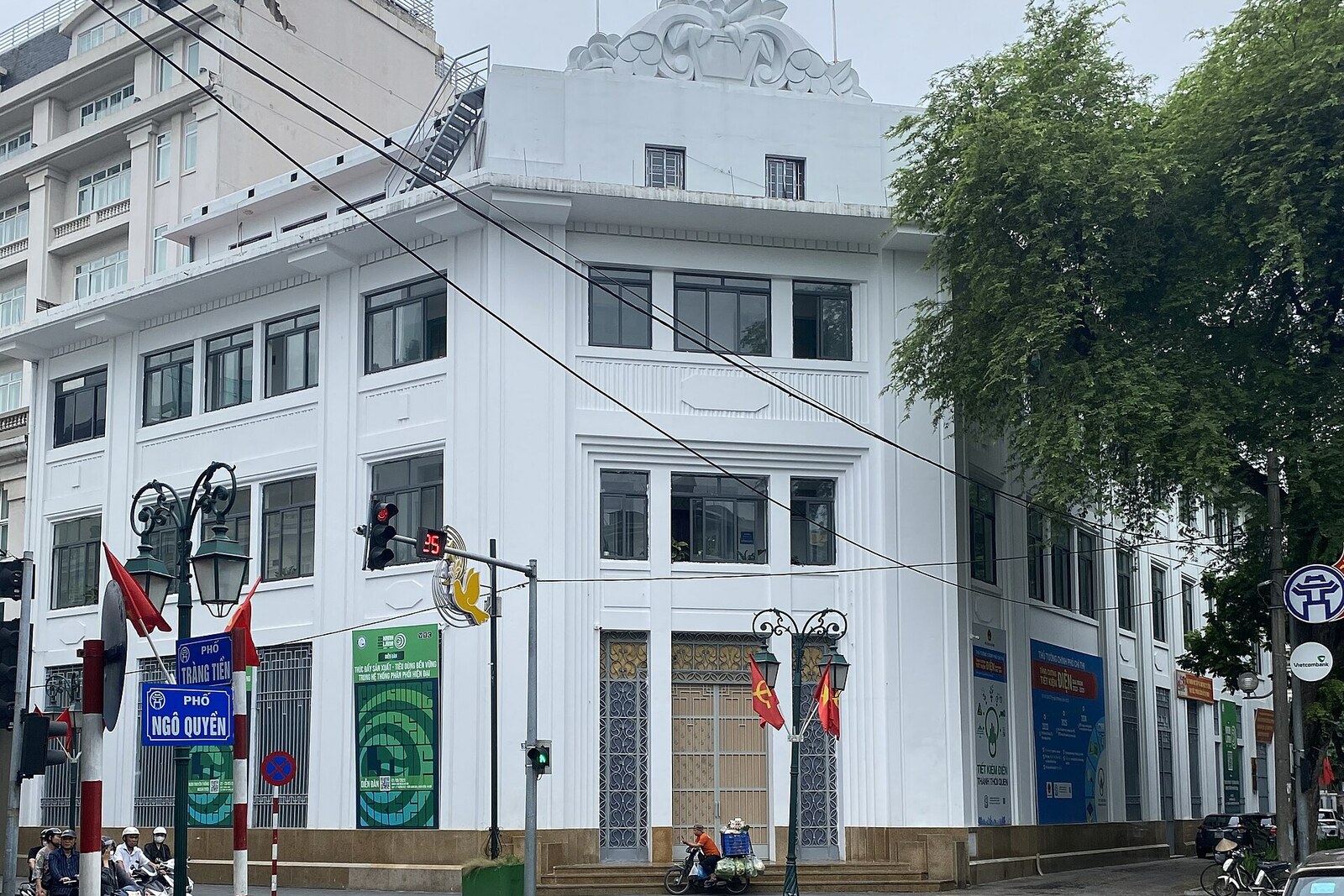
Look around first
What to notice
- Street sign
- Facade of Trang Tien Plaza
- The line of the street toward the Hanoi Opera House
The story of the place
Trang Tien Street runs from Hoan Kiem Lake to the Hanoi Opera House. Its name means “mint”: “trang” means workshop, and “tien” means money. Such a mint stood roughly where Trang Tien Plaza now stands.
At the beginning of the nineteenth century, Gia Long made Hue the capital. Salaries for officials and soldiers in the north had to be transported from there to Hanoi, then called Bac Thanh. The journey took a long time, and on one occasion an escorted convoy carrying money was robbed. In eighteen oh eight, the emperor ordered coins to be cast here, on the land of Cuu Lau village.
Workers were paid about eight coins for every hundred they produced. According to a Hanoi local historian, this was not enough to support a family. The casters made an arrangement with the guards and began carrying out some of the finished coins. Truong Van Minh, the official responsible for the mint and for safeguarding the metal, compared the weight of the coins received with the stocks of copper and zinc. A shortage was discovered, but he could not identify the organizer of the thefts.
Truong Van Minh then dismissed all the male casters. In a report to the court, he claimed that women were physically weaker but more honest, and asked for women from nearby villages to be recruited in their place. Imperial officials agreed. The men lost their livelihood, women took their places at the casting molds, and the guards gained the right to search every worker on departure. A Hanoi saying about the lucky lot of a Trang Tien guard has preserved the memory of how unceremonious these searches could be.
The French administration secured the closure of the mint in eighteen eighty-two. Officials then widened the road, placed European shops, hotels, and banks along it, and named it after Paul Bert—the French Resident-General of Annam and Tonkin, who sought to firmly establish French rule. Bert himself spent only a few months in Hanoi and died in eighteen eighty-six; the street was named for him only after his death.
In the summer of nineteen forty-five, Hanoi’s first Vietnamese mayor, the physician Tran Van Lai, replaced the French street names. For the former Paul Bert Street, he chose the old local name: Trang Tien. The mint had then ceased to exist more than sixty years earlier.
In two thousand, the builders of Trang Tien Plaza uncovered its physical trace: old coins, copper slag, and the remains of smelting furnaces lay in the excavation pit. The mint itself remained beneath the shopping center, and its purpose on the street sign.
Useful on site
Open urban space; choose a viewing point that does not obstruct pedestrian flow.
Checked: date not specified. Check the official source before visiting.The street remains a busy commercial environment. View the facades from the sidewalk, watch the traffic, and do not stand by entrances.