 Guide On Map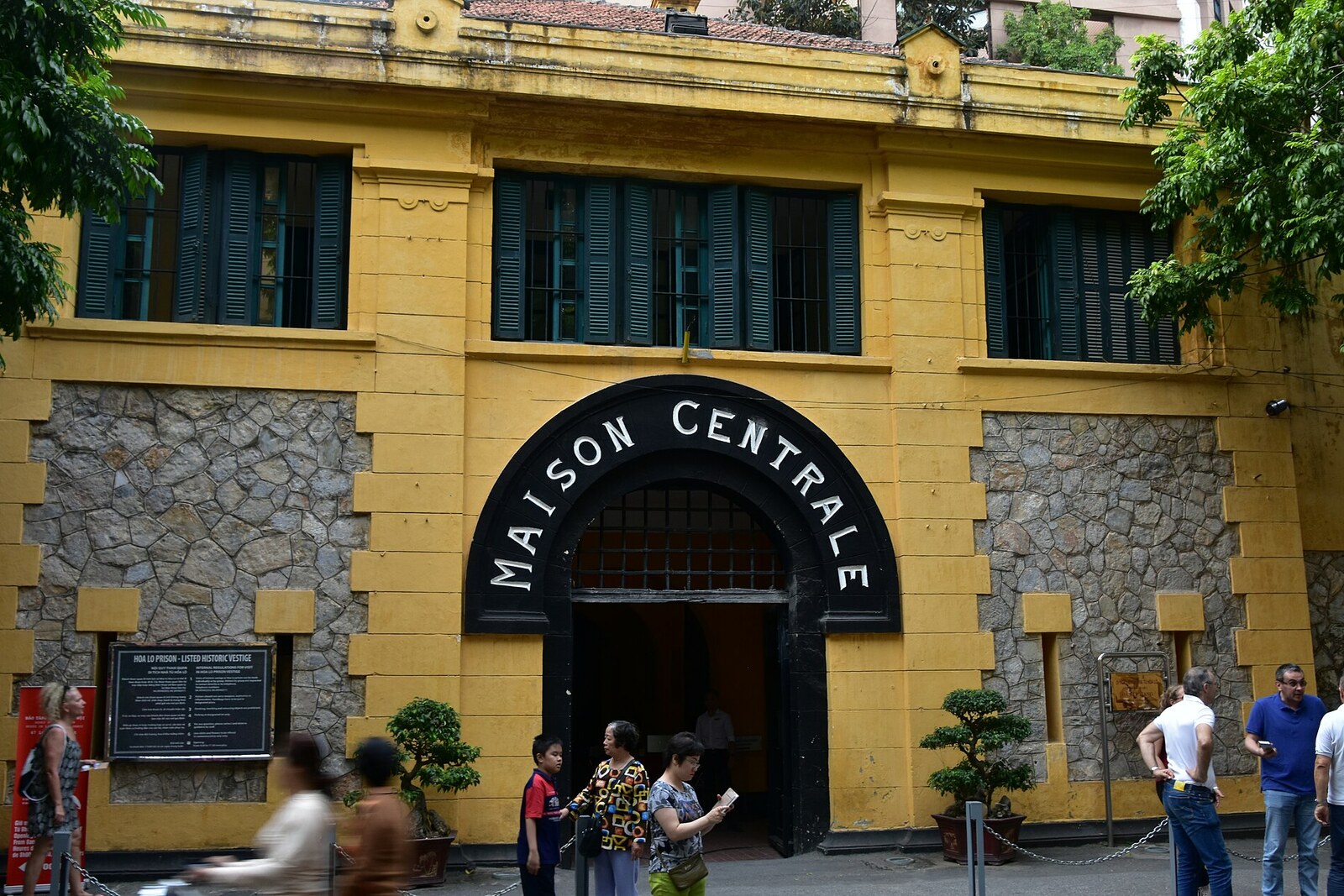
Look around first
What to notice
- The “Maison Centrale” inscription
- The concrete cover with an iron ring
- The entrance to the brick sewer
- The surviving prison wall
The story of the place
In the southeastern corner of what was once a huge prison complex, the wall, the gate, and several interior museum rooms have survived. The French administration linked this place to the nearby court and secret police: a person could be arrested, investigated, tried, and locked up with almost no need to take them out of the quarter. The fence rose five meters, broken glass lay along its top, and a patrol path and four towers kept the yard under constant observation. The name Hoa Lo outlasted this system: a village of potters once stood here, where stoves, pots, and teapots were fired.
In March nineteen forty-five, political prisoner Tran Tu Binh dressed as a criminal prisoner, put a rice container on his head, and walked past a Japanese guard into a neighboring block. He traded a small sum to a food vendor for the clothes and the container. Binh had already tried to escape from another prison, failed, and been transferred to Hoa Lo Prison. Now his comrades had chosen him to lead the prisoners’ internal organization, and he was looking for a way out for people serving long sentences who needed to return to underground work.
A few days earlier, Japanese troops had removed the administration of French Indochina and occupied the prison. Supervision weakened, and prisoners were able to move between blocks. One group managed to get over the wall, but then a crush began, the guards fired warning shots, and that route was closed.
In the yard of the juvenile block, Binh saw a square concrete slab with an iron ring. Other prisoners were breaking up the floor nearby, hoping to dig a passage under the wall. He realized that a ready-made route was already beneath the slab: the prison sewer must have led beyond the fence.
Three political prisoners were the first to lift the cover and go down to scout it out. They took a box of matches and an iron bar. In the narrow brick channel, they had to crawl through wastewater and trash. At junctions, the scouts lit a match and chose the branch where the water flowed. Through one of the openings, they saw the wheels of bicycles passing overhead and realized that they had reached beneath a city street.
On the evening of March twelfth, Tran Tu Binh and three other prisoners were the first to descend into the sewer. They were followed by people who had received the longest sentences. Twenty-nine people got out in one night; others left by the same route over the following days. In all, more than one hundred political prisoners left Hoa Lo Prison through the sewer, over the walls, and posing as visitors.
After getting out onto the street in stained clothes, scout Nguyen Huy Hoa asked permission to go home, wash, and change clothes. Binh forbade it: returning to a familiar home could end in another arrest. That same night, they left Hanoi and reached an underground base in the village of Van Phuc. A few months later, Tran Tu Binh returned to the capital and took part in preparations for the August Uprising.
The sewer belonged to a facility that French engineers had designed specifically to prevent escapes. In eighteen ninety-six, the colonial administration built the Central Prison here: five-meter walls topped with broken glass, a patrol path along the fence, and four guard towers. The court and secret police stood nearby, so arrest, investigation, sentencing, and imprisonment were housed in several neighboring buildings. The French words “Maison Centrale” above the gate mean “Central Prison.”
Hoa Lo is another name, left by the former owners of this site. Before the prison, the craft village of Phuc Khanh stood here. Its residents made clay stoves, pots, and teapots; “Hoa Lo” means an oven or brazier. To make way for construction, officials evicted forty-eight families, moved the communal house and one pagoda, and demolished two more pagodas. The French name stated the purpose of the new institution, while Hanoi residents continued to call it after the vanished village.
In nineteen ninety-three, four-fifths of the prison complex were demolished, leaving the southeastern corner for a museum. The inscription “Maison Centrale” has survived above the gate, and inside are the concrete cover and the entrance to the brick sewer that Tran Tu Binh and his comrades turned into a road out of prison.
Useful on site
Open urban space; choose a viewing point that does not obstruct pedestrian traffic.
Checked: date not specified. Check the official source before visiting.The main details of the story are easier to understand inside the museum, but plan that visit separately. The exhibition is heavy; if needed, take a break or limit yourself to viewing it from outside.